Blue Moon Metals Bolsters Critical Minerals Portfolio with Strategic Turner Deposit Acquisition
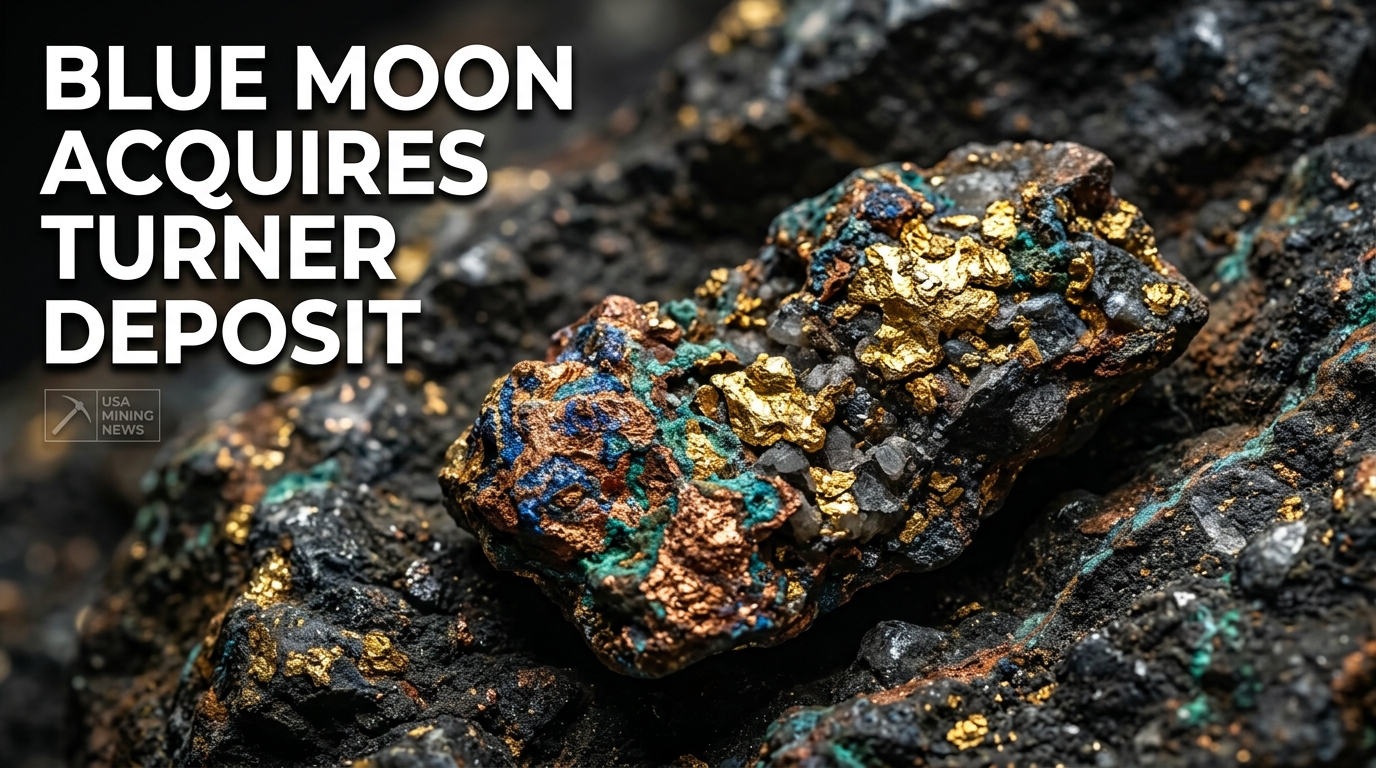
In a significant move poised to reshape its Western US critical metals footprint, Blue Moon Metals has announced a definitive agreement to acquire 100% ownership of the Turner copper-gold volcanic massive sulphide (VMS) deposit from Gold Coast Mining. The transaction, reported on September 24, 2026, marks a pivotal expansion for Blue Moon Metals, adding a polymetallic asset with robust potential for copper, gold, zinc, silver, and notably, unquantified cobalt mineralization to its burgeoning portfolio.
The Turner deposit, strategically located near O’Brien, Oregon, in close proximity to the California border, is a Cyprus-type VMS deposit, a geological classification known globally for its rich, often polymetallic, ore bodies. This acquisition aligns with Blue Moon’s broader strategy of consolidating high-potential critical metals projects within the Western United States, aimed at contributing to the domestic supply chain of vital industrial and battery minerals.
Comprehensive Transaction Mechanics and Financial Structure
The agreement between Blue Moon Metals and Gold Coast Mining encompasses a substantial land package and a detailed financial consideration, reflecting the project’s perceived value and future potential. Blue Moon will gain approximately 634 acres of private land and 15 unpatented mining claims, providing a solid foundation for future exploration and development activities. A key term of the agreement is the establishment of a 1.5% net smelter return (NSR) royalty payable to Gold Coast Mining, with no other encumbrances, a common mechanism in the mining industry that provides the seller with ongoing revenue linked to future production without direct operational involvement.
The financial component of the acquisition is multi-faceted, structured to provide Gold Coast Mining with immediate capital and long-term participation in the project’s success. Blue Moon Metals will make a total cash payment of $4.7 million (equivalent to C$6.62 million), which includes an initial deposit of $500,000 paid upon the announcement of the acquisition. In addition to the cash component, Gold Coast Mining is set to receive 4,778,761 Blue Moon common shares, valued at approximately $27 million. These shares will be issued in four equal tranches over a one-year period following the anticipated closure of the deal, which is projected for November 2026.
Further demonstrating a commitment to aligning the interests of both parties, the transaction incorporates a series of significant cash milestone payments, contingent upon the advancement of the Turner project:
- A payment of $2 million upon the successful permitting for underground exploration and/or development.
- An additional $2 million once all necessary mining permits are granted, signaling readiness for potential commercial operations.
- A final payment of $3 million six months after the commencement of commercial production, directly tying a portion of the acquisition cost to the project's operational success and revenue generation.
Notably, the agreement explicitly states that no finders’ fees are associated with this transaction, streamlining the financial structure and potentially enhancing value for shareholders.
Strategic Rationale: Synergies and Critical Metals Focus
Blue Moon Metals’ CEO, Christian Kargl-Simard, articulated the strategic rationale behind the Turner acquisition, emphasizing its fit within the company’s broader Western US critical metals initiative. “Through our screening of Western US critical metals projects, Turner clearly met our spoke requirements with potential scale, timeline and logistics to our Springer hub,” Kargl-Simard stated. This highlights Blue Moon’s disciplined approach to identifying assets that not only possess inherent geological potential but also offer strategic synergies with existing infrastructure and operational hubs.
The proximity of the Turner site to existing rail infrastructure, as noted by Kargl-Simard, is a crucial logistical advantage for potential future mining operations, reducing transportation costs and improving market access for mined products. Furthermore, the CEO pointed to a “clear synergy with the Blue Moon Mine,” suggesting that operational efficiencies and shared resources could be leveraged across these assets. The emphasis on "limited exploration" at Turner, coupled with the potential for a "VMS camp" and "unquantified cobalt potential," indicates significant upside exploration opportunity.
This acquisition follows Blue Moon’s recent strategic expansion, which saw the company acquire 33 tungsten and antimony projects in the Western US just last month. These projects are also situated near the company’s Springer complex, underscoring a deliberate strategy to establish a dominant position in critical metals production across the region. Tungsten and antimony are vital for various industrial and defense applications, while the polymetallic nature of the Turner deposit further diversifies Blue Moon’s exposure to commodities essential for the global energy transition, including copper for electrification, zinc for galvanization, and cobalt for high-performance batteries.
Geological Context: The Promise of Cyprus-Type VMS Deposits
The classification of Turner as a Cyprus-type VMS deposit is significant for industry professionals and investors. Volcanic Massive Sulphide (VMS) deposits are a type of ore deposit that are formed through hydrothermal activity associated with underwater volcanism. They are renowned globally for their polymetallic nature, often hosting significant concentrations of copper, zinc, lead, gold, and silver. Cyprus-type VMS deposits, specifically, are typically associated with mafic volcanic rocks and are characterized by high copper and zinc grades, often with precious metals. The identification of cobalt mineralization within the Turner deposit adds a critical layer of strategic importance, given cobalt's pivotal role in lithium-ion batteries and other high-tech applications, and its classification as a critical mineral by numerous governments.
The fact that Turner has seen “limited exploration” suggests that significant untapped potential may exist. Modern exploration techniques, combined with Blue Moon’s strategic focus and financial backing, could unlock substantial new resources or extend known mineralization beyond current understandings. The prospect of an entire “VMS camp” implies the potential for multiple VMS lenses or clusters of deposits within the broader land package, which could dramatically increase the project’s scale and longevity.
Operational Outlook and Permitting Pathway
Blue Moon Metals has outlined its immediate operational plans for the Turner deposit. The company intends to promptly commence the permitting process for exploration drilling and underground development. This permitting phase is crucial for moving any mineral project forward from an early-stage discovery to a potential mining operation. Blue Moon anticipates this process to last up to 18 months, reflecting the typical regulatory timelines involved in securing environmental assessments and operational approvals in the United States.
The structured milestone payments contingent on permitting success for exploration/development and later for mining operations, as well as the commencement of commercial production, serve as powerful incentives. They ensure that Gold Coast Mining maintains a vested interest in the efficient and successful progression of the project, aligning the long-term objectives of both the seller and the buyer. This phased payment approach also manages Blue Moon’s capital outlay, tying significant expenditures to concrete project advancement milestones.
Broader Industry Implications and Market Context
The acquisition of the Turner deposit by Blue Moon Metals is illustrative of several key trends in the global mining industry, particularly within the critical minerals sector. Firstly, it underscores the ongoing drive for consolidation and strategic acquisitions among junior and mid-tier explorers seeking to secure a robust project pipeline. As demand for critical metals accelerates due to the global energy transition and decarbonization efforts, companies are increasingly keen to acquire or develop assets with established mineralization or significant exploration upside.
Secondly, this move highlights the growing importance of North American critical mineral projects. With global supply chains facing increasing geopolitical risks and a renewed focus on domestic resource security, projects within stable jurisdictions like the United States are gaining significant investment traction. Copper is indispensable for electrical infrastructure and renewable energy technologies, while zinc is crucial for corrosion protection. The inclusion of cobalt, particularly with “unquantified potential,” positions Turner as a highly strategic asset in the context of electric vehicle (EV) battery production and advanced manufacturing.
For Blue Moon Metals, this acquisition reinforces its profile as a diversified critical metals player with a clear strategy for the Western US. By combining the Turner VMS project with its recently acquired tungsten and antimony assets, the company is building a comprehensive portfolio designed to meet the increasing demand for a wide array of industrial and high-tech metals.
Conclusion: A Strategic Move for Western US Critical Minerals
The acquisition of the Turner copper-gold VMS deposit represents a calculated and significant strategic step for Blue Moon Metals. By securing a polymetallic asset with potential for critical minerals such as cobalt, alongside established base and precious metal mineralization, Blue Moon is not only expanding its resource base but also strengthening its position as a key contributor to the Western US critical minerals landscape. With substantial exploration upside, strategic geographical location, and a well-defined operational pathway, the Turner project is poised to become a valuable component of Blue Moon Metals’ growing critical metals enterprise, contributing to the vital domestic supply chains required for modern industrial and clean energy economies.