In a rapidly evolving landscape driven by technological innovation, the global mining sector is standing at the precipice of its next major transformation. While the proliferation of individual autonomous equipment such as trucks, drills, and drones has already fundamentally altered many mine sites, the true potential of automation is now being unlocked through the sophisticated coordination of these diverse assets. This strategic evolution, as articulated by industry expert Alejandro Gonzalez on August 31, 2026, centers on moving beyond isolated autonomous units to establishing a comprehensive, coordinated intelligence that defines mining's next automation frontier.
The Proliferation of Autonomous Units
For several years, the mining industry has progressively embraced automation as a means to enhance safety, improve operational efficiency, and reduce costs. The deployment of autonomous haulage systems (AHS) has become a benchmark in large-scale open-pit mines, with companies reporting significant gains in productivity and a marked reduction in human exposure to hazardous environments. Similarly, autonomous drills are now common, executing precise drilling patterns with consistent accuracy, independent of operator fatigue. Drones, meanwhile, have become indispensable tools for surveying, volumetric measurements, safety inspections, and even real-time monitoring of operations, providing aerial intelligence that was once time-consuming and costly to acquire.
The benefits derived from these individual autonomous deployments are substantial. Autonomous trucks operate around the clock with fewer unplanned stops and consistent cycle times, often resulting in higher material movement rates compared to conventional fleets. Autonomous drills achieve better blast fragmentation through more accurate hole placement, leading to improved downstream processing efficiency. Drones offer rapid data acquisition, enabling quicker decision-making for mine planners and operational managers. However, as these disparate autonomous systems multiplied across mine sites, a new challenge emerged: how to make them communicate and collaborate seamlessly, optimizing not just their individual performance but the entire mining value chain.
Breaking Down Operational Silos with Coordinated Intelligence
The core issue facing the industry, as identified by Gonzalez, is the prevalence of "silos" within autonomous operations. While each autonomous truck, drill, or drone might perform its designated task with remarkable efficiency, they often operate within their own independent control systems. This can lead to localized optimization rather than holistic mine-wide efficiency. For example, an autonomous truck fleet might be optimized for hauling, but if drilling operations are delayed, the trucks might sit idle, creating inefficiencies that an isolated system cannot easily address.
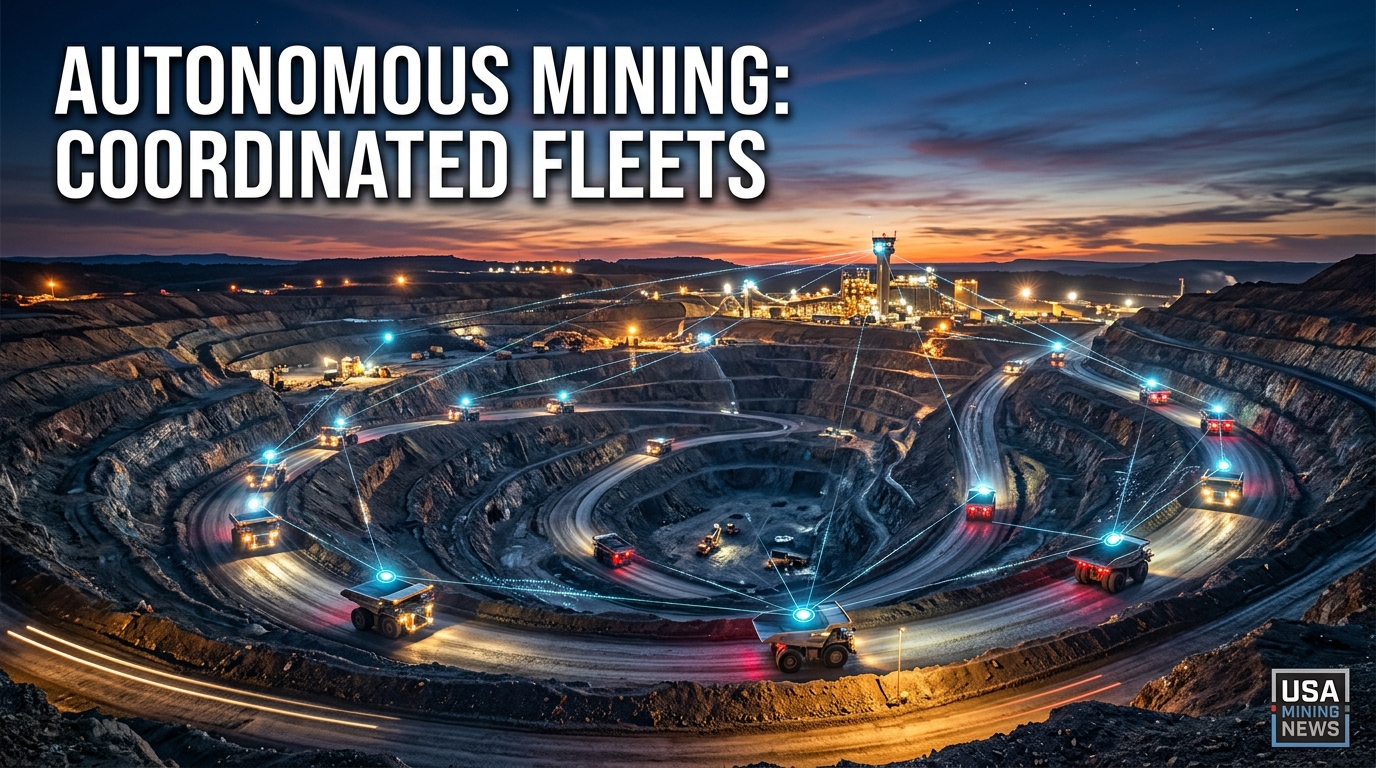
The solution gaining traction across the industry is the development and deployment of "coordinated intelligence." This concept moves beyond simply having autonomous equipment to having a unified, intelligent ecosystem where all connected assets can communicate, share data, and adapt their actions in real-time based on the needs of the overall operation. The vision is to orchestrate every piece of equipment, from the shovel loading the ore to the haul truck transporting it, and the drill preparing the next blast, ensuring they work in perfect harmony to achieve the mine's production targets.
AI-Enabled Operational Platforms: The Command Center
Central to achieving this coordinated intelligence are sophisticated AI-enabled operational platforms. These platforms serve as the central nervous system of the autonomous mine. They are designed to collect vast amounts of data from all connected autonomous equipment, as well as from other sensors and systems across the mine site. Utilizing advanced artificial intelligence and machine learning algorithms, these platforms then process this data to make real-time, informed decisions that transcend the capabilities of human operators or individual machine control systems.
The functional capabilities of these AI platforms are diverse and impactful:
- Dynamic Task Assignment and Scheduling: The platform can dynamically assign tasks to equipment based on current operational conditions, priority, and availability. For instance, if a specific loading point becomes congested, the platform can reroute trucks to an alternative shovel or adjust their speeds to maintain optimal flow.
- Predictive Maintenance and Resource Allocation: By analyzing performance data from all machines, the AI can predict potential equipment failures before they occur, allowing for proactive maintenance scheduling that minimizes unplanned downtime. It can also optimize the allocation of critical resources like fuel and spare parts across the fleet.
- Real-time Anomaly Detection and Response: The platform continuously monitors for anomalies in operational parameters, safety zones, or equipment behavior. It can autonomously trigger corrective actions, such as slowing down traffic in hazardous areas or re-sequencing operations to mitigate risks.
- Holistic Production Optimization: Beyond individual machine performance, these platforms look at the entire mining cycle—drilling, blasting, loading, hauling, and processing. They can identify bottlenecks and suggest or implement adjustments to maximize overall throughput and recovery, often through complex simulations and scenario planning that would be impossible for human planners to manage in real-time.
As depicted in industry visualizations, autonomous mining equipment is increasingly being deployed alongside these AI-enabled operational platforms, specifically designed to coordinate decisions across connected fleets. This integration is not merely about connecting machines; it is about creating a truly intelligent, self-optimizing mining system.
The Strategic Imperative for Integrated Autonomy
For mining companies and investors, the shift towards coordinated intelligence represents a critical strategic imperative. The benefits extend beyond the incremental gains seen with individual autonomous units, promising a new level of operational excellence:
- Enhanced Overall Efficiency: Instead of optimizing segments, the entire mine operation can be optimized as a single, cohesive unit, leading to higher overall productivity, lower energy consumption per tonne, and improved asset utilization.
- Superior Safety Performance: By removing human operators from dangerous environments and implementing system-wide safety protocols managed by AI, the risk of accidents can be further reduced. The AI's ability to monitor vast areas simultaneously and react instantly to potential hazards offers a level of safety vigilance unattainable by human crews alone.
- Cost Reduction: Optimized fleet management reduces fuel consumption, tire wear, and maintenance costs. Furthermore, the ability to operate with fewer human interventions and optimize production schedules can significantly lower operational expenditures.
- Data-Driven Decision Making: The rich datasets collected and analyzed by these AI platforms provide unprecedented insights into mine performance, allowing management to make more informed strategic decisions regarding mine planning, equipment acquisition, and process improvements.
- Resilience and Adaptability: Mines are dynamic environments, constantly subject to changing geological conditions, weather, and market demands. Coordinated AI platforms enable operations to adapt swiftly to these changes, maintaining efficiency and productivity even in challenging circumstances.
Key Players and Future Outlook
While the source material, authored by Alejandro Gonzalez in August 2026, does not specify individual companies leading this charge, it is clear that major mining equipment manufacturers (OEMs), specialized technology providers, and innovative mining companies themselves are at the forefront of developing and implementing these advanced AI-enabled platforms. Collaboration between these entities is crucial, as interoperability and data standardization are essential for seamless integration across diverse equipment fleets.
Looking ahead, the trajectory is clear: the future of mining lies in increasingly sophisticated levels of integration and automation. We can anticipate even more advanced AI capabilities, including predictive analytics that go beyond maintenance to forecast commodity price impacts on operational decisions, and machine learning models that continuously refine operational strategies based on evolving data patterns. The concept of a "digital twin" of a mine, fully integrated with an AI-driven operational platform, is becoming a tangible reality, allowing for virtual testing and optimization before physical implementation.
The journey from individual autonomous machines to a fully coordinated, intelligently managed mine site is complex, requiring significant investment in technology, infrastructure, and human capital to manage these advanced systems. However, the compelling advantages in safety, efficiency, and productivity make this transition not just an option, but an essential step for the mining industry to thrive in the 21st century.