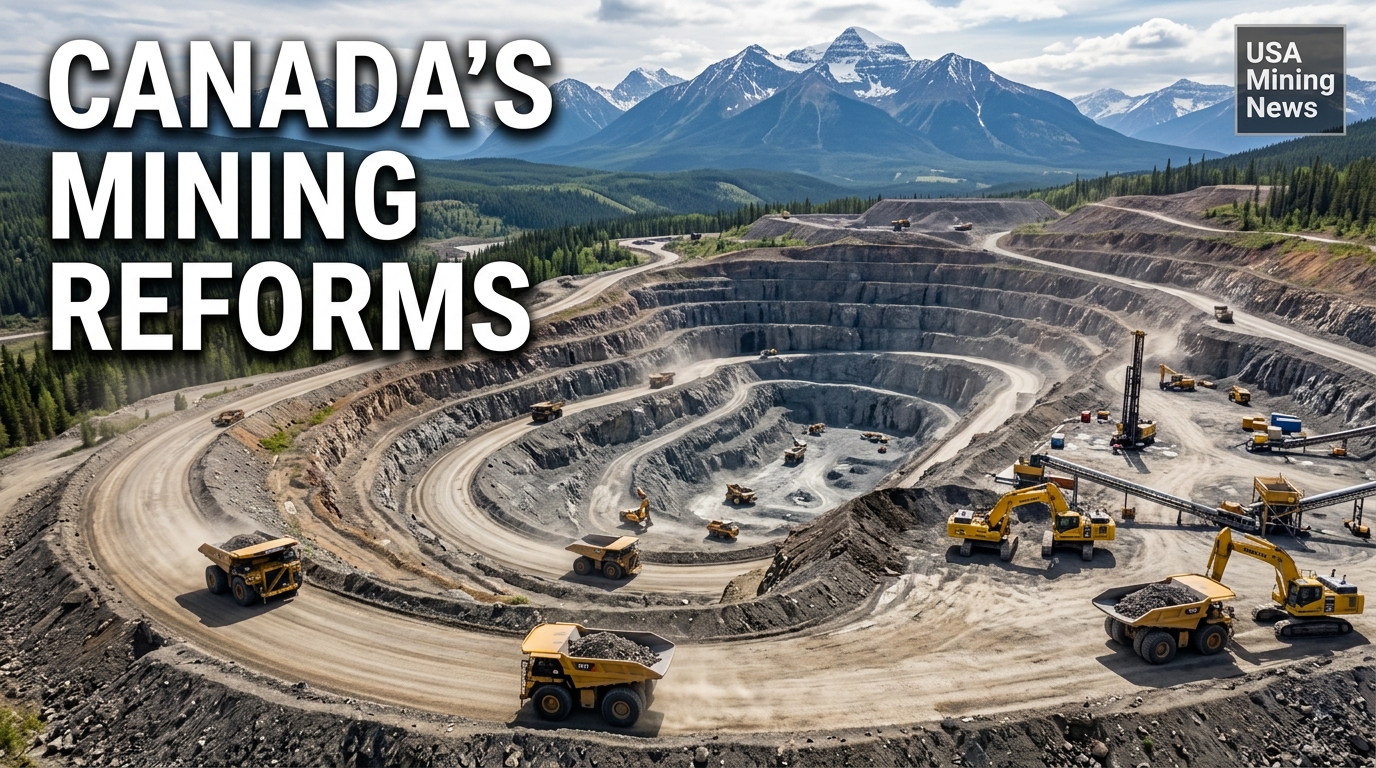
The Canadian mining industry, a cornerstone of the nation’s economy and a significant player on the global stage, finds itself at a pivotal moment, grappling with both substantial opportunities and persistent challenges. A new report from the Mining Association of Canada (MAC), titled Facts & Figures – The State of Canada’s Mining Industry, released on Wednesday, May 13, 2026, outlines sweeping reforms deemed essential for Canada to maintain and enhance its competitive edge in the international mining landscape.
The report, described as an overview of current trends based on the latest statistics and analysis, not only underscores the sector's vital economic contributions but also provides a strategic roadmap for Ottawa to unlock Canada's full potential, particularly in the realm of critical minerals. As global supply chains face increasing volatility and the demand for materials crucial to clean energy, defence, and high-tech sectors escalates, MAC's recommendations offer a timely perspective on the policy adjustments necessary to capitalize on these dynamics.
Canada's Mining Sector: A Cornerstone of the Economy
The MAC report unequivocally positions Canada's mining sector as a global leader, highlighting its profound impact on the national economy. In 2024, the industry contributed an impressive C$111 billion ($80.9 billion USD) to Canada’s gross domestic product (GDP), accounting for 3.6% of the country's total economic output. This figure alone demonstrates the sector's fundamental importance, providing direct and indirect employment, fostering innovation, and driving regional development across the vast Canadian landscape.
Beyond GDP contribution, mineral exports constitute a substantial portion of all goods exported from Canada. In 2024, the value of Canada’s mining exports reached C$152 billion, representing a significant 21% of the total value of all merchandise exports. This robust export performance underscores the sector’s role in balancing trade and generating foreign exchange earnings.
Specific commodities have seen their prominence grow. Gold, for instance, has become increasingly vital to Canada's export profile. In the first ten months of 2025, Canadian gold exports were valued at an average of C$4.3 billion per month, reflecting strong global demand and Canada’s significant production capabilities. The scope of the sector, as defined by MAC, is comprehensive, encompassing extraction, mining services, primary metal and mineral manufacturing, and downstream metal and mineral manufacturing. When broader categories such as mining, quarrying, and oil and gas extraction are included, the sector’s economic contribution rises to command more than 5% of Canada's GDP. This expanded definition, which includes the critical role of Alberta’s mined oil sands, illustrates a stable and significant share of the Canadian economy maintained over the past decade.
Global Trade Dynamics and Market Volatility
In an era defined by geopolitical tensions and shifting economic alliances, Canada’s mineral and metal trade relationships remain robust, though increasingly influenced by global trends. In 2024, the United States stood as Canada’s largest export market for minerals and metals, absorbing 51% of all shipments. This strong bilateral trade relationship with its southern neighbor continues to be a pillar of the Canadian mining industry’s export strategy. Following the U.S. were the United Kingdom, accounting for 15.6% of exports, and the European Union, which received 7.7%.
On the import side, Canada brought in C$126 billion worth of minerals and metals in 2024. The United States was again the top supplier, representing 45.8% of imports, highlighting the integrated nature of the North American mineral supply chain. China followed, accounting for 11.9% of Canada's mineral and metal imports, while the European Union supplied 9%.
MAC's report emphasizes that growing global export controls, tariffs, and trade bans are creating significant volatility across mineral markets. This instability is exacerbated by the fact that mining and processing capacity for many crucial minerals remains concentrated in a limited number of countries. The association issued a stark warning that such supply disruptions could trigger severe shortages and cause price spikes, particularly in key sectors like clean energy, defence, and semiconductor manufacturing, which are increasingly reliant on a secure supply of diverse minerals.
Leveraging Canada's Competitive Advantages
Against this backdrop of global uncertainty, the MAC report asserts that Canada is exceptionally well-positioned to benefit from concerted efforts by the G7 and allied nations to secure reliable supplies of critical minerals. Canada possesses inherent competitive advantages that align perfectly with evolving global procurement priorities. Specifically, MAC points to Canada’s production of low-carbon refined metals and its adherence to high environmental, social, and governance (ESG) standards as key differentiators. These attributes are becoming increasingly important for international buyers and investors who prioritize sustainability and responsible sourcing throughout their supply chains. The ability to guarantee a more environmentally conscious and ethically produced product gives Canadian miners a distinct edge in an increasingly scrutinized global market.
Policy Reforms: Accelerating Project Approvals and Investment
To fully capitalize on these inherent advantages and the burgeoning global demand for critical minerals, MAC stresses that the Canadian government must implement strategic policy reforms with greater urgency. A primary call to action from the association is for Ottawa to accelerate the approval process for new mining projects. Protracted permitting timelines are a major deterrent for investors and impede the timely development of essential resources.
In addition to streamlining approvals, MAC advocates for expanded infrastructure development, particularly in remote regions that hold significant mineral potential, such as northern Canada. Adequate infrastructure, including roads, power, and port facilities, is crucial for reducing operational costs, improving logistics, and enabling the economic viability of new projects in challenging terrains. Furthermore, the report recommends introducing competitive fiscal incentives designed to attract and retain significant investment in the Canadian mining sector. Capital is globally mobile, and Canada must ensure its tax and investment policies are attractive compared to other mining jurisdictions.
The association also calls for expanded geoscience work and mineral resource assessments, particularly in northern Canada, where the potential for new discoveries remains high but exploration efforts can be costly and logistically challenging. Robust public geoscience data can significantly de-risk early-stage exploration, making it more appealing for private companies to invest.
The report acknowledges positive steps taken by the government within the 2025 federal budget. Measures such as broader eligibility for exploration and clean technology tax credits, along with accelerated capital cost expensing, are designed to boost the production of minerals critical for defence, semiconductors, and clean technologies. However, MAC unequivocally stresses that the effectiveness of these welcome initiatives hinges entirely on the speed and efficiency of their implementation. Delays in rolling out these fiscal tools could diminish their intended impact and Canada's ability to respond swiftly to market demands.
Addressing Regulatory Hurdles
Beyond fiscal incentives and infrastructure, MAC’s report shines a spotlight on the perennial issue of regulatory complexity. Mining projects in Canada continue to face lengthy and convoluted approval processes, involving a multi-layered bureaucracy that includes provincial regulations, federal impact assessments, and a multitude of federal permits. This labyrinthine system leads to significant delays, increased costs, and uncertainty for project proponents, often pushing investors towards less cumbersome jurisdictions.
While governments have initiated some reforms aimed at shortening timelines and improving efficiency, the association argues that further, more substantive improvements are desperately needed. Key recommendations from MAC include:
- Stronger federal-provincial coordination to harmonize regulatory requirements and reduce duplication.
- Enhanced cooperation between federal departments involved in the permitting process.
- More efficient consultation and permitting processes that are both thorough and timely, without compromising environmental or social standards.
- Extending Canadian Exploration Expense (CEE) eligibility to technical studies, recognizing these as fundamental to de-risking projects.
- Making development costs for brownfield mine expansions fully eligible for tax credits, encouraging existing operations to grow and extend their life, thus creating sustained economic benefits.
These recommendations collectively aim to create a more predictable and competitive regulatory environment that fosters, rather than hinders, responsible mineral development.
Future Outlook: Seizing the Critical Minerals Opportunity
The global energy transition, coupled with increasing geopolitical focus on supply chain security, presents an unprecedented opportunity for Canada's mining sector. With abundant untapped resources, a skilled workforce, and a commitment to high ESG standards, Canada is uniquely positioned to become a premier supplier of critical minerals to the world. The shift towards electrification, renewable energy infrastructure, and advanced technological applications means that demand for minerals such as copper, nickel, lithium, cobalt, and rare earth elements will only intensify.
However, realizing this potential requires decisive action from policy makers. The detailed call for reforms from the Mining Association of Canada is not merely a request for industry support; it is a strategic imperative for the nation. By streamlining regulatory processes, investing in crucial infrastructure, and offering competitive fiscal incentives, Ottawa can create an attractive ecosystem for capital investment and project development. The timely implementation of these recommendations will determine Canada's ability to lead in the global critical minerals race, securing its economic future and contributing significantly to international energy security and sustainability goals. Failure to act swiftly risks ceding this strategic advantage to other mining nations that are actively vying for the same investment and market share.