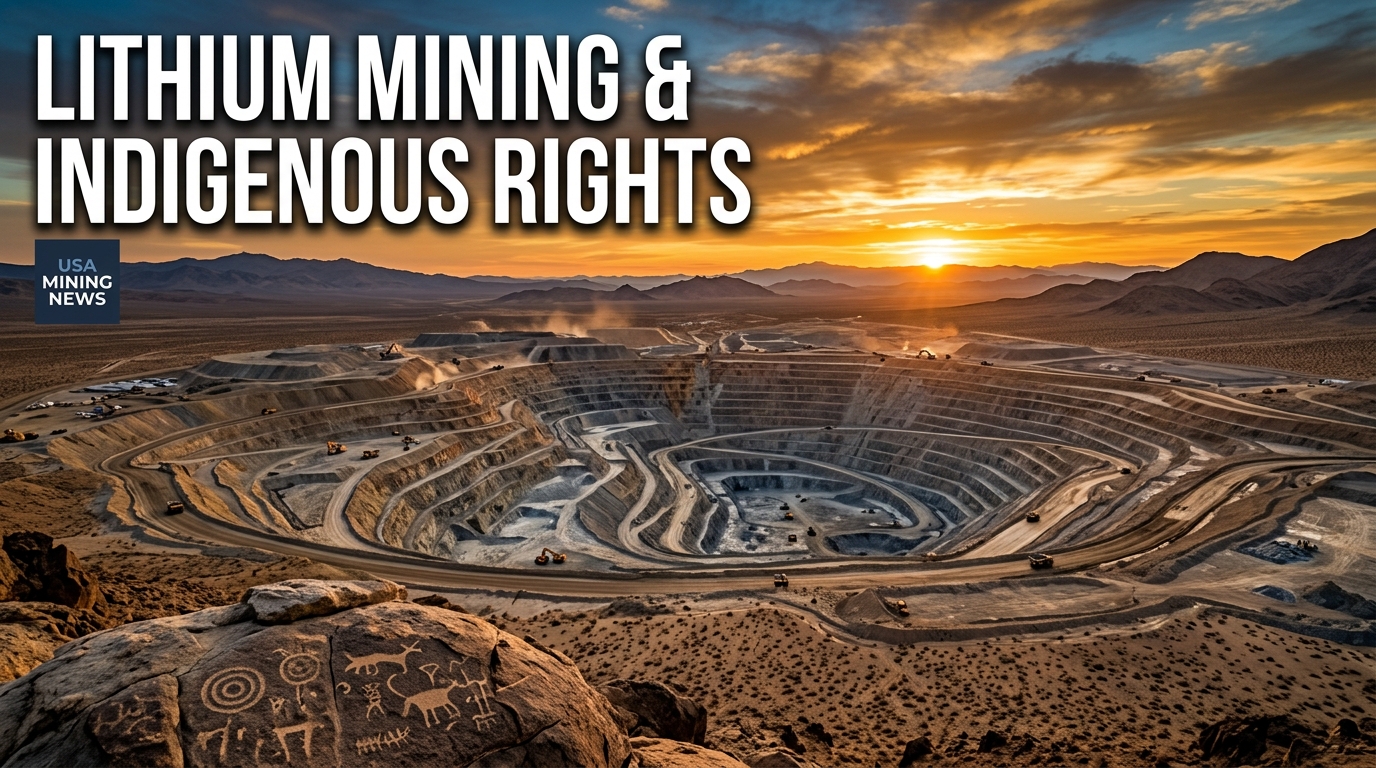
In a burgeoning critical minerals landscape, where the demand for lithium is being rapidly accelerated by the electric vehicle (EV) and artificial intelligence (AI) sectors, Nevada stands as a pivotal hub, holding approximately 85% of the known lithium reserves in the United States. However, this strategic importance is now at the center of a significant ethical and regulatory debate, as major industry players face scrutiny over their engagement with Indigenous communities.
On May 13, 2026, Amnesty International released a new report alleging that three prominent lithium projects in Nevada—Lithium Americas’ Thacker Pass, Ioneer’s Rhyolite Ridge, and Surge Battery Metals’ Nevada North — are proceeding without securing free, prior, and informed consent (FPIC) from the Indigenous Peoples whose ancestral lands they are located on. This assertion underscores a critical divergence between US federal permitting law and international human rights standards, posing complex questions for the mining industry operating within the United States.
The Core Dispute: US Law vs. International Standards
The crux of Amnesty International’s argument, articulated by researcher Alysha Khambay, is that “consent was never sought, nor was it an objective of the engagement that did take place” for any of the three mining projects. Khambay further stated that this situation indicates the United States is “breaching international human rights standards and continuing the same patterns of dispossession that Indigenous Peoples have faced for generations.”
This dispute hinges on a fundamental difference in legal and ethical frameworks. US federal law mandates consultation with Indigenous groups as part of environmental reviews, particularly for projects on public land. However, it notably does not grant these communities a definitive veto power over such projects. This is where Amnesty International argues a gap exists, as this consultation requirement falls short of the FPIC standard. FPIC, deeply embedded in international norms such as the UN Declaration on the Rights of Indigenous Peoples (UNDRIP), requires that Indigenous communities explicitly give or withhold consent for developments that could impact their territories or resources.
Tara Scurr, an Amnesty campaigner based in Ottawa, confirmed the organization’s stance, pointing out efforts in various US jurisdictions, including New York and Washington, to introduce legislation that would strengthen consultation processes and incorporate elements of FPIC. Additionally, proposed legislation in California, Senate Bill 957 (SB 957), aims to expand existing supply chain transparency laws to include mandatory human rights due diligence, though such bills often encounter significant political hurdles.
Company Defenses: Compliance with US Regulatory Frameworks
The companies involved, Ioneer and Lithium Americas, have robustly defended their operations and engagement strategies, emphasizing their full compliance with current US legal and regulatory requirements. They contend that the Bureau of Land Management (BLM), the federal agency responsible for approving such projects, does not mandate FPIC or adherence to UNDRIP under existing US law.
An Ioneer spokesperson, addressing Amnesty’s claims, stated that the organization is relying on “unsupported claims” that disregard Ioneer’s extensive outreach efforts and adherence to US law. Ioneer highlighted its successful federal permitting process, which was upheld in Nevada District Court on March 27, and noted the absence of any legal challenges from Tribal Nations regarding its cultural resource protections. The company detailed having “328 documented points of contact with 13 Tribal Nations” and developing “voluntary monitoring agreements that exceed current industry practices,” underscoring what it describes as a “unique and collaborative approach to tribal outreach and engagement.”
Lithium Americas largely echoed Ioneer’s position, as noted in an annex to Amnesty’s report. The company criticized Amnesty for mischaracterizing its “intensive consultation process” which, according to Lithium Americas, has received support from all relevant government agencies and courts. Referencing a 2011 statement from the US government, Lithium Americas reiterated that UNDRIP possesses “moral and political force” but is “not legally binding or a statement of current international law.” The company further explained the US government’s interpretation that UNDRIP’s FPIC provisions are consistent with existing federal law, which calls for “a process of meaningful consultation with tribal leaders, but not necessarily the agreement of those leaders, before the actions addressed in those consultations are taken.”
Surge Battery Metals, the developer of the Nevada North project, was not mentioned in the annex to Amnesty’s report, and the company did not provide an immediate response to inquiries regarding the issue.
Indigenous Perspectives: The "Railroaded" Sentiment
Despite the companies’ assurances of legal compliance and extensive consultation, Amnesty International’s report includes poignant sentiments from Indigenous community members who feel their voices have been sidelined. Shelley Harjo of the Fort McDermitt Paiute and Shoshone Tribe, for example, articulated a sense of disempowerment regarding the Thacker Pass consultation process. “Consent does not apply here,” Harjo conveyed, emphasizing, “There was never any genuine consent given by the community. We were just railroaded.” This sentiment highlights the profound human dimension of the dispute, illustrating a perception of procedural compliance overriding true participatory decision-making.
Nevada's Lithium Hub: Project Scale and Strategic Importance
The projects under scrutiny are critical components of the United States’ strategy to secure a domestic supply of battery metals, reducing reliance on foreign sources amidst growing geopolitical tensions and supply chain vulnerabilities. Nevada’s status as a leading locus for lithium extraction is thus not merely economic but also one of national strategic interest.
- Lithium Americas’ Thacker Pass: This project, currently under its first stage of construction, represents a significant investment, with capital spending targeted between $1.3 billion and $1.6 billion. Lithium Americas refers to Thacker Pass as potentially the largest lithium source in the Western Hemisphere, with production anticipated to commence sometime within this decade. The project’s scale underscores its national importance in the battery metals supply chain.
- Ioneer’s Rhyolite Ridge: Situated approximately 360 km northwest of Las Vegas, Rhyolite Ridge is recognized as having the world’s largest known lithium-boron deposit. Ioneer recently expanded its reserves to an impressive 1.92 million tonnes of lithium carbonate equivalent. This expansion has significantly extended the projected mine life to 95 years, though it has also increased the estimated capital costs for the project to approximately $1.67 billion. The longevity and scale of Rhyolite Ridge further solidify Nevada’s role in future critical mineral production.
- Surge Battery Metals’ Nevada North: While less detailed project specifics are available in the immediate context of this report, Nevada North contributes to the broader narrative of escalating exploration and development activity in the region.
These projects are not just about resource extraction; they are integral to the global transition towards a cleaner energy economy and the expansion of advanced technological applications, from electric vehicle batteries to AI data centers. Therefore, ensuring their responsible and ethically sound development carries immense weight.
Beyond Legal Compliance: Industry Implications and Future Landscape
While Ioneer and Lithium Americas are currently in full compliance with US federal permitting laws, the challenge posed by Amnesty International’s report brings into sharp focus the notion that
“longer-term risks tied to environmental and community impacts may outweigh immediate legal exposure.”
This suggests that adherence to the letter of the law may not always be sufficient to mitigate broader reputational, social, and eventually, financial risks in an increasingly ethically conscious global market. Investors, industry professionals, and original equipment manufacturers (OEMs) are increasingly scrutinizing supply chains for adherence to Environmental, Social, and Governance (ESG) principles. A perceived lack of genuine consent from Indigenous communities, even if legally defensible under current US law, could lead to sustained opposition, project delays, or difficulties in securing financing from ethically-minded investors or off-take agreements from leading global manufacturers.The mining industry's evolving landscape demands a delicate balance between extracting essential resources to meet urgent global demand and upholding the rights and interests of local and Indigenous communities. The spotlight on Nevada's lithium projects serves as a significant case study for how extractive industries in developed nations globally navigate these complex social license to operate issues.
Legislative Horizons: State-Level Efforts
The report by Amnesty International may also catalyze further legislative action within the United States. As highlighted by Tara Scurr, efforts are already underway in states like New York and Washington to introduce legislation that would strengthen consultation processes and incorporate elements of FPIC. In California, proposed legislation like SB 957 aims to enhance supply chain transparency by requiring mandatory human rights due diligence. While these bills face significant political hurdles, the increasing awareness and advocacy around Indigenous rights and ethical sourcing could gradually shift the legal and regulatory landscape, potentially compelling federal agencies and project developers to adopt higher standards of engagement beyond current minimum requirements.
Conclusion
The controversy surrounding Nevada's lithium projects underscores a critical juncture for the US mining industry. As the nation pushes to secure its supply of critical minerals vital for the clean energy transition and technological advancement, it must also navigate the complex terrain of Indigenous rights and international human rights standards. While companies like Ioneer and Lithium Americas rightly assert their compliance with existing US law and regulatory frameworks, the enduring accusations from groups like Amnesty International and affected Indigenous communities signal a potential long-term risk. The path forward for Nevada’s lithium boom, and indeed for US critical minerals development more broadly, will likely require not only robust legal adherence but also a proactive, ethical engagement strategy that seeks to bridge the gap between national legal obligations and global best practices for social responsibility.