Canadian Steel Sector Faces Deeper Economic Headwinds as Tariff Uncertainty Persists
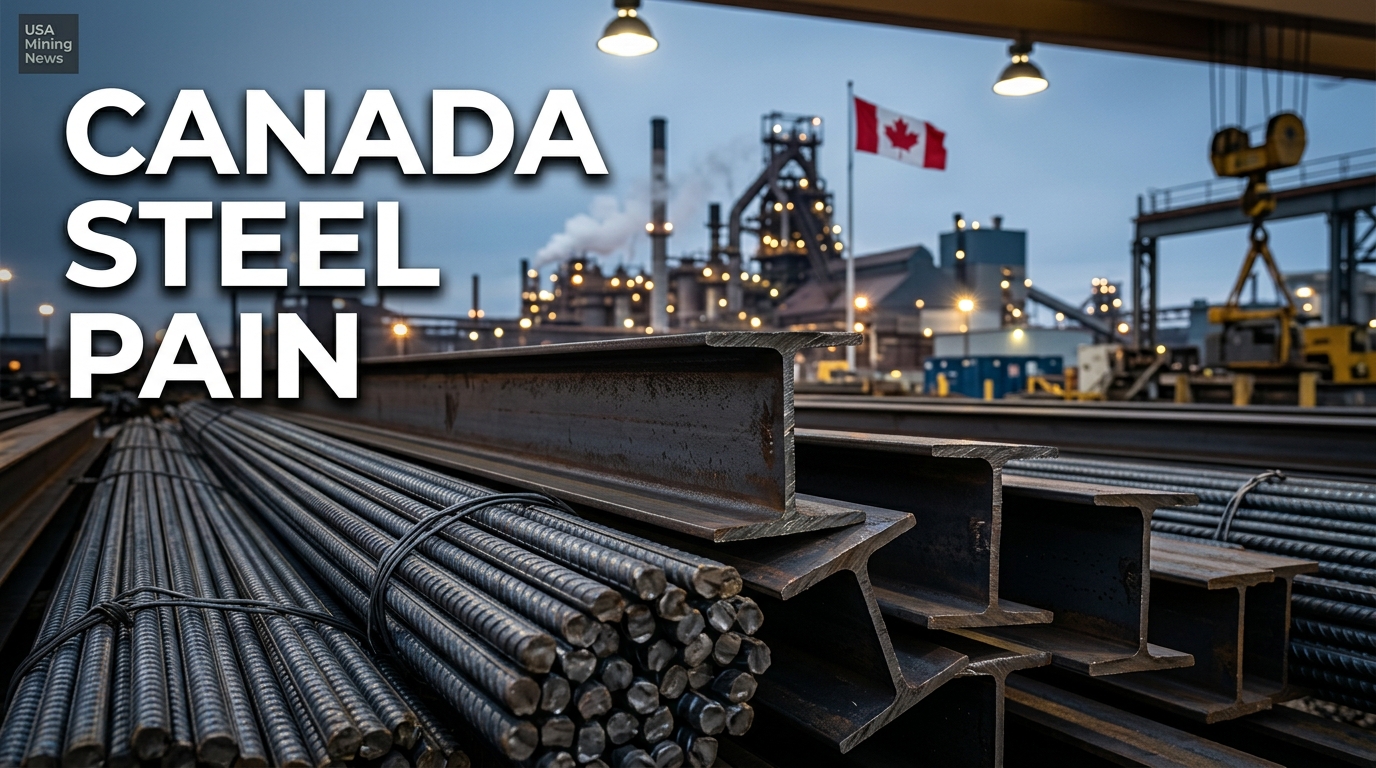
Toronto, Canada – May 22, 2026 – The Canadian steel industry is enduring a more profound and potentially enduring economic disruption from U.S. tariffs than the aluminum sector, according to a recent analysis by a senior economist at PwC Canada. The federal government’s recently announced support package, while politically significant, is largely designed to provide temporary relief rather than address the fundamental challenges posed by a shifting North American trade landscape, which continues to be clouded by the upcoming review of the Canada-United States-Mexico Agreement (CUSMA).
Speaking with MINING.COM this week, Gemma Stanton-Hagan, Director of Economics and Policy at PwC Canada, articulated the severe impact on Canadian steel producers. She highlighted that Canadian steel export values to the United States have plummeted to approximately one-third of their pre-tariff levels, representing a substantial blow to the sector's financial health.
“So far this year on a monthly basis, steel exports are about $500 million lower than they were pre-tariffs,” Stanton-Hagan stated, emphasizing the continuous and significant revenue contraction. “That’s every month revenue is $500 million lower than it would have been.” This ongoing drain underscores the scale of losses facing producers, far surpassing the proportional impact of Ottawa’s support measures.
Stanton-Hagan characterized the government funding as a “relatively short-term solution,” acknowledging that many of the affected companies are large multinational firms with considerable capital reserves and well-defined, long-term operational strategies. This suggests that while immediate liquidity can be managed, the tariffs necessitate a more fundamental re-evaluation of business models and market presence.
The Tariff Shadow Deepens on Canadian Steel
The severity of the challenge for the Canadian steel sector stems from a confluence of factors that distinguish it from the experience of aluminum producers. Historically, the Canadian steel industry has relied heavily on the U.S. market, with between 85% and 90% of its exports destined for the United States prior to the imposition of tariffs. This deep integration, while beneficial in times of free trade, has proven to be a significant vulnerability when trade barriers are erected.
A critical impediment for Canadian steel producers in finding alternative markets is the existence of a global oversupply of steel. This glut complicates efforts to divert exports to other regions, as competitive pricing and saturated markets make entry difficult. “There’s global oversupply of steel,” Stanton-Hagan explained. “Canada produces steel for domestic usage and then also mostly for the U.S., so we really don’t have those other trade relationships.” This lack of established alternative trade relationships means that Canadian steel, often specialized for the North American market, struggles to find new buyers quickly or profitably in the face of U.S. restrictions.
The impact of diminished exports and the inability to pivot to new markets has translated into significant financial pressure across the sector. Companies have reported considerable quarterly losses, compelling them to reassess investment plans, potentially deferring or canceling projects that would otherwise contribute to growth and modernization.
Aluminum's Relative Resilience and Market Diversification
In contrast to steel, the Canadian aluminum sector has demonstrated a relatively stronger capacity for adaptation and recovery, despite also having a high dependence on the U.S. market. Before tariffs, approximately 94% of Canadian aluminum exports were shipped to the United States, highlighting an even greater initial concentration than steel.
However, aluminum producers have successfully mitigated some of the tariff impact by diversifying their export destinations. “We’ve seen actually a really good bounce back in aluminum exports, mostly because of growing exports to Europe,” Stanton-Hagan observed. This ability to redirect shipments to European markets, even if Europe is not expected to be a major long-term growth market, provided a crucial valve for excess production that the steel industry largely lacked. The fungibility of aluminum, coupled with specific demand dynamics in Europe, offered an avenue for recuperating some lost U.S. export volumes, demonstrating a greater measure of market resilience.
Ottawa's Response: A Short-Term Lifeline Amidst Strategic Uncertainty
In response to the economic challenges facing both sectors, the Canadian federal government announced a support package totaling $1.5 billion. Stanton-Hagan noted that this package is structured around two distinct policy objectives:
- The $1-billion loan program: This initiative is primarily aimed at easing immediate liquidity pressures that companies are experiencing due to reduced revenues and weaker export demand. Stanton-Hagan described this component as “really about stopping the bleeding,” signifying its role as an emergency measure to prevent financial distress among producers.
- The $500-million regional tariff response initiative: This fund is designed with a longer-term vision, targeting smaller and medium-sized businesses. Its purpose is to facilitate diversification into new export markets and to enhance the resilience of these businesses against future trade shocks.
Despite these measures, Stanton-Hagan emphasized that the federal government appears to be deliberating whether the current tariff regime represents a temporary disruption that can be outlasted, or a more permanent, structural shift in North American trade relations. “Is this a blip we’re waiting out … or is this everyone needs to pivot to not sell anything to the US?” she pondered, underscoring the vastly different policy responses required depending on the answer to this critical question. This strategic uncertainty complicates long-term planning for both industry and government.
Beyond Export Numbers: Strategic Imperatives for Canada
The implications of a weakened domestic steel and aluminum industry extend far beyond lost export revenues and employment figures. Stanton-Hagan underscored the increasing recognition of these sectors as strategically vital for Canada’s broader industrial and national security objectives. Both steel and aluminum are foundational inputs for critical national priorities:
- Housing: Essential for residential construction and urban development.
- Transportation: Crucial for automotive manufacturing, rail infrastructure, and shipbuilding.
- Energy Infrastructure: Indispensable for pipelines, grids, and renewable energy projects.
- Mine Development: Required for machinery, structures, and ongoing operational needs within the mining sector itself.
- Defense: Key materials for military equipment, vehicles, and national security assets.
Stanton-Hagan explicitly pointed out that "These are also strategic inputs for defense," highlighting a national security dimension to maintaining robust domestic production capacity. Policymakers are faced with the weighty decision of how to prevent the erosion of this capacity, which is integral to Canada's economic fabric and strategic autonomy.
U.S. Manufacturing and Political Pressures: A Potential Turning Point?
While the focus has largely been on the negative impacts on Canadian producers, Stanton-Hagan also suggested that the tariff regime could eventually face stronger internal pushback from within the United States. She illuminated a critical vulnerability in the U.S. domestic supply chain: “The US actually cannot produce enough to satisfy its own needs.” Consequently, U.S. manufacturers are forced to pay higher prices for metals, a cost that feeds into inflation and increases overall production expenses.
With U.S. midterm elections approaching, and with concerns about high living costs already a significant factor for voters, the political sustainability of the tariff regime may increasingly come under scrutiny. Elevated metal prices directly contribute to inflation, affecting a wide array of consumer goods and industrial products. This could potentially mobilize U.S. manufacturing lobbies and consumers to advocate for a reconsideration of the tariffs, viewing them as detrimental to domestic economic stability and competitiveness.
The Path Forward: Adapting to a Shifting Trade Landscape
The challenges facing the Canadian steel sector are multifaceted, requiring more than just immediate financial aid. The analysis by PwC Canada underscores that while the federal government's $1.5 billion support package provides crucial breathing room, it serves primarily as a short-term intervention. The fundamental issue persists: a heavy dependence on a U.S. market increasingly prone to protectionist measures, coupled with a global steel oversupply that limits diversification options.
For Canadian mining investors and industry professionals, this situation signals profound implications. The long-term viability and growth of domestic steel production, crucial for Canadian infrastructure and resource development projects—including new mine construction, as highlighted by Stanton-Hagan—are directly impacted. The strategic importance of these materials mandates that Canada carefully navigate its trade relationships and potentially invest in further domestic processing capabilities or global partnerships to reduce reliance on any single market.
The ongoing uncertainty surrounding U.S. trade policy, particularly as the CUSMA review looms, necessitates a robust, adaptable strategy from Canadian industry and government alike. Whether the current trade dynamics represent a temporary “blip” or a permanent “pivot” will dictate the ultimate shape of North American industrial relations and the strategic direction for Canada’s vital steel industry.