Power Minerals Ignites Exploration at Brazil's Morro do Ferro, Targeting High-Grade Rare Earths
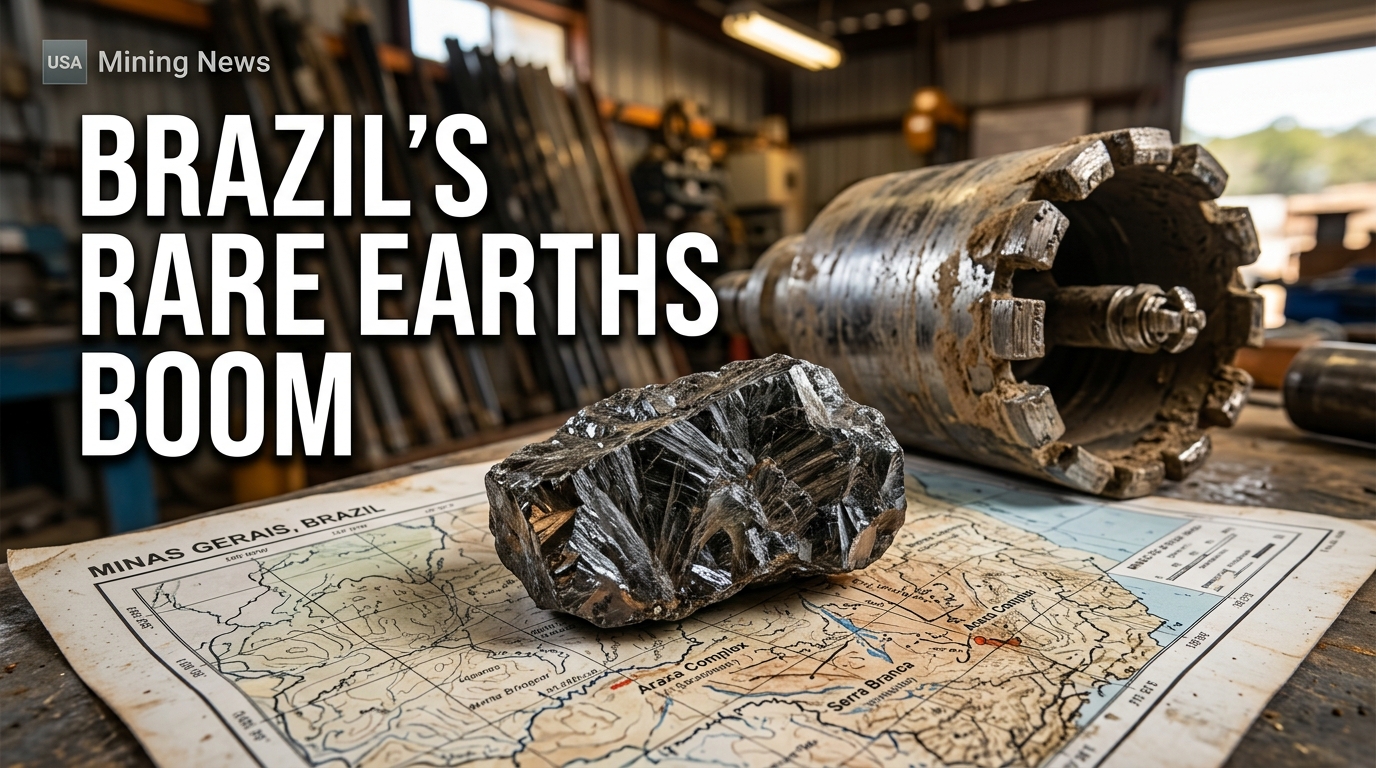
In a strategic move poised to significantly impact the global rare earth elements (REE) supply chain, Power Minerals has announced the imminent commencement of its maiden diamond drilling program at the Morro do Ferro Rare Earths Project (MDF Project) in Minas Gerais, Brazil. This aggressive exploration campaign, set to begin later this month, follows closely on the heels of the company's acquisition of the project last month, signaling a rapid progression towards defining a substantial resource in a region gaining prominence for its critical mineral potential.
The MDF Project is strategically located within the renowned Poços de Caldas alkaline complex, an area increasingly recognized as a developing global hub for rare earth mineralization. This geological setting is known to host significant concentrations of REEs, providing a robust foundation for Power Minerals' exploration endeavors. The rapid deployment of a drilling program underscores the project's perceived value and the company's commitment to expediting its development.
A Strategic Foothold in Brazil's REE Frontier
Brazil, with its vast and underexplored mineral potential, is emerging as a critical player in the global pursuit of diversified rare earth supplies, moving beyond traditional sources. The Poços de Caldas alkaline complex, where the Morro do Ferro Project resides, is a prime example of this emerging landscape. Alkaline complexes are often associated with unique depositional environments that can host a broad spectrum of rare earth minerals, including those vital for high-tech and green energy applications.
The geographical advantage of the MDF Project within this complex is multifaceted. Beyond the geological prospectivity, Brazil offers a relatively stable political and regulatory environment for mining investments compared to some other REE-rich nations. Furthermore, the country's developing infrastructure, particularly in mineral-rich states like Minas Gerais, can provide essential logistical support for mining operations as projects mature. Power Minerals’ decision to prioritize this asset speaks volumes about its confidence in both the geological endowment and the operational viability within Brazil.
Aggressive Drilling Program Targets High-Grade Mineralization
Power Minerals' initial drilling campaign is meticulously designed to achieve several key objectives, consolidating the project's technical understanding and advancing it towards a maiden Mineral Resource Estimate (MRE). The program encompasses a total of approximately 3,800 meters of diamond drilling, split into two distinct components:
- 3,000 meters of Diamond Core Drilling: This primary component is focused on exploring both the depth and lateral extensions of the known high-grade magnetic rare earth oxides (MREO) and total rare earth oxides (TREO) mineralization. Understanding the full geological footprint is crucial for defining the overall scale and continuity of the deposit. Diamond core drilling provides detailed geological and assay information, essential for resource modeling.
- 800 meters of Larger-Diameter Drilling: This supplemental drilling is purposed to acquire larger quantities of material specifically for detailed metallurgical testing. Metallurgical work is paramount in REE projects, as it determines the optimal processing routes, recovery rates, and ultimately, the economic viability of extracting the valuable rare earth elements from the host rock. Efficient metallurgy can significantly impact capital and operating costs.
The drilling campaign is scheduled to commence later in May 2026, with the company anticipating its completion within the following quarter. Power Minerals has stated that results from these activities will be progressively released as they become available, with initial outcomes expected as early as June 2026. This rapid turnaround suggests efficient planning and a clear intent to provide investors and stakeholders with timely updates on the project's progress. The work explicitly aims to evaluate mineralisation in the main deposit, which remains open at depth and along strike, indicating significant potential for expansion beyond currently defined areas.
A Foundation of Exceptional Prior Results
The impetus behind Power Minerals' accelerated drilling program is significantly bolstered by compelling historical assay results that indicate exceptional grades of rare earth mineralization at Morro do Ferro. These results provide a robust technical foundation and derisk the initial exploration phases considerably.
Previous diamond drill-hole assays revealed intercepts of remarkable thickness and tenor:
- MFSR35: Intercepted 60.85 meters at an impressive 89,177 parts per million (ppm), which translates to 8.92% Total Rare Earth Oxides (TREO), extending from the surface to the end of the hole.
- MFSR44: Yielded 70.9 meters at 79,997 ppm (8% TREO).
- MFSR20: Showed 60.6 meters at 70,217 ppm (7.02% TREO).
These TREO grades are considered exceptionally high by global industry standards, particularly given their near-surface occurrence. High-grade, near-surface mineralization can significantly enhance a project's economic attractiveness by potentially reducing stripping ratios and overall mining costs, making for a more robust financial model.
Additionally, the project boasts ultra-high-grade Magnetic Rare Earth Oxide (MREO) samples, which are of particular interest due to their critical role in advanced manufacturing. MREOs primarily include neodymium (Nd), praseodymium (Pr), dysprosium (Dy), and terbium (Tb)—elements essential for permanent magnets used in electric vehicles (EVs), wind turbines, and defense technologies. The reported MREO samples include:
- MFSR-47: 2 meters at 34,835 ppm (3.48% of whole rock) from 9 to 11 meters.
- MFSR-35: 2 meters at 33,569 ppm (3.36%) from 44 to 46 meters.
- MFSR-35: Another 2 meters at 31,860 ppm (3.19%) from 38 to 40 meters.
The presence of such high concentrations of MREOs significantly elevates the project's desirability, as these elements often command higher market prices due to their specialized demand and relatively scarcer supply. The verification sampling conducted recently further reinforces the reliability of these historical data points, providing a strong technical basis for building towards an initial MRE.
Navigating Permitting with a "Manifesto de Mina"
One of the key advantages highlighted for the MDF Project is its benefit from a "Manifesto de Mina" mining licence. This particular type of licence in Brazil plays a crucial role in expediting the exploration and initial development phases of a project. A "Manifesto de Mina" facilitates ground-disturbing activities, which are fundamental for comprehensive exploration, without the protracted delays often associated with preliminary permitting processes.
While environmental approvals are still a prerequisite for full-scale mining operations and often for certain advanced exploration activities, the "Manifesto de Mina" allows companies to progress significantly faster through initial geological surveys, trenching, and drilling programs. This regulatory advantage reduces the lead time from discovery to resource definition, providing Power Minerals with a streamlined pathway to establish a maiden Mineral Resource Estimate and subsequently advance the project through further feasibility studies. In a fast-moving commodity market like REEs, every regulatory efficiency can translate into a competitive advantage.
Power Minerals' Vision: From Acquisition to Maiden MRE
Power Minerals CEO, Alistair Stephens, articulated the company's clear vision and enthusiasm for the project. "We are delighted to announce the commencement of our maiden drilling campaign at the MDF Project, following the completion of the acquisition in the previous month," said Stephens. His comments emphasize the rapid transition from acquisition to active exploration, a testament to the company's operational agility and strategic focus.
Stephens elaborated on the objectives of the current campaign: "Drilling is planned to begin this month and will include approximately 3,800m of diamond drilling, designed to expand the current mineralised footprint along strike and down-dip and enhance our understanding of the mineralogy at the MDF Project, to help facilitate a swift progression towards a maiden mineral resource estimate [MRE] for the project." This statement underscores the strategic intent: not just to confirm mineralization, but to systematically expand its known boundaries and collect the specific data necessary to formally quantify the resource in accordance with internationally recognized reporting standards.
The CEO also confirmed the timeline, noting that "the campaign is expected to be completed in the following quarter and results are planned to be progressively released as they become available." This commitment to transparency and steady updates will be crucial for investor confidence and market perception. Furthermore, Power Minerals has temporarily halted drilling activities at its Santa Anna Niobium Project to concentrate resources and focus entirely on the MDF initiative. This decision highlights the company's prioritization of the Morro do Ferro project, indicating its significant strategic importance to Power Minerals' overall portfolio.
Broader Implications for the Global REE Market
The Morro do Ferro Project's progression holds significant implications for the broader global rare earth market. Rare earths are designated as critical minerals by numerous governments, including the United States, due to their indispensability in modern technologies and national security applications. The market is currently characterized by concentrated supply chains, with China historically dominating both production and processing.
As geopolitical tensions rise and the demand for clean energy technologies like electric vehicles and wind power accelerates, Western nations are actively seeking to diversify their REE supply. Projects like Morro do Ferro in Brazil, offering potentially high-grade and accessible mineralization, become vital components of this global de-risking strategy. The economic viability of REE projects is highly sensitive to grade, mineralogy, and metallurgical complexity. The exceedingly high TREO and MREO grades reported at Morro do Ferro suggest a potentially robust economic profile, capable of competing effectively in the global market.
Morro do Ferro’s development could contribute to establishing Brazil as a more prominent, Western-friendly source of critical rare earth elements, thereby fostering greater supply chain resilience and reducing reliance on single-country suppliers. This aligns with broader industry trends towards localization and diversification of critical mineral sources.
Future Outlook and Market Impact
The initiation of drilling at Morro do Ferro represents the first major operational step in unlocking the project’s full value, moving beyond historical data and initial assessments. The results from this drilling campaign, particularly those expected by June 2026, will be keenly watched by investors, analysts, and industry stakeholders. Positive results, confirming the continuity and extensions of the high-grade mineralization, will be instrumental in de-risking the project further and paving the way for a maiden Mineral Resource Estimate.
A successfully delineated MRE would be a transformative milestone for Power Minerals, providing a quantifiable basis for future feasibility studies, project financing, and potential strategic partnerships. The market impact could include increased investor interest in Power Minerals and potentially other Brazilian rare earth projects. As the global demand for REEs continues its upward trajectory, projects that demonstrate high-grade resources, efficient permitting, and a clear path to production will command significant attention.
Power Minerals' decisive action at Morro do Ferro positions it at the forefront of Brazil's emerging rare earth industry, with the potential to become a key contributor to the secure and sustainable supply of these essential elements for the future global economy.