China’s Rare Earth Grip Endures Despite High-Stakes Summit, Analysts Warn
The global mining industry, particularly stakeholders reliant on critical minerals, closely watched the proceedings of the US-China summit held on May 14-15, 2026, in Beijing. President Donald Trump’s visit, his first to China in nearly a decade, was anticipated to address a range of geopolitical and trade issues, with the contentious topic of rare earth elements (REEs) front and center. Despite the high-level engagement, analysts from Fitch Group’s BMI assert that China’s formidable control over the world’s rare earth supply is expected to "stay firmly in place," leaving the United States and its allies facing persistent supply chain vulnerabilities.
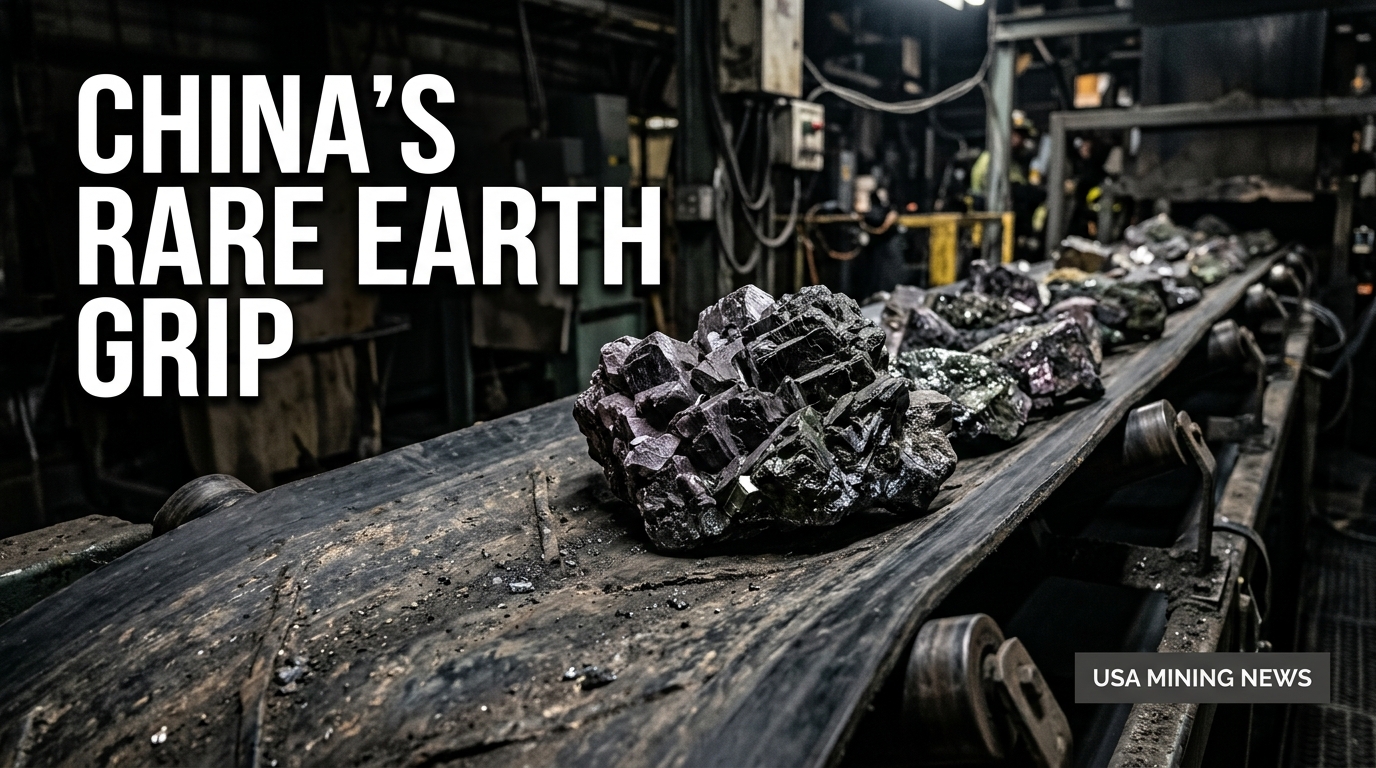
China currently commands approximately 60% of the world’s mined rare earth output and, critically, maintains a near-monopoly on the processing capacity required to transform raw rare earth oxides into usable materials for advanced technologies. This strategic advantage has been demonstrably leveraged by Beijing in recent years, particularly in response to US tariffs, creating significant market instability and prompting urgent calls for supply chain diversification across Western nations.
China's Strategic Deployment of Market Leverage
Beijing’s willingness to utilize its rare earth dominance as a geopolitical and trade instrument became starkly evident last year. China implemented two successive waves of export restrictions, designed to counter US tariffs and underscore its irreplaceable role in the critical minerals supply chain. The initial wave targeted seven specific rare earth elements, along with their related compounds and magnets, tightening the flow of these essential materials to global markets.
Subsequently, China broadened these controls, extending the restrictions to encompass an additional five rare earth elements. More significantly, Beijing expanded its licensing requirements to cover products manufactured using Chinese-sourced rare earth materials or technologies, effectively extending its regulatory reach beyond raw minerals to sophisticated downstream products. This move sent ripples of alarm through industries globally, highlighting the profound implications of China’s rare earth control.
While Beijing later agreed to suspend the broader, second set of measures in late October for a period of one year, BMI emphasizes that this respite is temporary. These comprehensive controls are expected to resume in November 2026, reintroducing a significant layer of uncertainty for global manufacturers and mining sector strategists. The period leading up to and during the May 2026 Trump-Xi summit saw intense speculation among market observers, who hoped for an extension of this crucial one-year suspension, or even the possibility of a definitive rare earth accord between the two economic rivals.
The Trump-Xi Summit: High Hopes, Limited Outcomes
The May 14-15 summit in Beijing was indeed a focal point for the critical minerals sector. While President Trump publicly declared his trip a “success,” the concrete outcomes regarding rare earths proved to be limited. The White House’s official statements remained notably vague, reporting only that Beijing had committed “to addressing US concerns over supply shortages of rare earths,” without providing specific details, timelines, or formal agreements. The anticipated extension of the one-year export suspension, or any broader trade truce concerning rare earths, failed to materialize.
According to analysts at BMI, this lack of definitive resolution means that the uncertainty surrounding rare earth supplies is expected to persist. Their assessment underscores a sobering reality: Beijing’s deeply entrenched chokehold on US mineral supplies is not projected to dissipate readily. This conclusion reinforces the long-standing understanding within the mining industry that geopolitical tensions directly translate into commodity market volatility and strategic supply chain risks.
Acute Shortages and Market Impact
The lingering uncertainty and China’s past export restrictions have already had tangible impacts on specific rare earth markets. Data from the US Geological Survey consistently highlights America’s significant reliance on China for a substantial portion of its mineral imports, a dependence that continues despite ongoing efforts to diversify. Even with the temporary suspension of some Chinese measures, the supply of certain minerals, particularly the so-called “heavy” rare earths, remains exceptionally challenging to source, as indicated by customs data.
BMI’s analysis reveals a concerning trend: overall shipments of export-controlled rare earths have remained well below their historical levels. Specifically, exports of yttrium, dysprosium, and terbium – all critical heavy rare earths – have been running at drastically reduced volumes, registering just 42%, 41%, and 49% respectively, compared to the 12-month period preceding China’s initial restrictions. These heavy rare earths are indispensable for a wide array of high-tech applications, including magnets for electric vehicles, wind turbines, and advanced defense systems.
The situation for yttrium, in particular, has become acutely critical. Its price has witnessed a staggering 15-fold increase since the implementation of Chinese export controls. Yttrium is a vital material used as a thermal barrier coating on turbine blades in aerospace applications, and as a protective coating and insulator in semiconductor manufacturing – two industries of immense strategic importance to the United States. Slower shipments of this crucial mineral have triggered widespread alarm across both the US aerospace and semiconductor sectors, highlighting the real-world implications of supply chain disruptions.
The United States' Strategic Response: Building a Resilient Supply Chain
Recognizing the profound national security and economic risks posed by this overwhelming dependence on China, the US government has intensified its efforts over the past year to forge a resilient mine-to-magnet rare earth supply chain. This multi-faceted strategy encompasses both accelerated domestic industrial policy and deepened international cooperation.
On the domestic front, significant investments are being channeled into various stages of the rare earth supply chain. Key initiatives include:
- A landmark $400 million investment into MP Materials (NYSE: MP), which operates the Mountain Pass mine in California, currently the only rare earth miner in the United States. This funding is critical for bolstering domestic refining and processing capabilities, moving beyond raw material extraction.
- A substantial $1.6 billion funding allocated to USA Rare Earth (NASDAQ: USAR). This investment is earmarked for the development of a large rare earth deposit in Texas, alongside the crucial establishment of integrated domestic processing capacity. Such projects are vital for creating an end-to-end US-based supply chain, reducing reliance on offshore processing.
Concurrent with these domestic efforts, the US government is actively mobilizing coordinated international strategies to secure reliable rare earth supplies from diverse, friendly nations. These diplomatic and financial engagements are targeting select projects and partnerships across a spectrum of countries, including Australia, Canada, Greenland, Angola, Mozambique, Brazil, and Saudi Arabia. This global outreach aims to create a robust network of rare earth producers and processors, thereby mitigating the risks associated with a single dominant supplier.
Broader Implications for the Global Mining Industry
The ongoing saga of rare earth supply control extends far beyond the immediate geopolitical sparring between the US and China. For the global mining industry, it underscores several critical themes:
- Strategic Importance of Critical Minerals: The intensity of focus on rare earths highlights the growing recognition of critical minerals as foundational to modern economies and national security. This will drive increased investment and exploration in these sectors.
- Supply Chain Resilience as a Priority: Governments and corporations alike are now prioritizing the creation of resilient, diversified supply chains over purely cost-driven models. This shift presents significant opportunities for new mining projects in geopolitically stable regions.
- Value-Add Opportunities: The emphasis on processing capacity, not just extraction, indicates a move towards fostering domestic or allied downstream industries. This integrated approach creates higher value opportunities for mining companies willing to invest in advanced metallurgy and manufacturing.
- Geopolitical Risk Integration: Investment decisions in the mining sector must now more thoroughly integrate geopolitical risk assessments, particularly concerning commodities with concentrated supply chains.
The Road Ahead: Navigating Persistent Uncertainty
As the November 2026 deadline for the potential resumption of China’s broader rare earth export controls approaches, the global mining landscape faces continued uncertainty. BMI’s assessment suggests that Beijing’s strategic leverage in the rare earth sector will remain firmly in place for the foreseeable future, challenging the ambitions of other nations to rapidly build independent supply chains.
The United States, through its dual-pronged approach of domestic investment and international collaboration, is attempting to carve out a more secure future for its critical mineral needs. However, the deep entrenchment of China’s rare earth industry, built over decades, means that achieving genuine supply independence will be a protracted and capital-intensive endeavor. Industry professionals and investors must remain acutely aware of these dynamics, as the rare earth market will continue to be a nexus of technological advancement, economic competition, and geopolitical strategy.