Staff Writer | July 6, 2026 | 12:10 pm EST
Gold Ascends: Central Banks, Chinese Investors, and Global Banks Signal a Structural Shift
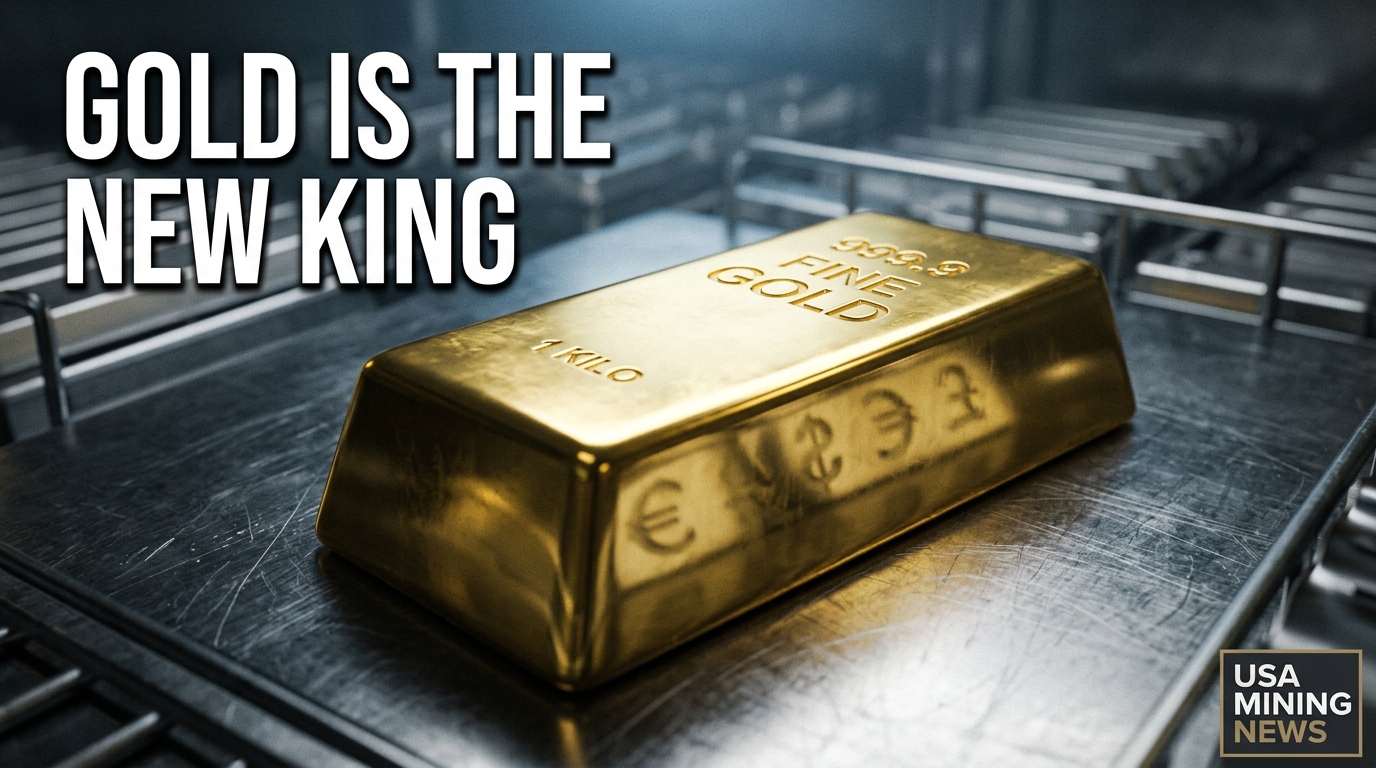
The global financial landscape is witnessing an undeniable pivot towards gold, with a series of significant developments converging within a single, pivotal week in early July 2026. These events, occurring across official central bank reserves, China’s domestic capital markets, and the fundamental Western bullion-trading infrastructure, collectively underscore a robust and potentially long-lasting shift in asset allocation strategies. For the mining industry, these indicators point to sustained demand and an increasingly central role for gold in the global financial system.
Within a mere five days, three distinct and authoritative signals emerged: central banks globally executed their second-largest monthly gold purchase of the year, China's most prominent exchange-traded fund (ETF) transformed from an equity-focused vehicle to a gold fund, and Citi, a major global financial institution, secured a coveted seat within the highly exclusive London bullion clearing network. Each signal, weighty in its own right, gains amplified significance when viewed as part of a synchronized movement, suggesting a deeper, structural re-evaluation of gold as an essential asset.
Central Banks Accelerate Gold Accumulation Amidst Global Uncertainty
The official sector continues to be a formidable driver of gold demand. New data released by the World Gold Council (WGC) confirms that central banks added a net 41 tonnes of gold to their official reserves in May 2026. This figure marks the second-highest monthly total for the year, trailing only the robust accumulation witnessed in February. This consistent appetite from sovereign institutions highlights a strategic imperative to diversify reserves and enhance financial resilience in an uncertain global economic and geopolitical environment.
Several key players were at the forefront of this accumulation trend:
- Poland led the charge, adding 18 tonnes in May. This brings its year-to-date (YTD) purchases for 2026 to an impressive 64 tonnes, propelling its total gold reserves to 614 tonnes. Poland is actively pursuing a stated target of 700 tonnes, signaling continued intent to augment its gold holdings.
- China, a consistent and influential buyer, added 10 tonnes in May. This represents its largest single-month increase since December 2024 and extends its remarkable streak to a 20th consecutive month of accumulation. China's official gold reserves now stand at 2,331 tonnes, constituting approximately 9% of its total reserves. The steady, measured pace of accumulation by the People's Bank of China has long been a key support for the gold market.
- Uzbekistan and Kazakhstan continued their programs of gold accumulation, reflecting a broader trend among resource-rich nations to fortify their balance sheets with the yellow metal. Uzbekistan’s YTD purchases amount to 33 tonnes, and gold now accounts for an extraordinary 87% of its total reserves, showcasing an exceptionally high conviction in gold’s reserve asset status.
- Singapore returned to the market as a net buyer for the first time since September 2025, adding 4 tonnes in May. This re-entry suggests a widening circle of central banks re-evaluating their gold exposure.
While the vast majority of central banks were net buyers, Turkey and Russia were notable net sellers in May, collectively trimming 9 tonnes from their reserves. However, their combined sales were dwarfed by the broader accumulation trend.
Looking forward, the WGC’s ninth annual Central Bank Gold Reserves Survey provides a telling insight into future intentions. A striking 89% of central bankers surveyed expect global gold reserves to increase over the next 12 months. More significantly, a record 45% of respondents indicated that they expect their own institution’s reserves to rise. This figure is up from 43% last year and a mere 29% two years ago, demonstrating a growing internal consensus among central bank decision-makers regarding the necessity of holding more gold. This proactive stance from sovereign entities offers a powerful long-term demand signal for gold miners and investors alike.
China's Domestic Investors Pivot to Gold as Top ETF Shifts
Away from the sovereign vaults, an equally compelling, if not more striking, transformation has unfolded within China’s sophisticated domestic capital markets. According to Bloomberg, the Huaan Yifu Gold ETF has officially surpassed the Huatai-PineBridge CSI 300 ETF to become China's single largest exchange-traded fund of any kind. The Huaan Yifu Gold ETF now boasts approximately 90 billion yuan in assets under management, eclipsing the CSI 300 fund’s roughly 83 billion yuan.
This is far more than a mere leaderboard change; it signifies a fundamental shift in the investment psyche of Chinese capital. For years, the dominant ETFs in China were overwhelmingly linked to broad equity benchmarks, reflecting significant investor confidence in domestic growth prospects, often bolstered by state-backed support in the stock market. The ascendancy of a gold ETF to the top position suggests that investor preference is no longer primarily for broad market exposure or "beta," but rather for insulation and capital preservation.
The context for this shift is multifaceted and deeply rooted in China’s unique financial environment. Chinese investors operate within a system defined by:
- Capital Controls: These limit the ability of domestic investors to diversify their portfolios offshore, effectively trapping significant capital within the country.
- Impaired Property Market: The once-dominant property sector, a traditional store of wealth for Chinese households, remains under significant duress, eroding investor confidence and access to liquid assets.
- Low Bank Deposit Yields: Domestic bank deposits offer meager returns, making them unattractive for wealth growth amidst inflationary pressures.
- Struggling Domestic Equities: Despite periodic interventions, Chinese equities have struggled to rebuild investor confidence, leading to prolonged periods of underperformance and volatility.
In this restrictive and challenging investment landscape, a liquid, exchange-traded gold product offers a particularly clean and efficient vehicle for hedging. It provides a crucial hedge against currency weakness, potential financial repression, and broader policy uncertainty, all without requiring investors to navigate complex and restricted offshore diversification avenues.
The symbolic weight of this shift is profound. Gold is no longer exclusively a reserve asset held by the People's Bank of China or a traditional form of jewelry purchased by households. It has demonstrably moved to the very center of China’s modern, liquid ETF market, directly displacing the country's most important proxy for broad stock market performance. This timing is also critical, aligning with suggestions that Beijing’s so-called "national team" – state-linked funds that have historically intervened to prop up Chinese equities during market stress – appears to be withdrawing its support. As official gold buying continues quietly below the surface, ordinary Chinese investors and domestic institutions are independently and proactively choosing gold over the stock market, precisely at a moment when state-backed stability in equities seems to be fading.
Citi's Entry Into London Bullion Clearing Underpins Structural Shift
The third, and perhaps most subtle yet equally significant, development occurred in the foundational infrastructure of global bullion trading. Citi, one of the world's largest financial services corporations, has become the fifth bank admitted to clear transactions in London’s over-the-counter (OTC) gold market. This market, recognized as the world’s largest bullion trading hub, facilitates an astounding volume of roughly $160 billion in transactions daily.
Citi now joins an elite group of institutions – HSBC, ICBC Standard Bank, JPMorgan, and UBS – within the London Precious Metals Clearing Limited (LPMCL) network. This admission is particularly noteworthy as Citi is the first new entrant to this highly exclusive clearing group in a decade, signifying a major milestone for both the institution and the broader precious metals market.
In a public statement, Citi announced, "Citi and the London Precious Metals Clearing Limited (LPMCL) today announce Citi’s admission as a clearing member of LPMCL, adding Loco London settlement services for gold, silver, platinum and palladium." James Cressy, Chair of LPMCL, commented on the significance of the move, stating, "The addition of Citi as a clearing member of LPMCL demonstrates the openness and transparency of our membership process, allowing new entrants to join and participate in the clearing and settlement of the predominate global over the counter precious metals market."
Taken in isolation, a bank joining a clearing network might appear to be a routine administrative or "back-office" story. However, when viewed in conjunction with the concurrent central bank accumulation data and the dramatic shift in China’s top ETF, Citi’s move takes on an altogether different meaning. It suggests that a major Western financial institution is strategically securing a direct and integral role in gold-market settlement infrastructure precisely at the moment when both official sovereign reserves and private Chinese domestic capital are decisively rotating towards gold. This strategic positioning implies that at least one large institutional player views this pervasive rotation towards gold as a durable, structural trend rather than a fleeting, short-term positioning trade. It signifies a long-term commitment to and belief in the sustained relevance and growth of the precious metals market.
The Confluence of Signals: Why This Matters for the Mining Industry
These three distinct yet synchronized signals – heightened central bank buying, a fundamental shift in Chinese domestic investment preferences, and expanded institutional infrastructure – collectively paint a compelling picture of gold's ascending global importance. For the mining industry, these developments are not merely financial curiosities; they represent concrete indicators of robust and potentially enduring demand.
A structural shift of this magnitude implies several key considerations for gold producers, explorers, and associated service providers:
- Sustained Demand Base: The consistent buying from central banks, coupled with a fundamental re-allocation by a massive pool of private capital in China, establishes a strong, resilient demand base for gold, independent of short-term speculative forces.
- Price Stability and Upside Potential: While the gold price itself is subject to numerous factors, increased structural demand from diverse and strategic sources typically contributes to greater price stability and can provide a supportive floor, with potential for long-term appreciation.
- Investment in Exploration and Production: A clear long-term demand signal encourages mining companies to invest confidently in exploration for new deposits, expand existing operations, and pursue technological innovations to improve extraction efficiencies. Higher sustained prices make marginal projects more viable and attractive.
- Global Diversification of Demand: The combined demand from sovereign entities and individual investors in a major economic power like China, coupled with strengthening Western clearing infrastructure, underscores gold’s role as a truly global and diversified asset, mitigating reliance on any single market segment.
The fact that these signals are emerging from such disparate parts of the financial system – policy-driven reserve accumulation, capital-controlled domestic retail/institutional investment, and global interbank infrastructure – underscores the profundity of the shift. This isn't just a reaction to current events; it appears to be a recalibration for the long haul.
Future Implications and Outlook
The events of early July 2026 serve as a powerful reminder of gold’s enduring allure and its evolving role in the global financial system. As central bankers explicitly state their intentions to increase reserves and as ordinary investors in a major economy actively seek solace in gold over traditional equities, the implications for the future are clear.
For the mining industry, this is an unequivocal signal to prepare for a future where gold demand remains robust, driven by deep-seated economic and geopolitical factors rather than transient market sentiment. Companies involved in gold exploration, mining, and refining will likely find themselves operating within a more favorable and predictable demand environment. Investors in the sector should take note of these structural shifts, as they indicate a robust foundation for gold prices and a compelling long-term investment case for gold-related assets. The yellow metal is not just finding its footing; it is solidifying its indispensable position as a cornerstone of global stability and wealth preservation.