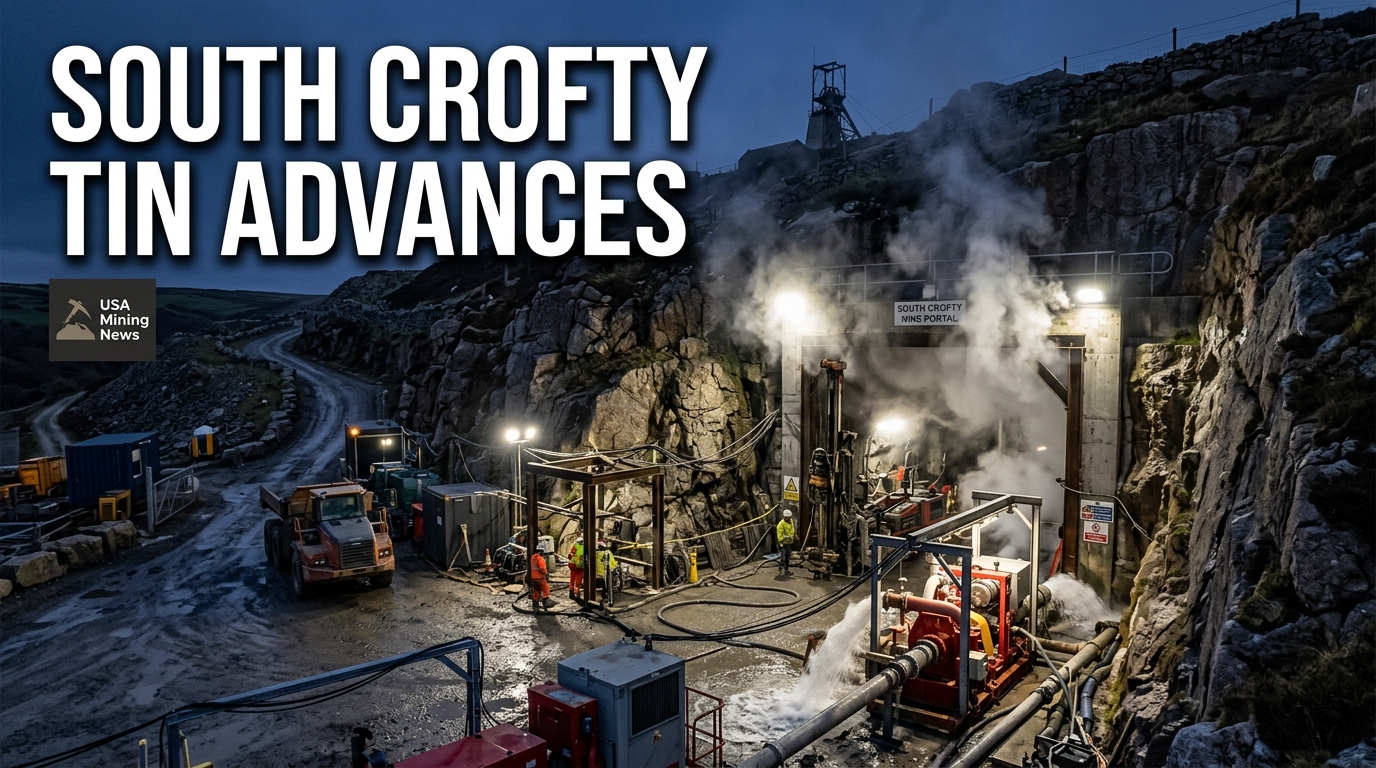
In a significant development for the European mining landscape, Cornish Metals has announced substantial progress in the underground revitalization of its flagship South Crofty tin project in Cornwall, UK. The update, released on June 11, 2026, details advancements across multiple key operational fronts, signaling a methodical approach to bringing the historic mine back into production. This phased approach, encompassing critical dewatering, infrastructure refurbishment, and strategic engineering, positions South Crofty as a crucial future source of tin amidst burgeoning global demand for the critical metal.
Revitalizing a Historic Tin Mine: South Crofty's Strategic Re-emergence
The South Crofty site, deeply embedded in Cornwall's rich mining heritage, represents a compelling opportunity to re-establish domestic tin production in the United Kingdom. Cornish Metals has been diligently working to reactivate this high-grade asset, which ceased operations in 1998 during a period of low commodity prices. The current phase of underground development is central to the project’s overarching strategy, focusing on restoring essential access and operational infrastructure that will underpin future mining activities. For the mining industry, particularly in jurisdictions with a legacy of mineral extraction, projects like South Crofty highlight the potential for leveraging existing geological knowledge and infrastructure, albeit with considerable investment in modernizing facilities and ensuring contemporary safety and environmental standards.
The strategic re-emergence of South Crofty is not merely about reactivating a mine; it is about addressing the evolving demands of the global industrial economy. Tin, often referred to as the "glue" of the green economy, is indispensable for solders in electronics, particularly in electric vehicles, renewable energy systems, and advanced computing. As such, establishing secure and ethical supply chains for critical minerals like tin is becoming an increasingly strategic imperative for developed nations. Cornish Metals’ systematic dewatering, refurbishment, and development efforts are laying the groundwork for a long-term, sustainable operation that could meaningfully contribute to these global supply requirements.
Dewatering and Infrastructure at the New Cook’s Kitchen (NCK) Shaft
A cornerstone of the current work program is the ongoing dewatering of the New Cook’s Kitchen (NCK) shaft. This critical activity, which began in late 2021, is proceeding as planned, marking steady progress towards re-establishing access to deeper sections of the mine. Dewatering a historic mine is an extensive engineering challenge, requiring continuous pumping and careful monitoring to manage the ingress of groundwater. The successful execution of this phase is paramount, as it directly impacts safety, access, and the overall timeline for project development.
Cornish Metals has set an ambitious target of reaching the 400-Level, situated approximately 730 meters below surface, in the first half of 2027. Concurrently, comprehensive refurbishment activities are underway at the NCK shaft to prepare it for future production. This includes the removal of the existing shaft cover, the meticulous installation of scaffolding, and the construction of work platforms. These foundational steps are crucial for the subsequent preparation of infrastructure required to support both the production and service winders, which are vital for hoisting ore, waste, personnel, and equipment. The efficiency and reliability of these hoisting systems will be central to South Crofty’s operational performance.
Further demonstrating the project's advanced planning, engineering design for these critical areas is also progressing. Specifically, Front-End Engineering Design (FEED) for the loading, unloading, and hoisting systems is being undertaken by Optimult, a specialist engineering firm. The completion of FEED is a significant milestone, providing a robust basis for detailed engineering, equipment procurement, and construction. To that end, orders have already been placed for long-lead items such as skips and cages for the NCK shaft, underscoring the company's commitment to maintaining its project timeline and mitigating potential supply chain delays.
Developing Subsurface Operations: The 25-Level and 290-Level
Beyond the primary NCK shaft, development work is also advancing at shallower and mid-level sections of the mine, serving distinct strategic purposes. At the 25-Level, located approximately 45 meters underground and stemming from the Tuckingmill decline, progress continues on multiple fronts. This area is earmarked for future rock handling and skip discharge infrastructure, which will streamline the movement of excavated material from underground to surface processing facilities. Crucially, the 25-Level is also serving as an essential location for ongoing employee training, allowing the workforce to gain practical experience and develop critical skills ahead of anticipated full-scale production. This focus on human capital development is a hallmark of robust mine planning, ensuring a skilled and safety-conscious team is ready for complex underground operations.
Looking to deeper horizons, pre-production development at the 290-Level, situated around 530 meters deep, is currently slated to begin in the fourth quarter of 2026. This phase typically involves developing ramps, drives, and other access infrastructure that will facilitate future mining blocks. Following shortly after, an underground drilling program is scheduled to commence. Such drilling is instrumental for infill drilling to upgrade resource classifications, delineate ore bodies more precisely, and potentially expand known mineralized zones. This sequential approach to development and exploration is standard industry practice, aiming to optimize mine design and enhance the project's overall economics.
Roskear Shaft: Vital for Ventilation and Safety
The importance of robust ventilation and emergency egress systems in underground mining cannot be overstated. Cornish Metals is making early-stage refurbishment progress at the Roskear shaft, located approximately 850 meters west of the NCK shaft. Work at Roskear includes the installation of scaffolding and the removal of the shaft cover, mirroring initial steps taken at the NCK shaft. The Roskear shaft is designated to perform two critical functions: it will serve as the primary ventilation shaft for the entire mine and a secondary emergency exit. As a primary ventilation shaft, it will be essential for ensuring adequate air circulation, managing underground temperatures, and removing hazardous gases and dust. Its role as a secondary emergency exit provides a vital safety redundancy, crucial for meeting modern mining regulations and ensuring workforce protection.
On the surface at Roskear, infrastructure development is also evident, with the erection of the winder house reported to be well advanced. This winder house will eventually house the machinery necessary for operating the shaft for its ventilation and emergency purposes.
Surface Works and Strategic Engineering
While the focus of the latest update heavily emphasizes underground activities, Cornish Metals simultaneously reported continued progress on surface infrastructure. As stated by Cornish Metals CEO Don Turvey, the new NCK offices are now fully operational, providing essential administrative and planning support for the project. Furthermore, construction of the workshop and stores building is nearing completion. These facilities are critical for the efficient maintenance of mining equipment, storage of spare parts, and overall logistical support for a large-scale mining operation, directly impacting operational uptime and cost efficiency.
A significant strategic milestone highlighted by CEO Turvey is the completion of FEED for the process plant. This achievement is particularly noteworthy as it signifies that the conceptual design and critical parameters for ore processing have been thoroughly defined, allowing for detailed engineering and procurement to proceed with greater certainty. A well-designed process plant is fundamental to maximizing metal recovery and optimizing operational costs, directly influencing the project's long-term profitability.
Market Dynamics and Economic Viability
The timing of South Crofty’s advancement aligns favorably with robust market conditions for tin. The commodity is currently trading around $53,000 per tonne, a price point that significantly underpins the economic viability of the project. This elevated tin price reflects persistent demand, driven by its critical role in the electronics sector, particularly in advanced technologies and the green energy transition. Supply has faced challenges from various geopolitical and operational factors, contributing to a tight market and strong price support.
The positive economic outlook for South Crofty is further validated by its estimated net present value (NPV). At current market rates, the project's NPV is approximately £500 million, or approximately $669.35 million. The NPV is a crucial financial metric for investors, representing the profitability of a project when discounted to its present value. A strong NPV signals confidence in the project's ability to generate significant future cash flows, making it an attractive prospect for capital allocation in the mining sector.
Looking Ahead: Timelines and Operational Readiness
Cornish Metals’ latest update provides a clear roadmap for the immediate future. With strategic milestones being met across surface and underground fronts, the company continues to target operational readiness. The scheduled commencement of pre-production development at the 290-Level in Q4 2026, quickly followed by an underground drilling program, highlights an aggressive yet carefully planned timeline.
Don Turvey, CEO of Cornish Metals, expressed satisfaction with the ongoing progress, stating, "I am pleased to report continued strong progress across multiple workstreams at South Crofty." His comments underscore the comprehensive nature of the development, from operational readiness in surface offices to foundational advances underground and strategic engineering completions like the process plant FEED. The systematic progression through these complex stages is essential for derisking the project and preparing South Crofty for a successful return to production, contributing significantly to the global supply of critical tin.