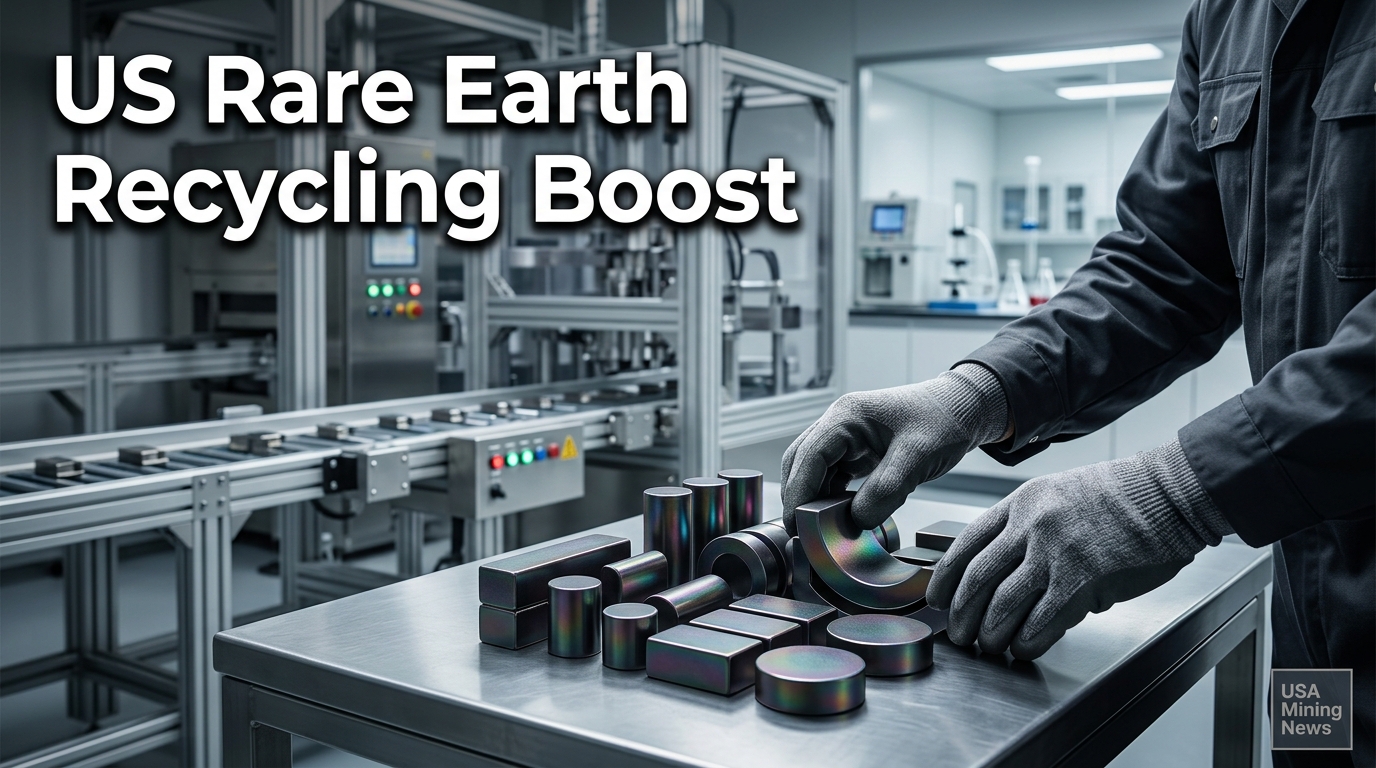
In a significant move poised to bolster the United States' critical minerals independence, Cyclic Materials has announced the successful completion of a $75 million (C$103.93 million) strategic financing round. This latest investment elevates the company's total equity funding to an impressive $237 million, reflecting strong investor confidence in its vision to establish robust domestic rare earth and critical mineral recycling capabilities. The funding infusion is earmarked to accelerate the development of Cyclic Materials’ integrated rare earth recycling campus in South Carolina and to expand its innovative "Hub-and-Spoke" infrastructure model nationwide.
Strategic Funding Fuels Domestic Rare Earth Ambition
The $75 million financing round represents a pivotal moment for Cyclic Materials, underscoring the growing recognition of critical mineral recycling as an indispensable component of national economic and strategic security. Accounts advised by T. Rowe Price Associates spearheaded this round, building upon their initial investment in the company made in 2025. This continued commitment from a prominent institutional investor highlights the long-term potential seen in Cyclic Materials' proprietary technologies and strategic approach to re-shoring critical supply chains.
The investment also drew expanded commitments from existing investors, signaling a unified belief in the company's trajectory and its operational achievements to date. The cumulative $237 million in equity funding positions Cyclic Materials with substantial capital to execute its ambitious expansion plans. Such significant financial backing is crucial in the capital-intensive critical minerals sector, enabling the rapid scaling of infrastructure and advanced technological deployment necessary to meet escalating domestic demand.
The Hub-and-Spoke Model: A Blueprint for Critical Mineral Resilience
At the core of Cyclic Materials' strategy is its distinctive "Hub-and-Spoke" infrastructure model, designed for efficient collection and processing of critical mineral feedstocks. This model envisions a network of smaller, regionally distributed "Spoke" facilities focused on initial material separation and aggregation, feeding into larger, integrated "Hub" campuses for advanced recovery and refining. The expansion aims specifically to increase domestic capacity for recycling rare earths and other critical minerals, materials that are fundamental to a wide array of high-growth and strategically important sectors. These include:
- Artificial Intelligence (AI): Components requiring high-performance magnets and specialized alloys.
- Automotive: Electric vehicle motors, sensors, and lightweighting materials.
- Defense: Advanced weaponry, guidance systems, and communication technologies.
- Medical: MRI machines, surgical tools, and diagnostic equipment.
- Robotics: Precision motors, actuators, and sensing devices.
- Semiconductors: Fabrication processes and advanced microelectronics.
- Other Manufacturing Sectors: A broad spectrum of industrial applications reliant on high-strength magnets and specialized metallic compounds.
By establishing this decentralized yet integrated network, Cyclic Materials intends to create a resilient, efficient, and domestically controlled pipeline for critical minerals, reducing reliance on volatile international supply chains and bolstering American manufacturing capabilities.
Key Operational Milestones and Upcoming Developments
The recent financing round is underpinned by a series of tangible operational achievements and significant progress across Cyclic Materials' project pipeline. Notably, the company has successfully commissioned its commercial Spoke facility in Arizona. This facility specializes in the crucial initial steps of magnet separation and broader critical mineral recycling, representing an important first node in the Hub-and-Spoke network. Operations at the Arizona plant are slated to commence in the third quarter of 2026 (Q3 2026), marking a critical step towards commercial-scale processing.
Concurrently, substantial progress has been made on the development of the company's much-anticipated rare earth recycling campus in McBee, South Carolina. This integrated facility will serve as a central "Hub" in Cyclic Materials' network. The company plans to break ground on the South Carolina campus in the fourth quarter of 2026 (Q4 2026). This significant construction milestone follows a previous announcement in January 2026 regarding an investment of more than $82 million into the McBee campus, demonstrating a sustained commitment to developing this flagship facility.
The South Carolina facility is designed to host Cyclic Materials’ advanced technology platforms, encompassing sophisticated processes for magnet separation, rare earth recovery, and refining. This comprehensive approach ensures that not only are rare earths extracted, but they are also refined to purity levels suitable for direct reintroduction into high-value manufacturing supply chains. The co-location of these processes within a single campus aims to maximize operational efficiency and minimize logistical complexities, thereby reducing both cost and environmental footprint.
Technological Edge and National Priorities
The strategic importance of Cyclic Materials' endeavors resonates deeply with national priorities. The US Government has officially classified the recovery of critical materials—specifically targeting end-of-life rare earth magnets and manufacturing scrap—as a national security imperative. This classification underscores the critical role that a secure and sustainable supply of these materials plays in maintaining technological leadership and defense capabilities. Rare earth elements, particularly neodymium and praseodymium used in permanent magnets, are vital for numerous advanced technologies, making their secure sourcing a matter of strategic urgency.
Ahmad Ghahreman, founder and CEO of Cyclic Materials, articulated this national significance, stating, "The continued support of our investors is enabling us to build vital US rare earth infrastructure at a time when it has become a national priority. This additional capital will enable us to move faster in South Carolina and across the US, accelerate the expansion of our Hub-and-Spoke network, produce more rare earths and critical minerals domestically and return them to American manufacturing." His statement highlights not only the commercial ambition but also the patriotic mission embedded in the company's operations, aiming to re-establish a domestic circular economy for these indispensable resources.
Strengthening the Supply Chain: Strategic Partnerships and Feedstock Sourcing
Central to the success of any recycling operation is a robust and reliable feedstock supply. Cyclic Materials has strategically addressed this challenge through key partnerships, most notably with ERI. ERI, which recently joined Cyclic Materials as a strategic partner and investor, brings to the table an extensive electronics collection and processing network. This partnership is designed to significantly improve feedstock sourcing for Cyclic Materials by leveraging ERI’s established infrastructure for collecting end-of-life electronics, a rich source of critical minerals, particularly rare earth magnets.
Beyond ERI, Cyclic Materials has attracted a diverse array of prominent institutional and strategic investors, reflecting broad industry confidence in its model and market potential. This impressive roster includes global giants such as Amazon, BMW i Ventures, Energy Impact Partners, Hitachi Ventures, Jaguar Land Rover, and Microsoft. The involvement of these leading companies, many of whom are significant consumers of critical minerals in their manufacturing processes, underscores a strategic imperative to secure diverse and sustainable sources of materials. Their investment not only provides capital but also signals a commitment to integrating recycled rare earths and critical minerals into their own supply chains, thereby driving demand and fostering a more circular economy.
Broader Industry Implications: Reshaping the Rare Earth Landscape
For the broader mining industry and its investors, Cyclic Materials' accelerated expansion carries profound implications. It represents a significant advancement in the global shift towards a circular economy for critical minerals, supplementing traditional primary mining operations. While primary mining will always be essential, enhanced recycling capacity offers a crucial buffer against geopolitical supply chain disruptions, commodity price volatility, and environmental concerns associated with conventional extraction methods.
The development of domestic rare earth recycling infrastructure directly addresses a long-standing vulnerability in the US industrial base: an over-reliance on foreign sources for these strategically vital materials. By establishing a robust internal supply loop, the US can enhance its economic sovereignty and ensure consistent availability of materials for its high-tech and defense sectors. This move also aligns with global environmental, social, and governance (ESG) trends, as recycling generally has a lower environmental footprint compared to virgin mining, particularly in terms of energy consumption and waste generation.
Furthermore, the participation of major technology and automotive companies as investors signals a powerful market pull for recycled critical minerals. This indicates that end-users are not merely interested in supply security but are actively investing in it, anticipating a future where recycled content plays a much larger role in their product portfolios. This integrated approach, linking recyclers, refiners, and end-users, creates a more resilient and sustainable value chain for critical minerals, setting a precedent for other resource sectors.
Future Outlook and Market Impact
As Cyclic Materials moves rapidly towards its operational milestones in Arizona and South Carolina, its impact on the US rare earth market is poised to be transformative. The company's "Hub-and-Spoke" model, combined with its advanced recovery and refining technologies, is designed to significantly boost the availability of domestically sourced rare earths and other critical minerals. This expansion is not just about increasing volume; it is about establishing a high-quality, reliable, and environmentally responsible source that can feed directly into American manufacturing, reducing dependencies and fostering innovation.
The projected start of operations in Arizona in Q3 2026 and the groundbreaking in South Carolina in Q4 2026 are crucial timelines for industry observers and investors. These milestones will demonstrate the tangible progress of Cyclic Materials' strategy, moving from concept to commercial reality. The successful scaling of these facilities and the growth of commercial partnerships will be key indicators of the company's ability to fundamentally reshape the landscape of critical mineral supply in the United States, driving a new era of domestic resource security and sustainable industrial practice.