Underground LDES: Turning Mines and Caverns into Energy Storage Hubs
The global energy landscape is undergoing a profound transformation, driven by an imperative to decarbonize and transition towards renewable sources. However, the inherent intermittency of solar and wind power presents a formidable challenge: ensuring a stable, reliable energy supply when the sun isn't shining or the wind isn't blowing. This pressing need is propelling demand for long duration energy storage (LDES), and increasingly, the industry is looking beneath the surface – to repurposed mines and subterranean caverns – for robust, scalable solutions.
As of August 14, 2026, the development of underground LDES technologies represents a significant frontier in energy innovation. These solutions offer distinct advantages over traditional electrochemical batteries, which often grapple with issues such as degradation over time, thermal runaway risks, and complex supply chain dependencies for critical minerals. While nascent, the technologies of Compressed Air Energy Storage (CAES) and Underground Gravity Energy Storage (UGES) are demonstrating considerable promise, albeit with their own unique techno-economic considerations.
The Mechanics of Subterranean Energy Storage
Two primary approaches are currently leading the charge in underground LDES: CAES and UGES. Each leverages different physical principles, tailored to specific geological conditions and operational requirements.
Compressed Air Energy Storage (CAES)
CAES operates on the principle of storing energy as compressed air and heat. Edward Barbour, an associate professor of energy systems and storage at the University of Birmingham, explains that the system "essentially combine these two things when energy is required to generate hot, pressurised air, which is used to drive a turbine." During periods of excess electricity (e.g., from abundant solar or wind), air is compressed and stored, often accompanied by the capture of heat generated during compression. When electricity is needed, the compressed air is released, reheated, and expanded through a turbine to generate power.
Efficiency, however, is a key consideration. Tallat Azad, CEO of Storelectric, a prominent CAES provider, notes that while their two CAES plants currently operate at around 42% efficiency, the company is targeting an improved efficiency of approximately 62%. Azad elaborates, "The actual energy that is usable on the other end in the grid would be less than that [in the cavern] by virtue of what the efficiency of the plant is," underscoring the importance of optimizing the conversion process to maximize usable output.
Underground Gravity Energy Storage (UGES)
UGES represents an entirely different concept, harnessing the fundamental principle of gravitational potential energy. As Barbour describes, "UGES moves weights up and down. You are storing gravitational potential energy when the weight is at the top, and then you are releasing that via a motor as the weight is lowered." The physics driving this technology is expressed simply as energy equals mass times height.
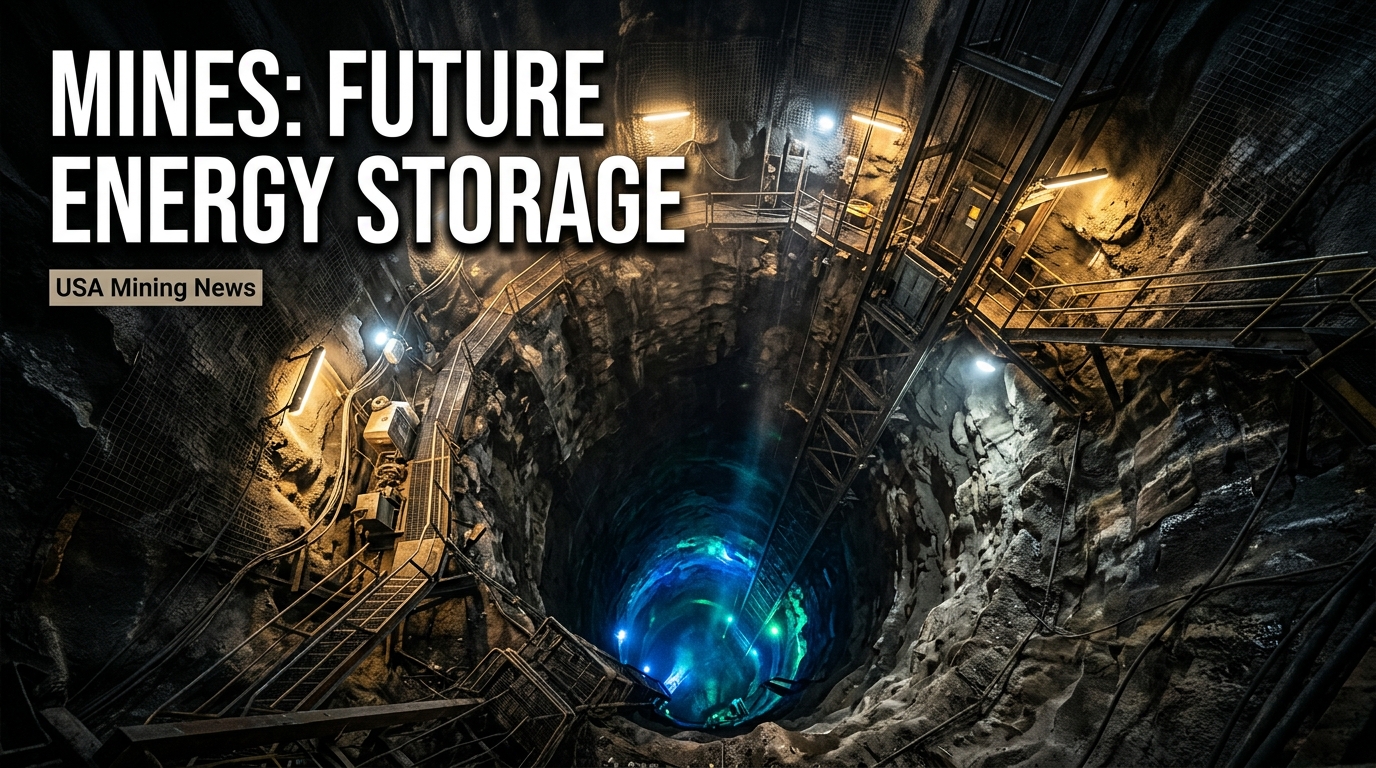
Mark Swinnerton, founder and CEO of Green Gravity, a developer in the UGES space, emphasizes why disused mine shafts are particularly well-suited for this application. "Our technology is serviced by having a lot of mass and a lot of height," he states. Mine shafts inherently provide the significant vertical drop necessary for effective gravitational energy storage, and their existing robust infrastructure can support the heavy masses involved.
Strategic Site Selection: Mines vs. Salt Caverns
The optimal location for an underground LDES system is heavily dependent on the specific technology employed, with geological characteristics playing a decisive role. As Barbour notes, "Proponents of each technology will state that they are all likely to have certain locations where that specific technology is best."
Salt Caverns for CAES
For CAES, salt caverns offer an ideal geological profile. Barbour highlights that in regions with salt deposits at the right depth, typically around 500 meters, CAES becomes economically viable. In such optimal conditions, the cost for CAES could potentially drop below £5 (approximately $6.75 USD) per kilowatt-hour (kWh) of storage capacity. Beyond economic advantages, salt caverns provide exceptional longevity. Azad points out that once a salt cavern is developed, it can last for "decades, if not hundreds of years," requiring only periodic maintenance checks, perhaps every ten years.
A crucial advantage of salt for CAES is its self-sealing nature. Unlike hard rock mines, which have been considered for CAES but pose a risk of air leakage, salt formations naturally seal any minor fissures, ensuring the integrity of the compressed air storage. Storelectric recently capitalized on these geological benefits, acquiring a 550-acre site in Teesside, UK. This region, historically a major industrial and chemical hub, is rich in natural caverns, providing a ready-made subterranean infrastructure for CAES deployment.
Disused Mines for UGES
Conversely, disused hard rock mines present an unparalleled opportunity for UGES. Swinnerton affirms that these sites are "one of the best places you can find height," directly aligning with the core physics of gravitational storage. Similar to salt caverns, mine shafts also boast impressive longevity, with existing infrastructure designed to last for decades or even longer, minimizing initial capital expenditure for new construction.
The scaling potential for UGES in disused mines is immense and globally significant. Swinnerton estimates that there are "nearly two million mines globally that are currently closed." Repurposing these sites for energy storage offers a compelling rationale: "the first reason to repurpose mines for energy storage is to repurpose mines for their land, their assets, their position." This not only breathes new life into inactive industrial assets but also offers economic revitalization opportunities for former mining communities, creating new jobs and sustainable infrastructure.
Unlocking Significant Energy Capacity
The potential storage capacities of both CAES and UGES are substantial, offering solutions that range from utility-scale to regional grid support.
UGES Capacity Potential
For UGES, storage capacity is a direct function of the mass of the weights and the height they can be moved. Swinnerton indicates that hundreds of thousands of disused mines worldwide would be classified as medium-sized mine shafts, each capable of offering between 20 to 50 megawatt-hours (MWh) of potential energy storage. The larger, yet still "plentiful," mine shafts hold even greater promise, with individual shafts capable of storing between 150 MWh and 350 MWh. These represent "very large energy densities," critical for grid-scale applications.
Furthermore, the capacity can be aggregated significantly. Swinnerton points out that "many mines that hold those shafts can have many shafts – we can talk about ten mine shafts at a single mine, often in that space." This aggregation means that a single disused mining complex could potentially host gigawatt-hour (GWh) scale storage systems, transforming former extractive sites into massive energy reservoirs.
CAES Capacity Potential
CAES storage capacity is primarily determined by the volume of the subterranean caverns utilized. At Storelectric's newly acquired Teesside site, the caverns average approximately 60,000 cubic meters. Azad states that this volume "equates to around 250 MWh of energy," which could power "probably something like 70,000 or 80,000 homes for an hour using that cavern."
However, Azad reiterates a crucial point regarding efficiency losses: "That is the energy density in the cavern itself. When you actually come to release that energy through a turbine, there are then efficiency losses that you have to take into account. The actual energy that is usable on the other end in the grid would be less than that." This highlights the distinction between gross stored energy and net deliverable energy to the grid, a vital consideration for project developers and investors.
Underground Innovation and Future Outlook
Despite their immense potential, underground LDES technologies are still in their nascent stages of commercial deployment. Green Gravity, for instance, commissioned its inaugural pilot plant in 2023, while Storelectric's significant acquisition of the Teesside site in the UK was the culmination of an extensive three-year due diligence process, underscoring the complexity and careful planning required for such large-scale infrastructure projects.
Nevertheless, the momentum for innovation in this sector is undeniably growing. This surge is directly correlated with the increasing global demand for tailored, long-duration storage solutions that can provide stability and resilience to electricity grids heavily reliant on intermittent renewable generation. For the mining industry, this trend offers a compelling vision for the future: a pathway to repurpose vast networks of disused assets and infrastructure, transforming them from environmental liabilities into critical components of the clean energy transition. This not only mitigates closure costs and environmental impact but also creates new economic opportunities and specialized employment for former mining communities.
Looking ahead, the role of subterranean spaces in energy systems is expected to diversify further. Edward Barbour alludes to related opportunities, noting that "Hydrogen storage in salt caverns is, in my opinion," suggesting an evolving landscape where underground geology will play an even broader role in the future energy economy. As these technologies mature and achieve greater scale, they are poised to become indispensable pillars of a sustainable, reliable, and decarbonized global energy infrastructure, with the mining sector at the forefront of this transformative repurposing.