The global mining industry stands at a pivotal juncture, grappling with mounting pressure to decarbonize operations amidst a backdrop of escalating energy costs and stringent environmental regulations. While the ultimate goal of achieving net-zero emissions is a complex, multi-decade endeavor, the sector is making tangible progress by prioritizing readily available and economically viable renewable energy sources. According to insights from a recent Decarbonisation in Mining report by GlobalData, the parent company of Mining Technology, solar power generation is rapidly emerging as the cornerstone of short-term decarbonization strategies, paving the way for the industry's ultimate reliance on electrification.
The Path to Decarbonization: A Multi-faceted Approach
Achieving complete decarbonization across mining operations is undeniably a lengthy and challenging process. It is hindered by the immaturity of certain promising technologies and the substantial capital investment required for integrating new infrastructure. However, the industry’s energy transition is not a singular pathway but rather a dynamic combination of strategic elements. These include the widespread adoption of renewables, the exploration of alternative fuels, and the systemic electrification of fleets and processing facilities.
While nascent technologies such as carbon capture and the use of hydrogen in fuel cells for fleet decarbonization, or in the production of green ammonia for explosives, hold immense long-term potential, they are largely considered to be over a decade away from broad commercial viability and integration within the mining sector. Consequently, the industry's immediate focus has shifted to robust, market-ready solutions that can deliver measurable reductions in carbon footprints today.
Immediate Advantages of Renewable Energy Integration
Renewable energy sources, particularly solar and wind, offer two compelling and immediate advantages that are accelerating their adoption within mining. Firstly, the solutions are already commercially available and have a proven track record of reliability. This eliminates the need for extensive research and development before deployment. Secondly, and perhaps more significantly, the levelized cost of electricity (LCOE) produced by renewable generation has been consistently decreasing, making it an increasingly attractive economic proposition compared to traditional fossil fuels. This economic viability reduces operational costs and enhances financial predictability for mining companies.
Beyond direct cost savings and carbon footprint reduction, renewables serve as an essential springboard for the sector's ultimate goal: comprehensive electrification. True decarbonization through electrification can only be achieved if the electricity powering mining equipment and processes is generated renewably. The initial phases of this transformative shift are already visible. Companies like Boliden, for instance, have adopted trolley-assist systems at its Aitik copper mine in northern Sweden, significantly reducing diesel consumption. Similarly, Canada’s Agnico Eagle has begun populating its operational fleets with battery electric vehicles (BEVs), signaling a clear commitment to an electrified, greener future.
Solar Takes Center Stage in On-site Generation and PPAs
The integration of renewable power into mining operations typically occurs via two primary mechanisms: Power Purchase Agreements (PPAs) and on-site renewable power plants. For mining sites situated near existing electrical grids, PPAs present a logical and efficient decarbonization strategy. These are contracts between electricity generators and buyers, allowing mining companies to purchase renewable energy at a fixed, pre-negotiated price. This arrangement not only helps mining companies meet their decarbonization targets but also offers long-term energy security and price predictability, shielding them from volatile commodity markets.
GlobalData's report notes a substantial rise in the number of PPAs signed by mining companies. BHP is identified as a frontrunner in this space, having executed ten PPAs between 2018 and 2025. Rio Tinto follows closely with nine PPAs over the same period, and Anglo American boasts six. While these PPAs can involve various renewable sources, depending on location and grid availability, wind and solar are the most common. However, leadership in signing PPAs does not always directly correlate to the highest share of electricity consumption derived from renewable sources, particularly for remote operations.
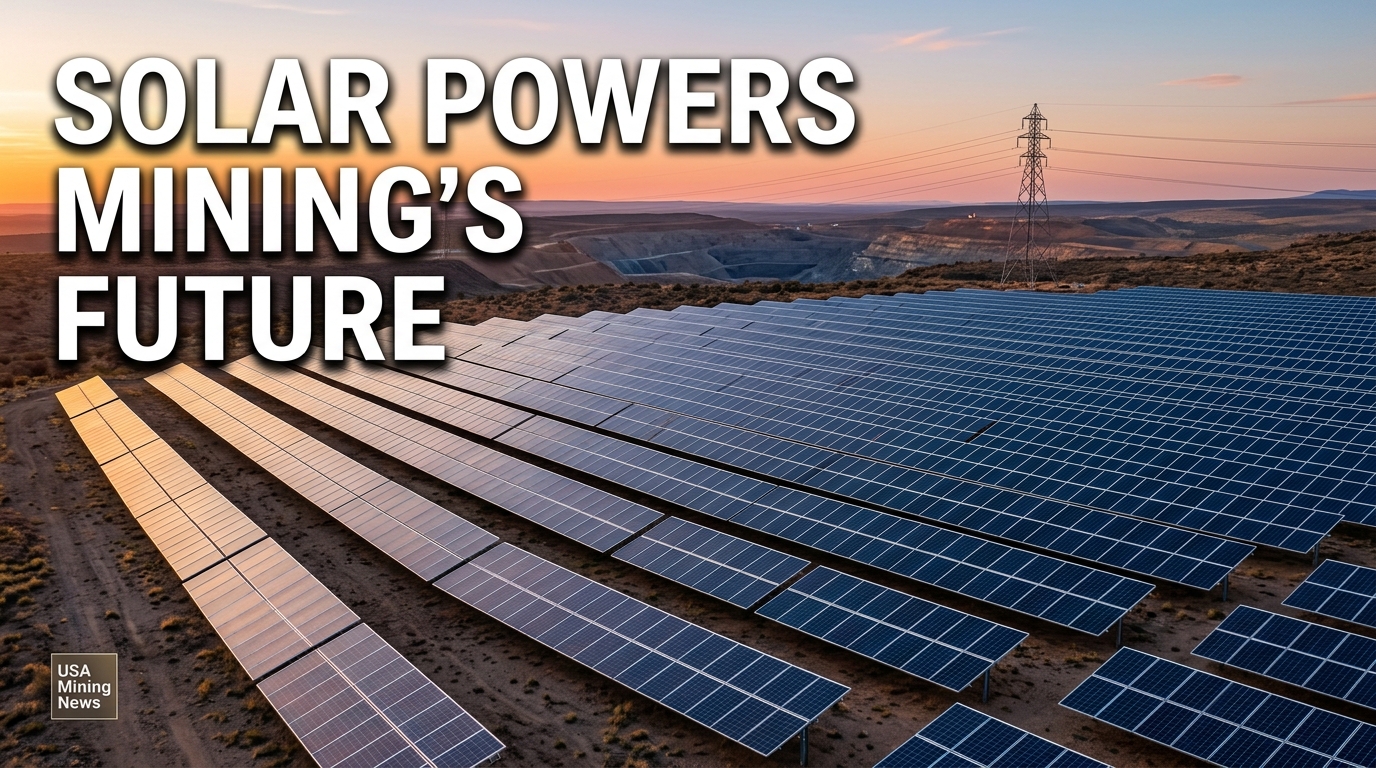
For many remote mining sites, grid connections are either economically prohibitive or physically impossible. In such scenarios, on-site power generation becomes the sole feasible option. Here, GlobalData's analysis reveals a significant trend: while natural gas remains the dominant power source for on-site generation at currently operating mines, solar power is rapidly gaining ground. Solar currently accounts for 11% of operating mines utilizing on-site power generation. Critically, its share skyrockets to an impressive 41% among mines currently in the development phase, unequivocally positioning solar as the dominant renewable source for future operations.
This increasing share of solar energy in new mine developments, often supported by natural gas, illustrates a clear industry shift towards phasing out high-emission fuels like coal, diesel, and heavy fuel oil, as detailed in the Decarbonisation in Mining report.
Leading Operators and Regional Disparities
The pace and composition of renewable energy adoption vary significantly across major mining jurisdictions and among leading operators. Brazil-based Vale has emerged with the most active renewable energy capacity globally. Meanwhile, India’s Coal India is leading the development of future renewable energy projects, planning an impressive 8GW of active and upcoming capacity. Of this, a commanding 7.98GW is designated for solar PV, with the remaining 25MW allocated to onshore wind projects, underscoring solar’s critical role.
- Europe: As of July 2025, solar energy is projected to dwarf natural gas, accounting for 87% of fuel sources at active and upcoming mines, compared to natural gas’ 10%. This regional leadership signifies a strong commitment to solar within European mining.
- North America: In stark contrast, North America exhibits the smallest share of solar for on-site generation at just 4%, with natural gas dominating at 51%. This regional difference highlights varying energy landscapes, policy incentives, and proximity to traditional energy infrastructure.
- South and Central America, Oceania, and Asia-Pacific: These regions primarily rely on natural gas, often alongside coal, for on-site power.
- Middle East and Africa: Solar leads as the primary on-site fuel source, indicating strong irradiance and favorable conditions for solar deployment.
- Former Soviet Union: Solar plays a significant role with a 32% share, though it is currently outpaced by diesel, which accounts for 63% of on-site generation.
The Transitional Role of Natural Gas
Natural gas has frequently been touted as a "transitional fuel" in the broader energy shift due to its comparatively cleaner combustion profile relative to other fossil fuels like coal, diesel, and heavy fuel oil (HFO). It facilitates decarbonization through coal-switching or by providing a less carbon-intensive alternative to HFO and diesel-fired power generation. However, GlobalData's analysis is explicit that natural gas is earmarked for a supportive role in the mining sector's long-term energy strategy. The report emphasizes that "The increasing share of solar energy within mines, supported by natural gas, indicates miners are phasing out high-emission fuels like coal, diesel, and heavy fuel oil in new mine developments." This position underscores natural gas as a bridge, enabling immediate emissions reductions while the capacity for entirely renewable solutions, especially solar, scales up.
Future Outlook and Industry Implications
The insights from GlobalData firmly establish solar power as a critical driver in the mining industry's decarbonization journey. Its immediate availability, declining costs, and ability to underpin true electrification make it an indispensable component of current and future operational strategies. For mining industry professionals and investors, this trend presents significant strategic implications. Companies prioritizing renewable integration are better positioned to meet increasingly stringent environmental, social, and governance (ESG) targets, mitigate carbon taxes, and enhance operational resilience through energy independence.
As the industry moves forward, the early adoption of electrification technologies, such as trolley-assist systems and BEVs, will increasingly be coupled with dedicated renewable energy generation. While hydrogen and carbon capture technologies remain on the horizon, projected to become more viable beyond the next decade, the present and near future of decarbonized mining are undeniably being illuminated by solar. This shift not only promises a more sustainable future for the industry but also unlocks new avenues for innovation, investment, and operational efficiency across the global mining landscape.