Toronto, Ontario – In a significant move poised to reshape the landscape of mineral exploration and development, the province of Ontario is preparing to introduce a comprehensive legislative package designed to substantially reduce regulatory hurdles for early-stage mining projects. This initiative, spearheaded by Energy and Mining Minister Stephen Lecce, marks a strategic shift for Canada’s mining powerhouse, aligning its mineral strategy more explicitly with global defence needs and North American supply chain security.
Speaking in late April, Minister Lecce outlined the Conservative majority government's intent to pass new laws this autumn. This legislative push is designed to expand upon previous efforts to fast-track major projects, which commenced last year, with the overarching goal of bolstering Ontario's position as a critical metals trading partner during the ongoing Canada-United-States-Mexico Agreement (CUSMA) review. The re-evaluation of CUSMA, which began this month, presents a crucial juncture for emphasizing North American mineral independence.
"Our plan is for a large-scale legislative package in the fall that’s going to help really catalyze private investment confidence and reduce the timelines, all of which is in the national interest," Lecce stated, underscoring the urgency driven by geopolitical tensions. "We still face very real threats to our economy and our sovereignty given the ongoing dispute with America."
Ontario's Regulatory Overhaul: Slashing Red Tape for Early-Stage Projects
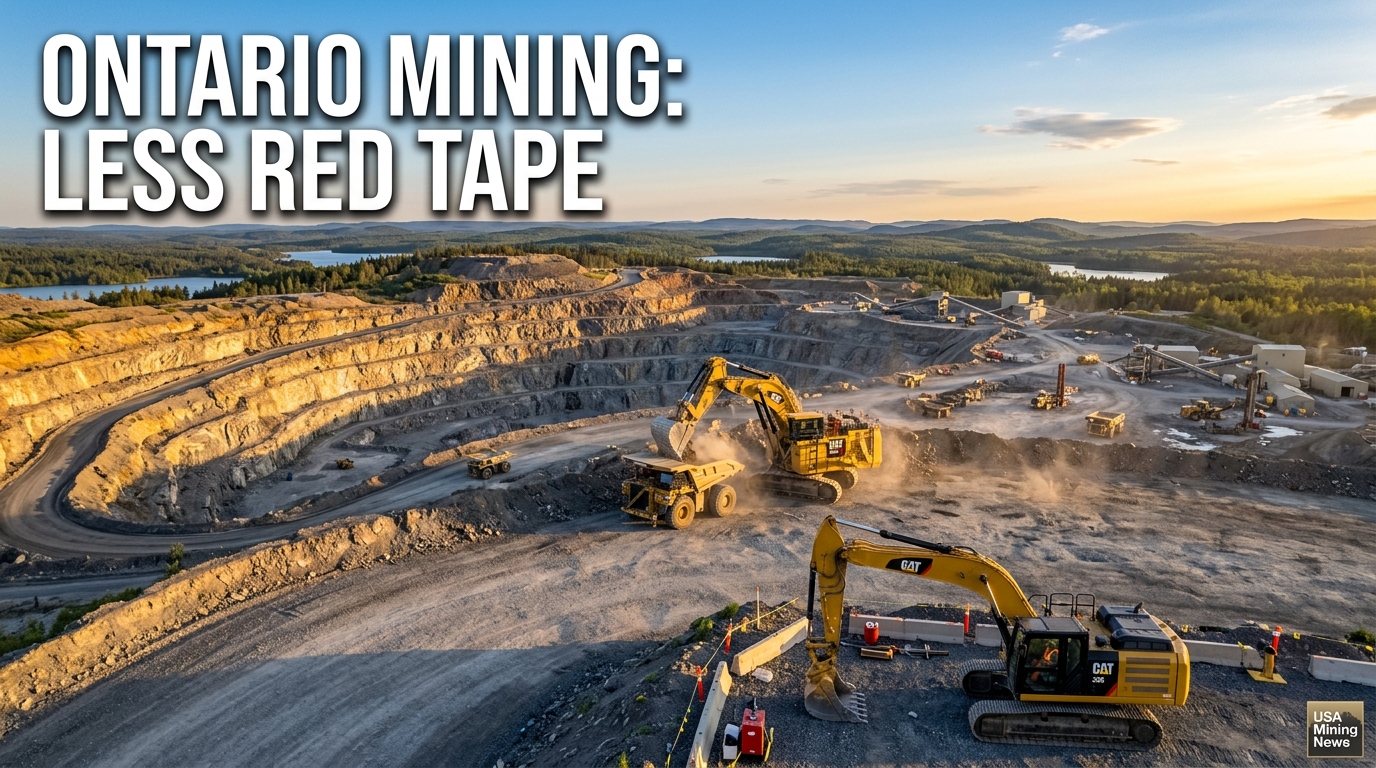
Ontario, consistently recognized as a top-tier mining jurisdiction – ranking second globally to Nevada this year by the Fraser Institute – is now focusing its regulatory reform efforts on the foundational stages of project development. This proposed legislation aims to streamline the complex and often time-consuming permitting processes that can deter early-stage exploration and investment. By targeting "red tape" at this critical juncture, the province seeks to accelerate the pace at which discoveries can advance through the development pipeline to potential production.
The upcoming bill is envisioned as a natural progression from the province's existing "One Project, One Process" program. Launched last year as one of the first of its kind in Canada, this program's core objective is to reduce duplicative provincial and federal permitting requirements. It works by establishing coordinated pathways for advanced developments, facilitating quicker approvals necessary to transition projects into production. Notable beneficiaries of this expedited process include Frontier Lithium’s (TSXV: FL) PAK project, Canada Nickel’s (TSXV: CNC) $2 billion capital expenditure Crawford project, and Kinross Gold’s (TSX: K; NYSE: KGC) Great Bear project. The minister indicated that more projects are expected to be added as they mature, reflecting a clear mandate to move promising mineral assets forward with "unprecedented speed."
The rationale behind this renewed focus is multi-faceted. Shorter permitting timelines translate directly into reduced exploration costs and mitigated financial risks for junior miners and exploration companies. This, in turn, can unlock dormant potential across the province’s vast mineral endowment, fostering a more dynamic and competitive environment for private capital. The reduction of administrative burdens enhances Ontario's appeal to global investors seeking stable and efficient jurisdictions for their mining ventures.
Shifting Strategic Focus: From EVs to Defence Metals
A significant aspect of Ontario’s evolving minerals strategy, announced by the province in March, is a deliberate pivot away from an exclusive focus on critical minerals for electric vehicles (EVs). This recalibration comes in the wake of several high-profile battery plant projects in Ontario encountering delays or restructuring challenges. Honda’s approximately C$15 billion EV and battery complex, for instance, has seen its timeline postponed by about two years, now slated for around 2030. Similarly, the C$5 billion LG Energy Solution NextStar plant in Windsor underwent restructuring after Stellantis temporarily withdrew, and Volkswagen’s PowerCo plant in St. Thomas has progressed more slowly than initially projected.
These market realities have prompted Ontario to broaden its strategic scope, embracing "defence metals" as a new priority. This shift is deeply rooted in geopolitical considerations and the urgent need to build resilient supply chains independent of adversarial nations. Minister Lecce emphasized this new orientation, stating, "We are uniquely positioned to mobilize public and private capital to help finance our defence expansions for our alliance and to build resilient supply chains that are not depending on the likes of Communist China or Russia or other geopolitical adversaries." This strategic recalibration positions Ontario’s mineral wealth not just as an economic asset, but as a critical component of national security for Canada and its allies.
Toronto's Bid for the Defence, Security and Resilience Bank
In alignment with its new defence-centric mineral strategy, Ontario is enthusiastically supporting Toronto's bid to host the NATO Defence, Security and Resilience Bank. This multilateral financial institution, slated to commence operations next year, aims to transform military spending amidst ongoing global conflicts by facilitating defence expansions. Toronto, often vying with Sydney for the title of the world’s top mining finance capital, presents a compelling case based on its unparalleled financial infrastructure and significant defence sector.
Key statistics bolster Toronto's bid: the province of Ontario hosts half of Canada’s manufacturing sector, accounts for 36% of its defence employment, and is home to 900 defence-capable companies. Crucially, as Minister Lecce noted, 40% of the world’s public mining companies are listed on the Toronto Stock Exchange (TSX), and approximately half of the global mining industry’s capital is raised through this exchange. This unique confluence of financial prowess and industrial capacity positions Toronto as an ideal locus for mobilizing both public and private capital to bolster defence capabilities and establish secure, ethical supply chains, thereby reducing reliance on non-allied nations for critical resources.
CUSMA Review and North American Mineral Security
The legislative and strategic shifts in Ontario occur against the backdrop of the ongoing CUSMA review, a critical discussion that commenced this month. The agreement's impact on cross-border trade, particularly in sectors such as steel, aluminum, and automotive manufacturing, is substantial. U.S. Trade Representative Jamieson Greer has indicated that a resolution is unlikely by the initial July 1 deadline, suggesting the need for separate protocols addressing specific issues pertinent to Canada and Mexico. Dominic LeBlanc, Canada's federal Minister Responsible for Canada-US Trade, highlighted in late April that these discussions represent an opportunity for Canada to negotiate lower tariffs on key commodities.
Minister Lecce, who participated in a Canadian delegation to Washington in April, underscored Ontario's priorities within these trade talks: ensuring local processing of critical minerals and collaboratively working to diminish China's pervasive influence over global mineral processing. "Our priority when it comes to minerals is to truly end the ripping and shipping of those resources by processing more at home," he asserted. Ontario, for instance, supplies roughly 50% of the nickel consumed by the United States, making it a prime example of the integrated supply chains that need strengthening and securing.
During his visit to Washington, Lecce met with a national security advisor to the U.S. President on critical minerals, where he emphasized Ontario's value proposition. He detailed the province’s commitment to "unprecedented speed to build mines, faster transmission lines, roads to Ring of Fire, cut permitting timelines by half and take an aggressive – in fact, I used the word hawkish – approach to responsible resource development." This proactive stance, Lecce believes, successfully captured the attention of American officials, highlighting Ontario's determination to be a reliable and secure partner.
Leveraging Mineral Wealth and Ethical Sourcing
A central tenet of Ontario's negotiating strategy is to leverage its extensive mineral wealth as a powerful incentive for CUSMA stability. Minister Lecce conveyed a direct message to American counterparts: "if you want access to our critical minerals and rare earths, for which we have among the largest bounty on earth, then we need to create some stability by getting this CUSMA review completed. One follows the other." This statement underscores a clear link between trade stability and access to Ontario’s ethically sourced resources.
Lecce further elaborated on the compelling attributes of Ontario’s minerals: they are "ethically sourced... low cost, low carbon, democratic and reliable." He made it clear that while Canada prioritizes its alliance with the United States, it is not without alternative trading options, noting, "I did alert them to the fact that the Asia-Pacific and Europe are knocking on our door." This firm but diplomatic approach aims to secure favorable terms within CUSMA, ensuring that Ontario’s resources contribute maximally to its own economy while supporting the broader North American critical minerals strategy.
Future Outlook and Industry Implications
The confluence of these policy initiatives – from comprehensive regulatory reform to a reoriented mineral strategy and assertive trade diplomacy – signifies a robust and dynamic period for Ontario's mining sector. For industry professionals and investors, these developments signal a more predictable and efficient environment for mineral exploration and project development, particularly in early stages that historically face substantial administrative hurdles.
The "One Project, One Process" program, currently benefiting critical projects like Frontier Lithium’s PAK, Canada Nickel’s Crawford, and Kinross Gold’s Great Bear, provides a tangible example of the province's commitment to accelerating project timelines. Industry observers will be closely watching for the autumn legislative package and the subsequent identification of additional projects that will fall under its expedited permitting framework. This proactive stance, coupled with strategic investment in infrastructure such as faster transmission lines and roads to remote regions like the Ring of Fire, demonstrates a holistic approach to fostering mining growth.
Minister Lecce’s message to the global mining community and international partners is unequivocal: "We mean business, we’re open for business, and we’re not going to slow down." This assertive approach, applied equally to both trade negotiations and domestic permitting reforms, positions Ontario as a critical and proactive player in the global quest for secure, sustainable, and ethically sourced mineral supply chains. The province’s dual focus on economic prosperity and geopolitical resilience is set to significantly influence North American mineral security for years to come.