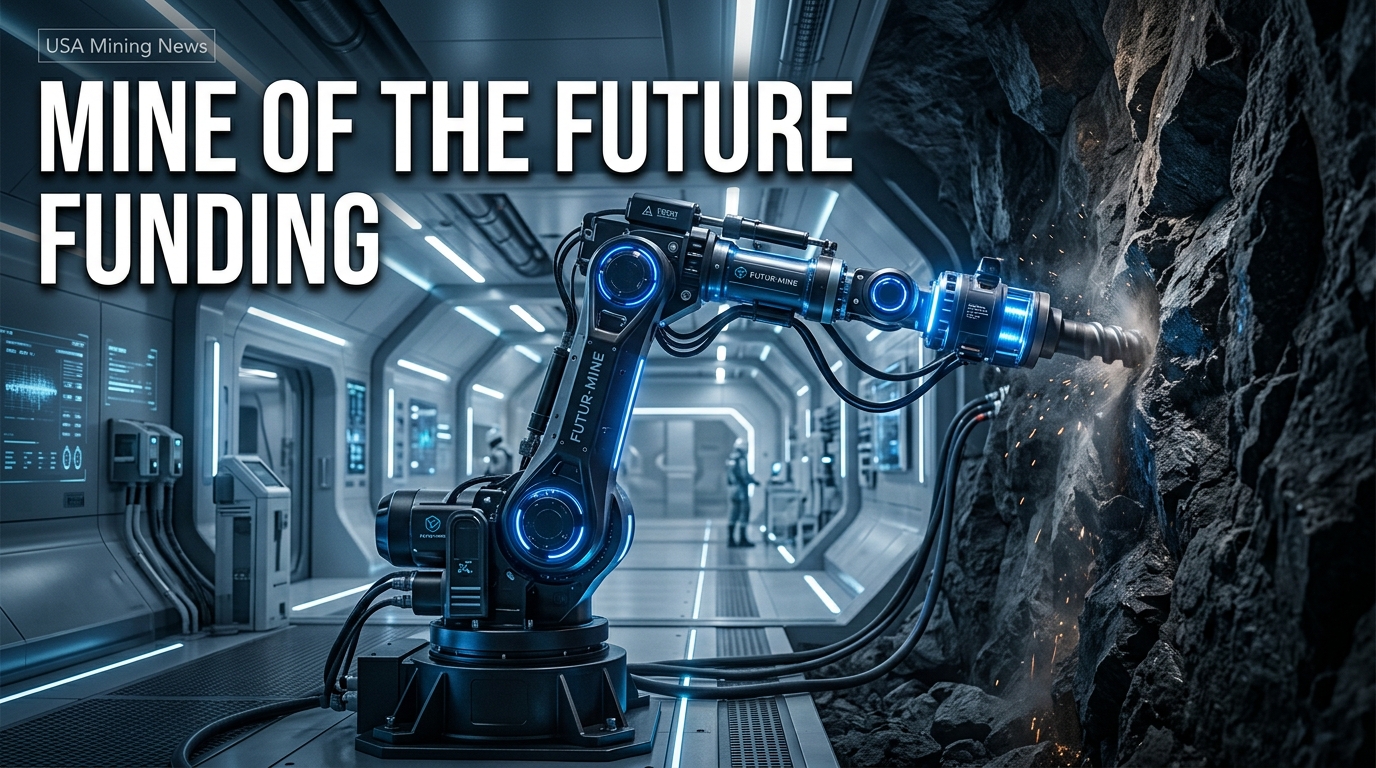
WASHINGTON – In a significant move to fortify America’s domestic critical minerals supply chains and propel the mining sector into a new era of innovation, the U.S. Department of Energy’s (DOE) Office of Critical Minerals and Energy Innovation (CMEI) announced on September 9, 2026, the selection of four groundbreaking projects for $73 million in funding. These awards, granted through the DOE's ambitious Mine of the Future initiative, are designed to establish real-world testing grounds for cutting-edge mining technologies across the nation. This strategic investment is poised to accelerate the commercialization of advanced solutions, significantly upgrade domestic mining capabilities, and reinforce President Trump’s comprehensive mission to secure America's access to vital raw materials.
The imperative behind this initiative extends beyond mere technological advancement; it is deeply rooted in national security and economic resilience. The ability to domestically source and process critical minerals—essential components for everything from advanced electronics and renewable energy technologies to defense systems—is paramount. By funding these innovative testbeds, the DOE aims to transition pioneering research from laboratories into practical, field-scale applications, thereby reducing technical and operational risks associated with their adoption.
The "Mine of the Future" Initiative: A Strategic Imperative
The Mine of the Future initiative represents a proactive federal effort to address the challenges facing the U.S. mining industry, particularly its reliance on foreign sources for many critical minerals. U.S. Secretary of Energy Chris Wright underscored this commitment, stating, "Investing in moving cutting-edge mining technologies out of the lab and into the field will help unleash America’s vast mineral resources." Secretary Wright emphasized the administration’s dedication to revitalizing the American mining industry, explicitly linking these investments to reducing dependence on foreign adversaries and securing the foundational critical minerals for the nation’s energy, manufacturing, and national security objectives.
Assistant Secretary of Energy Audrey Robertson further elaborated on the transformative potential of these investments. "These investments will prove that American innovation can redefine what’s possible in modern mining," Robertson remarked. She highlighted that by establishing world-class testing grounds, the initiative will accelerate breakthroughs that are crucial for strengthening not only America’s supply chains but also its workforce and overall national competitiveness. This sentiment reflects a broader understanding within the industry that sustained technological leadership is key to maintaining a competitive edge in global commodity markets and ensuring long-term resource security.
The Chosen Innovators: Four Pillars of Progress
The DOE’s Advanced Mining and Mineral Processing Technologies Office meticulously selected four projects for award negotiations, each presenting a distinct and complementary approach to developing advanced mining capabilities. These projects span diverse geographical locations and technological focuses, collectively creating a robust national network for innovation and validation.
-
Innovative Wireless Technologies, Inc. (HQ: Lynchburg, Virginia, project locations: Julian, West Virginia, Idaho Springs, Colorado, and Blacksburg, Virginia)
This ambitious project is designed to establish a national testbed dedicated to accelerating the development and deployment of advanced mining technologies. Its core objectives revolve around enhancing safety, boosting productivity, and strengthening supply chain resilience within the mining sector. Unique to this effort is its integrated approach, combining both underground and surface mining environments. This duality will enable the validation of next-generation digital, connectivity, and automation solutions under a comprehensive range of real-world operational conditions. For the industry, this means an accelerated pathway for technologies such as real-time data analytics, autonomous equipment operation, and robust communication systems to move from conceptual stages to proven field applications, addressing critical bottlenecks in efficiency and worker safety.
-
University of Arizona (HQ: Tucson, Arizona, project location: Sahuarita, Arizona)
The University of Arizona’s project focuses on creating a nationally accessible underground testbed specifically tailored to expedite the development and deployment of advanced mining, electrification, and energy management technologies. This scalable proving ground aims to significantly reduce both technical and operational risks inherent in adopting new systems. By fostering innovation in areas like battery-electric vehicles for underground operations and smart energy grids for mines, the project intends to bolster U.S. critical mineral supply chains through tangible improvements in productivity, energy efficiency, and faster commercialization cycles. The industry stands to benefit from validated solutions that not only decrease the carbon footprint of mining but also reduce operational costs associated with traditional diesel equipment and inefficient energy consumption.
-
Curators of the University of Missouri (HQ and project location: Rolla, Missouri)
This project will bring to fruition a multifunctional mining technology proving ground in Rolla, Missouri, by integrating two critical, complementary facilities: one for underground technology testing and another for advanced comminution research. The Curators of the University of Missouri will undertake the design, construction, and equipping of this national resource, which is poised to support a wide spectrum of innovation, real-world validation, and essential workforce development for next-generation mining technologies. Comminution, the process of crushing and grinding ore, is notoriously energy-intensive, often accounting for a significant portion of a mine’s total energy consumption. Advanced comminution research here holds the promise of developing more energy-efficient processes, which directly translates to lower operating costs and a reduced environmental footprint—a significant win for the industry seeking sustainability and competitiveness.
-
Southern Methodist University (HQ: Dallas, TX, project location: Navasota, Texas)
Southern Methodist University’s project is set to create what is described as the world’s first synthetic mine, integrated within an advanced drilling and sensing test facility. Located in Navasota, Texas, this innovative setup will accelerate the transition of next-generation mining technologies from nascent lab concepts to field-ready deployment. By repurposing a highly instrumented Texas drilling site, the facility will provide a unique environment for rigorous, repeatable, and safe testing of new mining tools, workflows, and automation systems. The concept of a "synthetic mine" allows for controlled experimentation with minimal environmental impact and maximum data collection, offering unparalleled opportunities to de-risk advanced drilling techniques, sensor technologies, and fully automated mining processes before their introduction into live operations. This approach is particularly valuable for proving technologies in challenging geological conditions or for hazardous applications.
Transforming Mining Operations: Technical and Operational Impact
The collective impact of these four federally funded projects extends far beyond the individual testbeds. Minerals and mining stakeholders globally face the critical challenge of needing field sites where innovative technologies can be rigorously tested under real-world conditions. These DOE selections directly address this gap. The projects will not only develop state-of-the-art mining proving grounds but also actively support ongoing research and development initiatives. This support is crucial for accelerating the progression of technologies from initial laboratory concepts to comprehensive testing and demonstration in a field-scale setting, a fundamentally essential step required to de-risk commercial adoption for the broader industry.
The technological advancements anticipated from these testbeds are wide-ranging. They include, but are not limited to, improved safety protocols through autonomous systems and remote operation, significant increases in productivity via enhanced digital connectivity and automation, advancements in mine electrification to reduce emissions and operational costs, and optimized energy management strategies. These innovations are expected to create a more efficient, safer, and environmentally responsible domestic mining industry capable of competing globally.
Workforce Development: Preparing for the Next Generation of Mining
A critical, often overlooked, aspect of technological advancement is the human element. The transition to a more automated and digitized mining landscape necessitates a highly skilled workforce. Recognizing this, these projects are explicitly designed to create opportunities for hands-on workforce training. This vital component will equip the next generation of American miners and engineers with the specialized knowledge and practical skills required to proficiently operate, maintain, and innovate within advanced mining systems. By fostering a skilled talent pipeline, the initiative ensures that the U.S. workforce remains competitive and adaptable to the evolving demands of modern mining.
Market and Industry Context: Why This Matters Now
The significance of the DOE’s $73 million investment cannot be overstated in the current geopolitical and economic climate. Critical minerals are not just industrial inputs; they are strategic assets vital for the energy transition, advanced manufacturing, and national defense. The global competition for these resources is intensifying, making domestic supply chain resilience a paramount national priority. By focusing on advanced mining technologies, the U.S. aims to unlock its own vast, yet often challenging, mineral resources more efficiently and sustainably. This initiative signals a clear commitment from the federal government to de-risk investments in new mining technologies for the private sector, encouraging greater capital deployment into domestic projects.
Furthermore, this move aligns with broader efforts to onshore and "friend-shore" supply chains, reducing vulnerabilities to geopolitical disruptions and leveraging American technological prowess. The development of domestic testing grounds provides U.S. companies and researchers with a distinct advantage, fostering an ecosystem where innovation can thrive locally and then be scaled globally. It positions the U.S. not only as a consumer of critical minerals but also as a leader in the methodologies and technologies required to extract them responsibly.
Future Outlook and Broader Implications
Looking ahead, the successful implementation and outputs of these four projects under the Mine of the Future initiative are poised to have a profound and lasting impact on the U.S. mining industry. The establishment of these diverse proving grounds—from underground testbeds for electrification to synthetic mines for automation—will create a comprehensive national infrastructure for mining innovation. This infrastructure will serve as a magnet for further research, private investment, and talent development.
The acceleration of commercialization for advanced mining technologies will lead to more efficient, safer, and environmentally sound mining operations. This, in turn, can help unlock previously uneconomic domestic deposits, increase domestic production of critical minerals, and significantly reduce America's reliance on foreign sources. The long-term vision is a robust, technologically advanced, and self-sufficient U.S. mining industry, capable of meeting the nation's strategic mineral needs while setting new global benchmarks for innovation and sustainability.