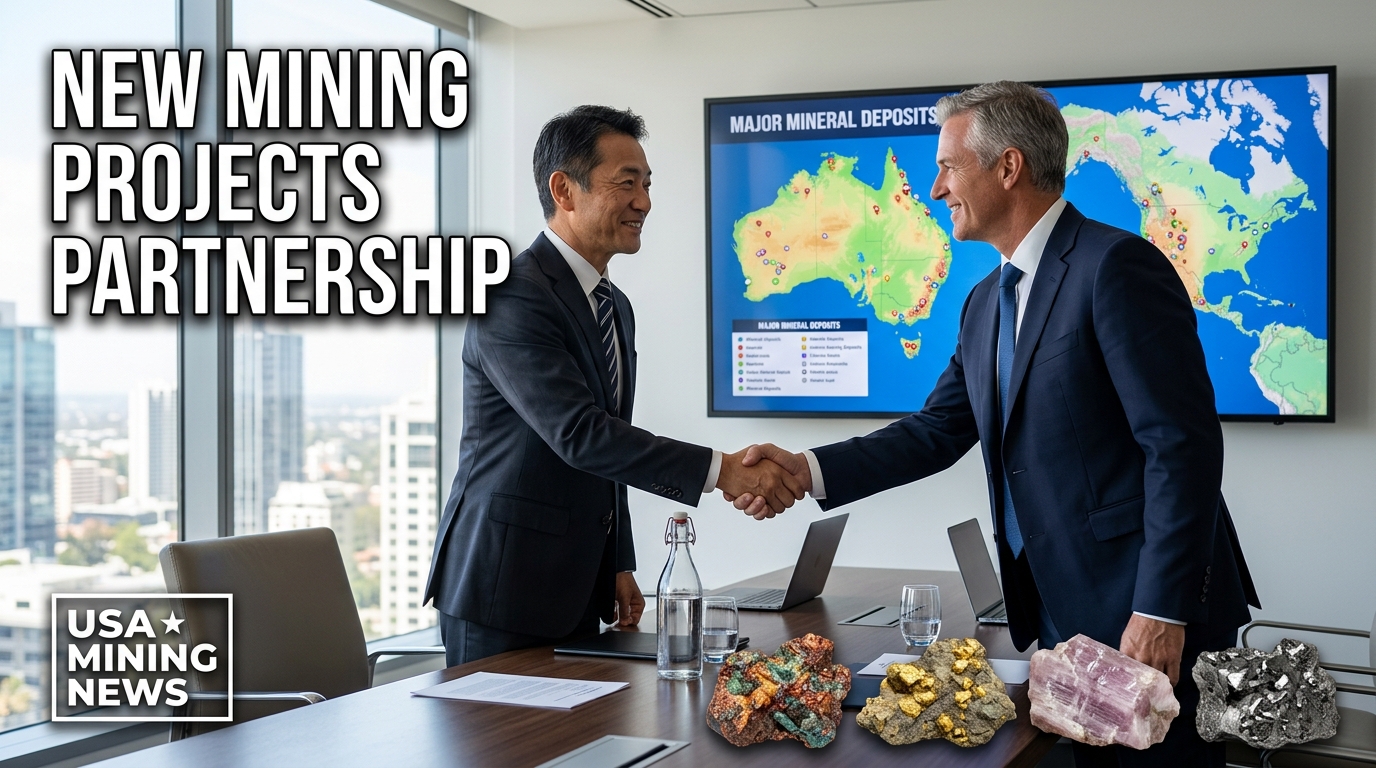
In a significant move that underscores the evolving landscape of global mining partnerships, Eagle Mountain Mining, an emerging explorer and developer, has entered into a non-binding Memorandum of Understanding (MoU) with Japan’s Nittetsu Mining. Signed on July 21, 2026, this strategic agreement formalizes a collaborative framework for the two companies to jointly evaluate and pursue new mineral projects worldwide, primarily focusing on critical and precious metals. The initiative represents a substantial expansion of their existing cooperative relationship, which currently centers on the Oracle Ridge Project in Arizona, US.
Forging a New Path: The Strategic Imperative
The newly established MoU outlines a clear mandate for Eagle Mountain Mining and Nittetsu Mining to proactively identify and assess potential mineral opportunities. This marks a pivotal step for both entities, signaling a proactive approach to growth and diversification in a global commodities market characterized by escalating demand and increasing competition for high-quality assets. The agreement creates a structured pathway for technical, economic, and strategic due diligence on a range of projects, aiming to convert promising assessments into tangible transactions and, ultimately, operational assets.
For Nittetsu Mining, a long-established Japanese conglomerate with a diversified portfolio spanning mining, materials, and machinery, this collaboration aligns with Japan's broader national strategy to secure stable and diversified supplies of crucial raw materials. Faced with geopolitical uncertainties and the accelerating global energy transition, Japanese industries are increasingly looking to forge direct partnerships with reputable mining companies in politically stable jurisdictions to de-risk their supply chains.
Eagle Mountain Mining, on the other hand, stands to benefit immensely from Nittetsu’s extensive experience, technical acumen, and potential access to significant capital, which can be instrumental in derisking and accelerating the development of new projects. Such partnerships are vital for junior explorers and developers seeking to advance their project pipelines beyond initial discovery, mitigating the substantial financial and technical challenges inherent in the mining lifecycle.
A Broad Spectrum of Commodities and Geographical Focus
The scope of commodities targeted by this MoU is strategically aligned with current and projected global demand trends. The agreement specifies a primary focus on the following metals:
- Copper: Essential for electrification, renewable energy infrastructure, and electric vehicles (EVs).
- Gold: A traditional safe-haven asset and store of value, maintaining consistent demand.
- Lead & Zinc: Fundamental industrial metals, critical for batteries (lead-acid) and galvanizing (zinc), respectively.
- Lithium & Nickel: Cornerstones of the rapidly expanding EV battery market and energy storage solutions.
- Silver: Used in industrial applications, particularly in photovoltaics, and as a precious metal.
The MoU also includes provisions for considering "other commodities" on a case-by-case basis, providing flexibility to adapt to future market shifts or emerging strategic opportunities. This comprehensive list reflects a dual strategy: capitalizing on the booming demand for critical minerals vital for the energy transition while also maintaining exposure to perennial precious and base metals.
Geographically, the primary targets for assessment are Australia and North America. These regions are highly attractive to global mining investors due to their:
- Strong regulatory frameworks and established legal systems.
- Mature mining sectors with extensive infrastructure and skilled labor.
- Significant geological prospectivity for a wide array of mineral deposits.
The agreement cleverly leaves room for "other jurisdictions to be considered on a case-by-case basis," ensuring that promising opportunities outside these core regions are not overlooked. This balanced approach to commodity and geographical focus positions the collaboration for robust and diversified growth.
Furthermore, the range of projects considered will span the entire mining lifecycle, from "early exploration" to "advanced exploration, pre-development, and production stages." This comprehensive scope allows the partnership to pursue opportunities that align with different risk profiles and investment horizons:
- Early and Advanced Exploration: Offers the potential for significant value creation through major discoveries, albeit with higher inherent risk.
- Pre-development: Projects with defined resources moving towards feasibility studies, representing a critical de-risking phase.
- Production Assets: Existing operations providing immediate cash flow and potentially a foundation for further expansion, offering lower risk but typically higher acquisition costs.
By considering all stages, Eagle Mountain and Nittetsu can build a balanced portfolio that includes both high-growth potential and stable revenue-generating assets.
Building on a Proven Partnership: The Oracle Ridge Catalyst
The foundation for this expanded collaboration is the partners' successful working relationship at the Oracle Ridge Project in Arizona, US. This existing partnership has evidently fostered a strong degree of trust and mutual respect between the two companies. The continuity of engagement is further highlighted by the recent visit of Eagle Mountain Mining executive director Fabio Vergara to Tokyo, where he met with Nittetsu’s management and toured the company’s advanced research and development center. During this visit, arrangements were made for metallurgical samples from Oracle Ridge to be analyzed at Nittetsu’s facility, demonstrating a deep technical collaboration beyond merely financial involvement.
This pre-existing rapport and operational synergy significantly enhance the prospects for the new MoU. It signifies that the companies are not merely seeking a transactional alliance but are expanding a proven, trust-based partnership that has already demonstrated its efficacy in a challenging operational environment.
Operational Framework and Non-Binding Principles
As a non-binding Memorandum of Understanding, the agreement is primarily a foundational document setting out the terms of engagement for project assessment. It does not impose any binding obligations for either entity to pursue any resulting transactions, except for certain non-circumvention clauses. This structure is typical for preliminary agreements of this nature, allowing both parties to conduct thorough due diligence without being immediately committed to a specific investment or acquisition.
The MoU is effective for an initial period of 24 months, with provisions for extension or earlier termination by mutual consent. This two-year window provides ample time for both companies to identify, evaluate, and potentially advance several opportunities. Crucially, the arrangement is non-exclusive, meaning each company retains the autonomy to independently consider or enter into similar agreements with other parties. This non-exclusive clause offers flexibility and ensures that individual growth strategies are not unduly constrained while the joint assessment process unfolds.
Executive Vision: Achieving Better Outcomes Through Collaboration
The strategic intent behind this MoU was clearly articulated by both parties. Shinichiro Mita, Nittetsu overseas mineral resources business general manager, and Fabio Vergara, Eagle Mountain Mining executive director, issued a joint statement underscoring their shared vision:
"Nittetsu and Eagle Mountain are keen to grow their partnership beyond Oracle Ridge. This agreement is testament to the quality of the people involved, the trust we have in each other and the understanding that by acting collaboratively we can achieve better outcomes in this competitive environment. We are looking forward to working together with our respective teams to identify, review and acquire new projects capable of adding value to both our companies."
This statement encapsulates several key themes:
- Commitment to Growth: A shared desire to expand beyond current projects and scale operations.
- Value of Human Capital and Trust: Recognition that strong relationships are as vital as technical expertise.
- Synergy in a Competitive Market: Acknowledgment that combining strengths through collaboration can yield superior results compared to individual efforts, especially in a fiercely competitive global mining sector where capital, expertise, and access to quality assets are increasingly scarce.
- Mutual Value Creation: The explicit goal of identifying projects that will deliver tangible benefits and contribute to the long-term success of both Eagle Mountain Mining and Nittetsu Mining.
These principles lay a strong cultural foundation for the partnership, suggesting a long-term strategic alignment rather than merely a transactional engagement.
Industry Implications and Future Outlook
The collaboration between Eagle Mountain Mining and Nittetsu Mining serves as a compelling example of a growing trend within the global mining industry: the formation of strategic alliances to de-risk exploration and development, secure critical mineral supplies, and accelerate growth. For integrated resource-dependent nations like Japan, such partnerships are crucial to ensuring raw material security for their advanced manufacturing and technology sectors.
For Eagle Mountain Mining, this MoU could significantly expand its project pipeline and provide access to the extensive due diligence capabilities, technical expertise, and potential funding of Nittetsu Mining. This could enable Eagle Mountain to consider larger and more complex projects than it might undertake independently. For Nittetsu Mining, it offers an opportunity to leverage Eagle Mountain’s on-the-ground exploration capabilities and regional expertise in key jurisdictions like Australia and North America, diversifying its asset base and strengthening its global footprint.
Over the next 24 months, the industry will keenly observe how many, if any, of the identified projects mature into more definitive agreements or joint ventures. Success in this initial phase could lead to extensions of the MoU or even broader strategic partnerships. Such collaborative models are instrumental in addressing the capital intensiveness of mining and the increasing demand for a secure, ethical, and sustainable supply of metals vital for global development and the transition to a greener economy.