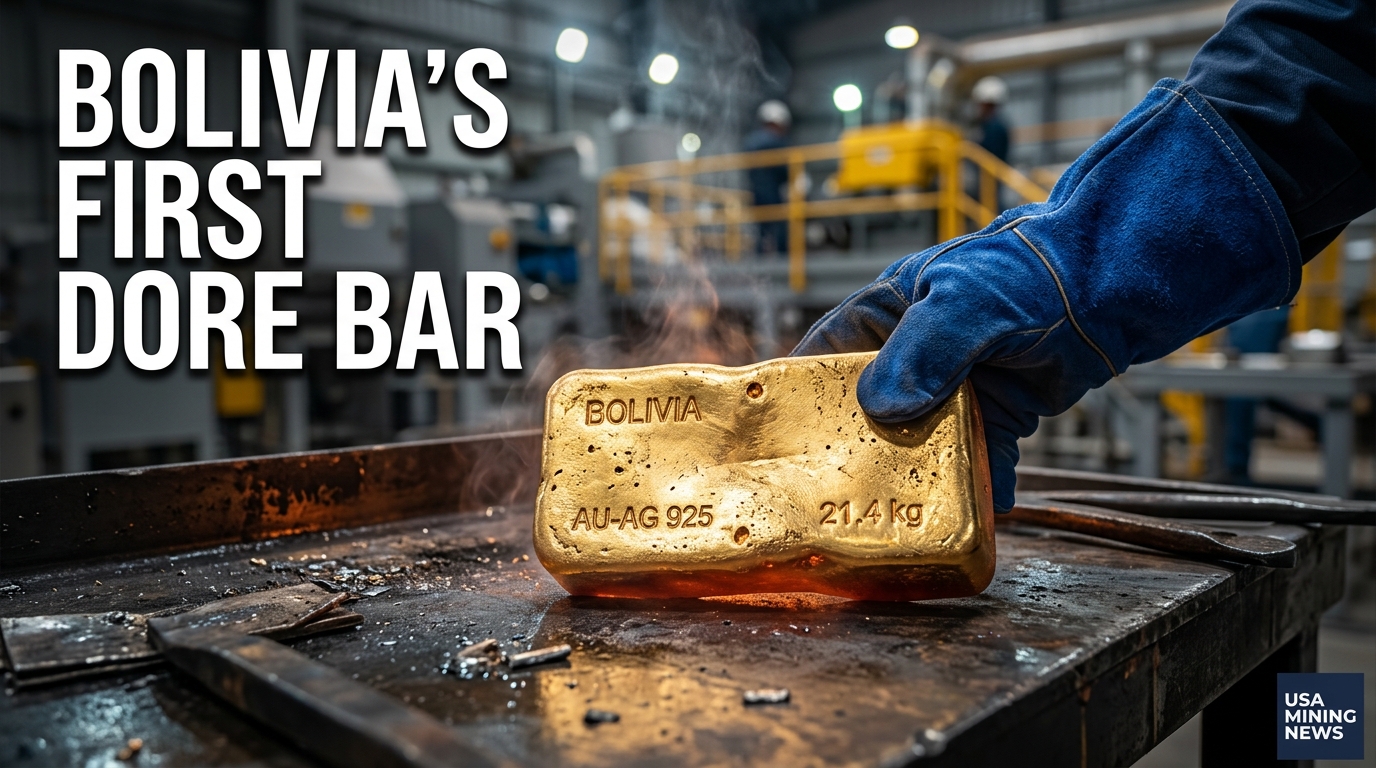
La Paz, Bolivia – September 9, 2026 – In a significant development for the South American mining landscape, Empresa Minera Paitití (EMIPA), the Bolivian subsidiary of Canada-based Orvana Minerals Corp., has successfully produced its inaugural gold-silver doré bar from the Don Mario site. This milestone signals a strategic and operational pivot for the Don Mario operation, marking its return to production through the processing of oxide stockpiles, following a suspension of mining and milling activities in the first quarter of fiscal year 2020 (Q1 FY20).
The successful pour, attributed to the diligent efforts of the Don Mario plant team, underscores Orvana’s commitment to optimizing its existing assets and extracting value from previously accumulated materials. This approach is increasingly prevalent within the mining industry as companies seek to extend the life of operations and enhance resource recovery from sites where primary ore bodies have been exhausted.
A Return to Production: Don Mario's Oxide Project
The Don Mario mine, owned and operated by EMIPA, holds a notable history within Bolivia’s mineral sector. However, conventional mining and milling operations at the site were halted in Q1 FY20, a decision necessitated by the depletion of accessible mineral reserves. This presented a common challenge in the lifecycle of many mines globally, where the economic viability of extracting further primary ore diminishes.
Following this suspension, Orvana Minerals adopted a strategic shift, redirecting its efforts towards processing the substantial volume of oxide materials that had been stockpiled from earlier stages of mining at the Don Mario site. These stockpiles, often considered lower priority during initial operations focused on high-grade primary ores, represent a valuable, pre-mined resource that can be economically processed with adjusted metallurgical approaches and upgraded plant capabilities. The decision to leverage these existing stockpiles not only extends the productive life of the Don Mario asset but also demonstrates an efficient use of previously incurred mining efforts and infrastructure.
The successful production of the first gold-silver doré bar from these oxide materials validates Orvana's strategic decision and the technical acumen applied to the project. It provides a blueprint for other mining companies facing similar challenges of reserve depletion at mature sites.
Technical and Operational Details of the Expansion
The current project at Don Mario extends beyond simply processing existing oxide stockpiles for gold and silver. It encompasses a broader strategy for enhancing the site's overall production capabilities and metallurgical efficiency. Key components of this revitalized operation include:
- Expansion of Copper Cathode Production: The project incorporates plans to significantly expand the facility’s capacity for producing copper cathodes. This move diversifies Don Mario’s product portfolio, adding a crucial industrial metal to its output alongside precious metals.
- Upgrade to Gold-Silver Recovery Circuit: Central to the success of processing the oxide stockpiles is a comprehensive upgrade to the gold-silver recovery circuit within the Don Mario processing plant. These enhancements are critical to efficiently extract precious metals from the lower-grade, oxidized material, which often requires different processing methodologies compared to fresh sulfide ores.
Orvana CEO, Juan Gavidia, emphasized the technical validation of these efforts, stating, "The first doré bar from EMIPA’s oxides confirms that the metallurgical performance of the expanded Don Mario Plant is in line with design and engineering assumptions. We remain focused on safely increasing throughput and optimising plant performance as operations ramp up." This statement underscores confidence in the engineering design and the metallurgical team's execution, which are crucial factors in the successful re-commissioning of complex processing facilities.
EMIPA has outlined its immediate operational priorities, which include centering efforts on a gradual increase of processing throughput. This phased ramp-up is standard practice in mining operations to allow for systematic testing, identification, and resolution of any operational bottlenecks, ensuring a stable and efficient production flow. Concurrently, the company is focused on the optimization of metallurgical performance at the expanded facility. This involves fine-tuning process parameters to maximize recovery rates for both gold-silver doré and copper cathodes while maintaining strict cost controls across all operational facets.
The company's ultimate objective is to advance towards full commercial production for both gold-silver doré and copper cathodes. The attainment of future production levels, particularly throughout fiscal year 2026 (FY26), will be critically dependent on the successful execution of these ramp-up activities, consistent plant performance, and the stabilization of all processing circuits. These factors are closely monitored by investors and industry analysts as indicators of a project’s long-term viability and profitability.
Strategic Context: Orvana Minerals' Portfolio
Orvana Minerals Corp. is not solely defined by its Don Mario operations. The company maintains a diversified portfolio of assets across key mining jurisdictions, extracting a combination of gold, copper, and silver. Its primary operating assets include:
- Orovalle Mine, Northern Spain: This operating asset forms a significant part of Orvana's production base, contributing to its gold, copper, and silver output.
- Taguas Property, Argentina: Located in the resource-rich San Juan Province, the Taguas project represents a significant growth opportunity for Orvana. The company demonstrated its commitment to expanding this asset in June 2026, when it successfully expanded its land holdings at the Taguas Project. This expansion was achieved through the acquisition of the Evelina claims from a subsidiary of Pan American Silver, a transaction valued at $1.2 million (C$1.7 million). This acquisition strategically enhances Orvana's footprint and potential resource base in Argentina, signaling a proactive growth strategy.
The re-establishment of operations at Don Mario, alongside ongoing production at Orovalle and strategic expansions at Taguas, reflects a cohesive corporate strategy aimed at leveraging existing infrastructure, optimizing resource utilization, and expanding its mineral asset base. This multi-pronged approach helps to mitigate risks associated with reliance on a single asset and provides a more robust foundation for long-term growth in fluctuating commodity markets.
Market Implications and Industry Relevance
The successful restart and expansion at Don Mario carries significant implications for Orvana Minerals and offers valuable insights for the broader mining industry. For Orvana, it represents a pivotal step in enhancing its overall production profile, particularly in gold, silver, and copper. These commodities are foundational to the global economy:
- Gold: Continues to serve as a safe-haven asset, an investment vehicle, and a vital component in jewelry and electronics.
- Silver: Possesses dual characteristics as a precious metal and an essential industrial commodity, increasingly critical in solar panels, electronics, and electric vehicles.
- Copper: Often seen as an economic bellwether, copper demand is projected to surge with global electrification efforts, renewable energy infrastructure, and general industrial growth.
By restarting and diversifying output at Don Mario, Orvana positions itself to capitalize on the robust demand for these metals. The project also highlights a growing trend within the mining sector: the strategic importance of extending mine life through the processing of marginal resources like oxide stockpiles. As new high-grade discoveries become rarer and more challenging to develop, companies are increasingly looking inwards, focusing on technological advancements and process optimization to unlock value from existing operations and waste materials. This approach reduces capital expenditure associated with greenfield projects and often comes with a shorter development timeline.
Furthermore, the successful execution of such a project in Bolivia underscores the continued viability and attractiveness of mining investment within the country's resource-rich landscape. It demonstrates that with the right strategic approach and technological investment, even previously suspended operations can contribute meaningfully to national mineral output and provide economic benefits.
Future Outlook and Next Steps
The immediate future for EMIPA and the Don Mario project centers on the successful and sustained ramp-up to full commercial production. The company's focus on gradually increasing throughput and optimizing metallurgical performance will be critical in achieving stable and profitable operations. The transition from initial doré pour to consistent, commercial-scale output for both gold-silver doré and copper cathodes will be a closely watched phase.
Longer-term, the success at Don Mario could potentially pave the way for further exploration or strategic initiatives within the vicinity, should additional economic resources be identified. The expertise gained in processing oxide materials may also be transferable to other projects or opportunities within Orvana's portfolio or even for the broader industry. The re-establishment of a productive mine asset, especially one with a diversified product offering like Don Mario, enhances Orvana’s overall corporate valuation and provides increased operational flexibility.
Investors and industry stakeholders will keenly monitor Orvana’s progress at Don Mario, particularly its ability to meet production targets for FY26, stabilize its new processing circuits, and maintain strong cost controls. This project serves as a testament to the mining industry's adaptive nature, showcasing how innovation and strategic re-evaluation can unlock renewed value from mature assets and contribute significantly to a company's growth trajectory.