Fortescue Forges Green Future with First Hot Metal Production at Christmas Creek
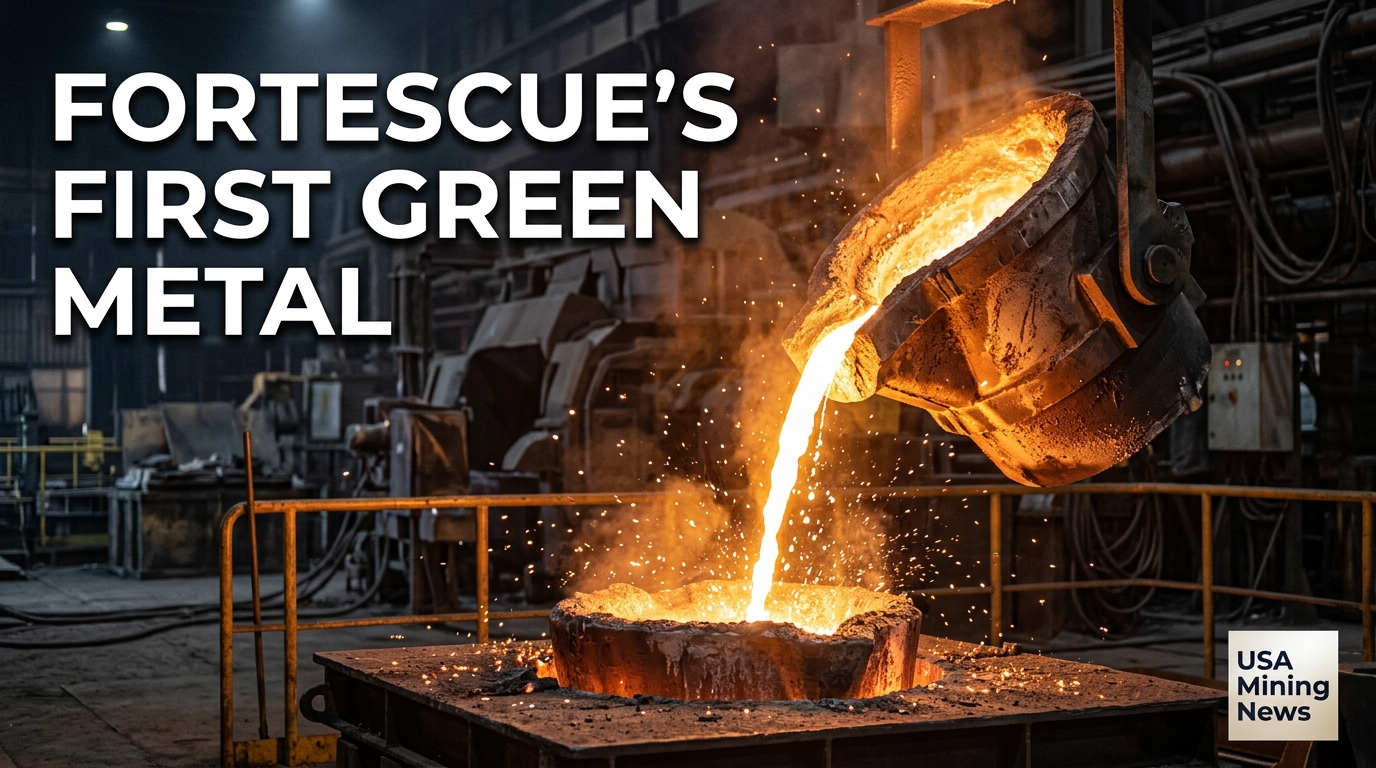
PERTH, Western Australia – August 19, 2026 – Fortescue, a global leader in iron ore production, today announced a pivotal achievement in its ambitious decarbonisation strategy: the successful production of inaugural hot metal at its Green Metal Project in Christmas Creek, Western Australia. This significant milestone, achieved through the initial operation of an electric smelting furnace, marks a tangible step towards developing lower-emission iron-making technologies from Pilbara ore and establishing a commercial-scale green metal industry in Australia.
The pilot facility, located on Nyiyaparli Country in the Chichester Ranges, successfully generated molten metal as part of its staged commissioning process. This early production phase leveraged a blended feedstock, allowing for crucial testing and optimisation of the electric smelting unit before scaling up to larger production volumes. The Christmas Creek site has been a cornerstone of Fortescue’s iron ore operations since ore production commenced there in 2009, making it a strategic location for trialling these transformative industrial processes in a real-world setting.
Pioneering Lower-Emission Iron-Making
The Green Metal Project is designed specifically to test new technologies and explore innovative methods for producing green metal. At its core, this initiative represents a fundamental shift away from conventional iron production, which has historically relied heavily on coal. Traditional blast furnaces use coking coal to extract oxygen from iron ore, a process that accounts for approximately 8% of global emissions in steel production. By developing and deploying electric smelting technology, Fortescue aims to significantly reduce this carbon footprint, aligning with global efforts to decarbonise heavy industries.
Fortescue CEO Dino Otranto articulated the strategic importance of this development, stating, "This is a significant milestone for our Green Metal Project and another step towards producing commercial-scale green metal in Australia." He further emphasised Australia's unique competitive advantage: "For decades Australia has exported iron ore to the world. The next opportunity is to create more value from that ore by producing green metal here at home. Australia has some of the world’s best renewable energy resources and one of the world’s largest iron ore industries. That is a competitive advantage we should be building on. If we don’t, other renewable-rich countries will." Otranto’s remarks underscore the company’s vision to transition Australia from a raw material exporter to a producer of high-value, low-carbon industrial products, capitalising on its abundant natural resources.
Technical and Operational Strategy
The commissioning process at Christmas Creek has been carefully orchestrated to ensure robust testing and gradual ramp-up. Utilising a blended feedstock during the initial production phases allows engineers to fine-tune the operational parameters of the electric smelting furnace and gather critical data on its performance with various ore compositions. This systematic approach is standard practice in pilot projects of this scale, ensuring that any challenges are identified and addressed before the technology is scaled for commercial application.
The electric smelting furnace itself represents a significant technological leap. Unlike blast furnaces, which rely on the chemical reactions of coal combustion, electric furnaces can utilise clean electricity, ideally from renewable sources, to generate the heat required for reduction. This method, when powered by renewable energy, promises a pathway to virtually carbon-free iron production, a cornerstone of green steel manufacturing. The project's success at Christmas Creek provides invaluable insights into the technical feasibility and economic viability of such a process using Pilbara iron ore, known for its high quality and vast quantities.
Strategic Investments in Green Energy Infrastructure
Fortescue’s commitment to green metal production is not an isolated endeavour. It is part of a broader, integrated strategy that includes substantial investments in renewable energy infrastructure. In April 2026, the company announced a significant investment of $680 million (A$952.44 million) to expand green energy infrastructure across the Pilbara region. This investment is crucial, as the successful operation of electric smelting furnaces and other lower-emission technologies is contingent upon a reliable and cost-effective supply of renewable electricity.
The expansion of green energy infrastructure will support not only the Green Metal Project but also other decarbonisation initiatives across Fortescue’s vast operations. This includes projects aimed at producing green hydrogen and green ammonia, which can serve as alternative reductants and fuels in steelmaking and other industrial processes, further reducing reliance on fossil fuels. The synergy between green energy generation and green metal production forms the bedrock of Fortescue’s long-term vision to achieve net-zero emissions.
Broader Industry Implications and Market Context
This achievement at Christmas Creek holds profound implications for the global mining and steel industries. As steel production is one of the largest industrial emitters of greenhouse gases, the successful piloting of green metal production offers a tangible pathway for decarbonisation. It signals to the market that alternative, cleaner methods of iron-making are not only conceptual but increasingly operational.
For Australia, this project reinforces its position as a potential global leader in the emerging green steel economy. By moving beyond merely exporting raw iron ore, Australia can add significant value domestically, creating new industries, jobs, and export opportunities for green commodities. This strategic shift could fundamentally alter global supply chains for steel, with increasing demand from manufacturers and consumers for sustainably produced materials.
The development also puts pressure on other major mining companies and steelmakers worldwide to accelerate their own decarbonisation efforts. Fortescue’s progress demonstrates that with strategic investment and technological innovation, the transition to green metal production is achievable, even for processes traditionally deemed hard-to-abate. This could spur further investment in research and development for various green steel pathways, including hydrogen-based direct reduced iron (DRI) and electric arc furnace (EAF) operations powered by renewables.
The Path Forward: Scaling and Commercialisation
While the production of first hot metal is a significant triumph, Fortescue’s Green Metal Project remains in its pilot phase. The immediate next steps involve continued testing, optimisation, and refinement of the electric smelting process. Engineers will meticulously analyse data from the initial operations, assessing energy efficiency, material inputs, product quality, and overall operational stability. This iterative process is vital for de-risking the technology before it can be scaled up to commercial volumes.
The ultimate goal, as articulated by CEO Dino Otranto, is to produce commercial-scale green metal in Australia. Achieving this will require not only the successful technical scale-up of the smelting process but also the establishment of a robust, cost-competitive supply chain for renewable energy. The $680 million investment in Pilbara green energy infrastructure is a clear indicator of Fortescue's commitment to building this essential ecosystem.
The success of projects like Fortescue’s Green Metal Project will be critical in demonstrating the economic viability and environmental imperative of decarbonising the steel value chain. As global demand for sustainably produced goods grows, companies capable of delivering green metal will gain a significant competitive advantage. Fortescue’s pioneering efforts at Christmas Creek are laying the groundwork for a cleaner, more sustainable future for the mining and metallurgical industries, positioning Australia at the forefront of this global transformation.