The Genesis of a New Era: DOE Unleashes AI Challenges to Revolutionize American Innovation and Mining
WASHINGTON D.C. – On February 12, 2026, the U.S. Department of Energy (DOE) unveiled a groundbreaking initiative: 26 science and technology challenges designed to propel the nation's innovation engine forward through the strategic application of artificial intelligence (AI). This announcement marks a significant milestone for the DOE's Genesis Mission, an overarching program explicitly created to accelerate discovery and bolster American leadership across critical sectors including energy, national security, and scientific research. For the global mining sector, these developments signal a pivotal shift in technological capabilities that will undoubtedly impact everything from subsurface exploration to advanced materials development and grid stability.
Catalyst for Discovery: Unpacking the Genesis Mission's Objectives
The Genesis Mission, launched under President Trump’s Executive Orders "Launching The Genesis Mission" and "Removing Barriers to American Leadership In Artificial Intelligence," is a federal directive aimed at leveraging the nation's unparalleled data resources, cutting-edge AI platforms, and world-class experimental facilities. Its core ambition is to double the productivity and impact of U.S. research and development within a decade, positioning the United States at the forefront of global technological innovation.
Dr. Darío Gil, DOE Under Secretary for Science and Genesis Mission Lead, articulated the profound implications of this strategic direction. "These challenges represent a bold step toward a future where science moves at the speed of imagination because of AI. It’s a game-changer for science, energy, and national security," Dr. Gil stated. He emphasized that by uniting the U.S. Government’s vast data resources and the DOE’s experimental facilities with advanced AI, the nation could "unlock discoveries that will power the economy, secure our energy future, and keep America at the forefront of global innovation."
Echoing this sentiment, Michael Kratsios, Assistant to the President and Director of The White House Office of Science and Technology Policy, highlighted the broader national imperative. "President Trump’s Genesis Mission is mobilizing America’s unmatched scientific infrastructure and AI ingenuity to double the pace of discovery. These 26 challenges are a direct call to action to America’s researchers and innovators to join the Genesis Mission and deliver science and technology breakthroughs that will benefit the American people." The mission anticipates expanding this list of challenges across federal agencies to maximize its national impact.
AI's Role in Reshaping the Mining and Energy Landscape
While the 26 challenges span a wide array of scientific and national security domains, several hold profound and direct implications for the mining industry. The application of AI within these areas promises not only to optimize current operations but also to unlock entirely new avenues for resource development and technological advancement.
Unleashing Subsurface Strategic Energy Assets: A Game-Changer for Exploration
Perhaps the most directly relevant challenge for the mining sector is "Unleashing Subsurface Strategic Energy Assets." This initiative focuses on applying AI to model underground environments for responsible, cost-effective energy development. For mining professionals, this translates into unprecedented opportunities in:
- Enhanced Exploration Efficiency: AI algorithms can analyze vast datasets from geophysical surveys, geological maps, and historical drilling records to identify potential new mineral deposits with greater accuracy and speed. This could significantly reduce the costs and environmental footprint associated with conventional exploration methods.
- Optimized Mine Design and Operations: Detailed AI-driven subsurface models can inform more precise mine planning, identifying optimal orebody boundaries, predicting geological hazards, and designing safer, more efficient extraction sequences.
- Resource Characterization: AI can improve the characterization of existing ore bodies, leading to better-informed decisions on processing strategies and maximizing resource recovery from complex deposits.
- Geotechnical Risk Mitigation: Predictive modeling can enhance understanding of ground stability, crucial for underground and open-pit mining operations, thereby improving safety and reducing operational risks.
Designing Materials with Predictable Functionality & Autonomous Laboratories
Two challenges, "Designing Materials with Predictable Functionality" and "Achieving AI-Driven Autonomous Laboratories," promise to revolutionize the development of critical materials and industrial processes. The former seeks to use AI to design materials based on performance goals, shrinking development timelines from decades to mere months. The latter aims to automate experiments to speed the discovery of new drugs, advanced materials, and next-generation energy technologies.
For mining, this advancement has several critical ramifications:
- Advanced Mining Equipment: AI-designed materials can lead to the development of more durable, lightweight, and corrosion-resistant components for heavy machinery, drill bits, and processing plant infrastructure. This directly translates to reduced downtime, lower maintenance costs, and improved operational longevity in harsh mining environments.
- Next-Generation Processing Solutions: Innovations in materials science, accelerated by AI, could yield new reagents for mineral processing, more efficient separation technologies, and novel methods for extracting critical minerals from low-grade ores or tailings.
- Rapid Prototyping and Testing: Autonomous laboratories can expedite metallurgical testing, process optimization, and environmental impact studies related to new mining projects or operational changes, significantly cutting down on R&D cycles.
Scaling the Grid to Power the American Economy
The challenge "Scaling the Grid to Power the American Economy" aims to use AI to improve power grid planning, interconnection, operations, and security. The stated goal is to enable decisions up to 20–100 times faster and improve electricity cost and reliability by up to 10 percent. For an energy-intensive industry like mining, these advancements are critical:
- Cost Reduction: A more efficient and reliable national grid directly translates to more stable and potentially lower electricity costs for mining operations, which are often significant energy consumers.
- Reliability for Remote Operations: Many mines are located in remote areas, often reliant on complex grid connections or off-grid solutions. Improved grid stability and faster decision-making can enhance the reliability of power supply, critical for continuous operations.
- Integration of Renewables: As mines increasingly look to integrate renewable energy sources, an AI-optimized grid with faster interconnection capabilities will facilitate this transition, supporting decarbonization efforts and energy independence.
Reenvisioning Advanced Manufacturing and Microelectronics
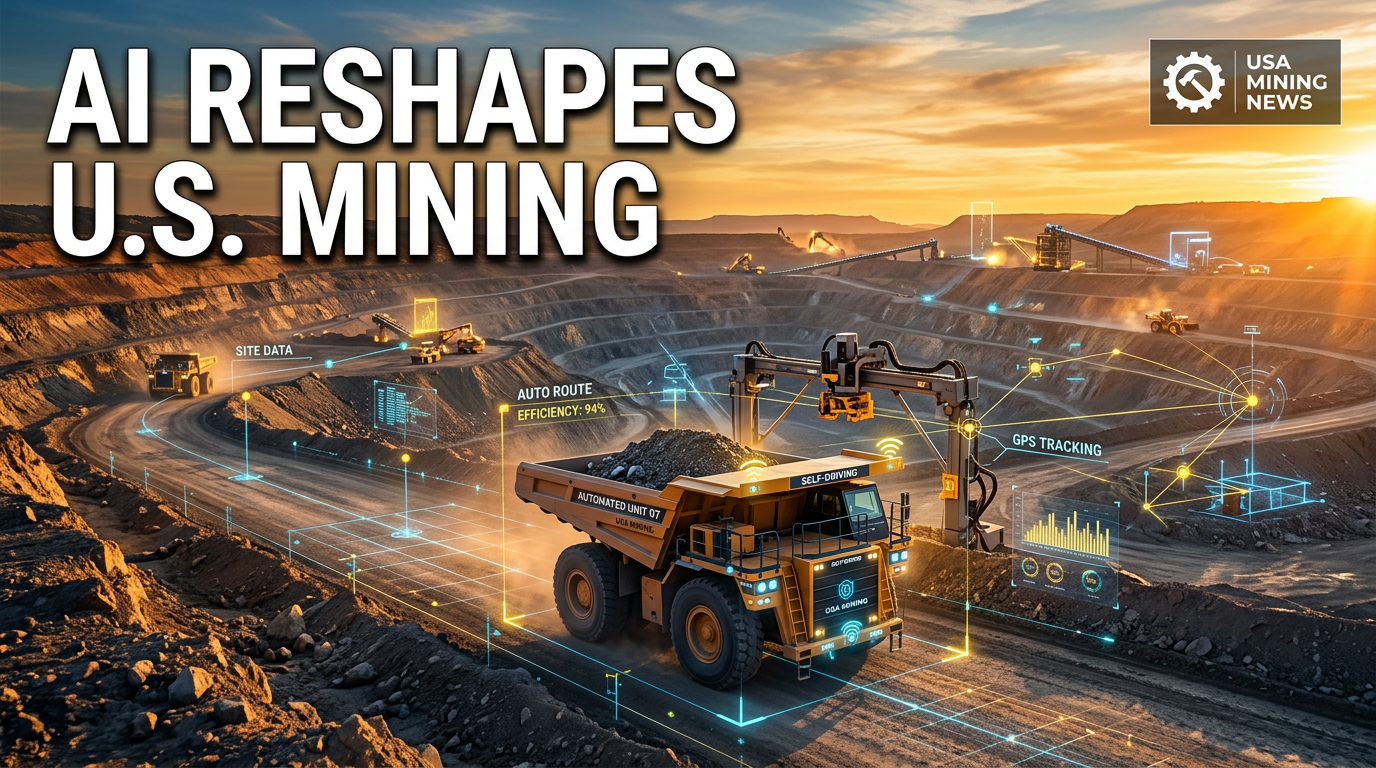
Other challenges, such as "Reenvisioning Advanced Manufacturing and Industrial Productivity" and "Recentering Microelectronics in America," will support the broader technological ecosystem that underpins modern mining. AI-driven manufacturing systems promise to strengthen supply chains, improve productivity, and speed the design-to-production loop for mining equipment and spare parts. Advancements in microelectronics are essential for the sensors, autonomous vehicles, and sophisticated control systems that define cutting-edge mining operations today.
Strategic Partnerships and Implementation Roadmaps
The success of the Genesis Mission hinges on a collaborative model involving DOE’s National Laboratories, industry leaders, and academic institutions. This integrated platform connecting the world’s leading supercomputers, experimental facilities, AI systems, and unique scientific data sets is designed to create a synergistic environment for innovation. The selection of these initial 26 challenges is strategic, chosen for their potential to demonstrate how AI can deliver tangible and measurable benefits for the American people, fostering faster discovery, stronger energy systems, and lasting leadership in science, technology, and national security.
DOE Acting Under Secretary of Energy Alex Fitzsimmons reiterated the administration's commitment, stating, "AI has tremendous potential to amplify the Trump Administration’s mission to unleash American energy dominance. Thanks to Secretary Wright’s leadership, these Genesis Mission challenges will help DOE leverage AI-enabled tools to build a more affordable, reliable, and secure energy system for the American people." Furthermore, DOE Under Secretary for Nuclear Security Brandon Williams highlighted AI's role in strengthening national security, from modernizing nuclear deterrents to safeguarding critical infrastructure, underscoring the broad applicability of the Genesis Mission's outcomes.
Future Outlook: Doubling Down on Discovery and Dominance
The announcement of the Genesis Mission's 26 AI challenges represents a bold declaration of intent from the U.S. government to solidify its position as a global leader in science and technology. For the mining industry, these efforts are not mere academic exercises but practical accelerators for innovation. The promise of AI to model complex subsurface environments, design superior materials quickly, power a more reliable energy grid, and streamline manufacturing processes directly addresses some of the sector's most pressing challenges: improving efficiency, reducing costs, enhancing safety, discovering new resources, and minimizing environmental impact.
As these integrated challenges move forward, the mining industry must closely follow the developments, seeking opportunities for collaboration with national laboratories and academic partners. By actively engaging with the Genesis Mission, mining companies can accelerate their adoption of AI-driven tools and methodologies, ensuring they remain competitive and sustainable in an increasingly technologically advanced world. The path laid out by the DOE suggests a future where the speed of discovery is not a limiting factor but a catalyst for unprecedented progress, promising to reshape the very foundations of resource development for decades to come.