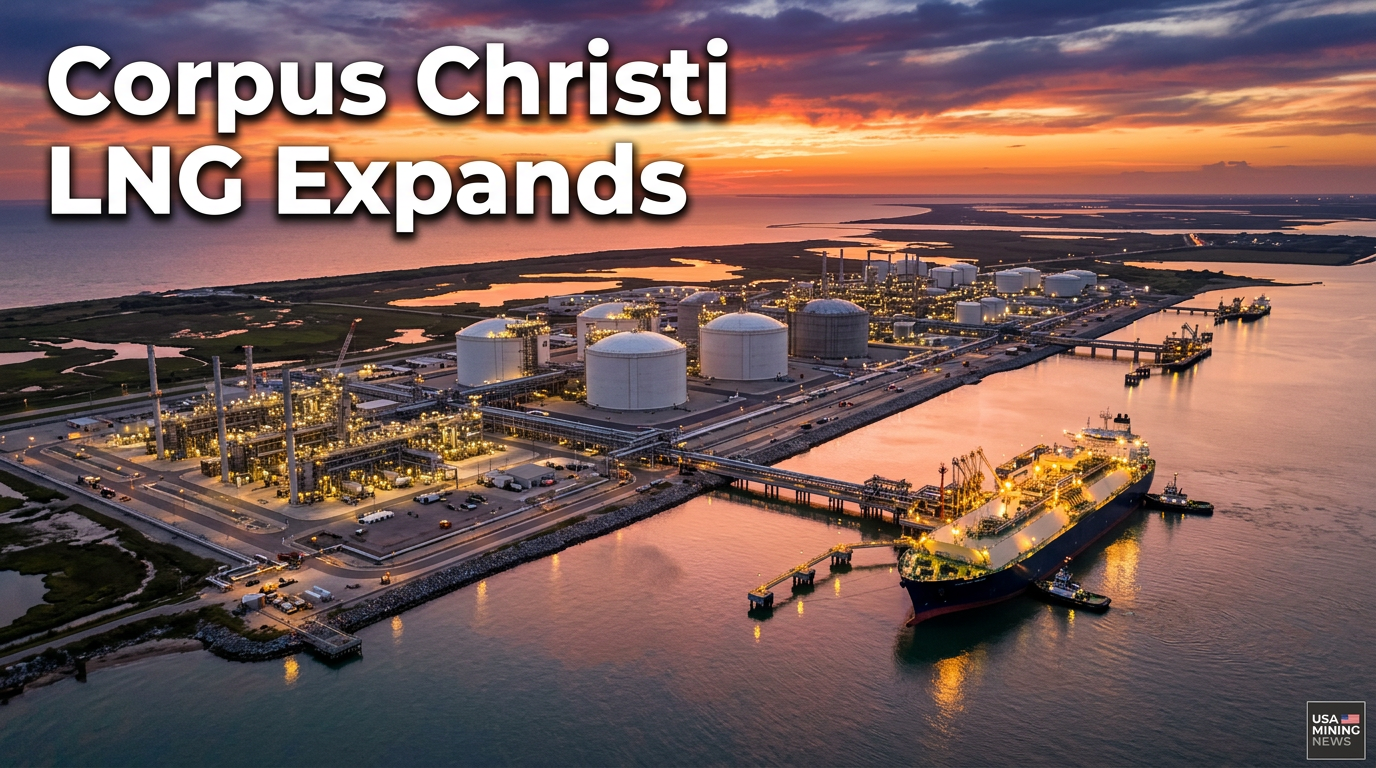
The U.S. Department of Energy, under Secretary Chris Wright, has authorized a significant 12% expansion of liquefied natural gas (LNG) exports from Cheniere Energy's Corpus Christi terminal, adding 0.47 billion cubic feet per day (Bcf/d) dedicated to non-Free Trade Agreement countries. This approval, announced February 26, 2026, elevates Corpus Christi to the nation's second-largest LNG export project with a total capacity of 4.45 Bcf/d, further solidifying the United States' position as the world's leading LNG exporter and creating substantial demand for mining sector products.
U.S. Department of Energy Propels Cheniere's Corpus Christi LNG Expansion, Reinforcing American Energy Dominance
**Corpus Christi, TX – February 26, 2026** – The United States Department of Energy (DOE) has taken a decisive step to further bolster American leadership in global energy markets, announcing a significant export authorization for Cheniere Energy’s Corpus Christi liquefied natural gas (LNG) Terminal. U.S. Secretary of Energy Chris Wright today signed the critical document, greenlighting a 12% expansion in export capacity at the Texas-based facility. This strategic approval is set to allow for additional exports of up to 0.47 billion cubic feet per day (Bcf/d) of U.S. natural gas as LNG, specifically destined for non-Free Trade Agreement (non-FTA) countries, originating from Trains 8 and 9 of the Corpus Christi Stage 3 Project, formally known as the Midscale Trains 8 & 9 Project.
This latest authorization elevates the Corpus Christi LNG Terminal's total permitted export volume to an impressive 4.45 Bcf/d. A facility of this scale firmly establishes it as the second largest LNG export project in the United States, a testament to the rapid development and ambition characterizing the nation's energy sector. The move underscores the U.S.'s continuing commitment to supplying global energy markets, a strategy that has significant ramifications for international energy security, competitive commodity pricing, and the demand for raw materials crucial to the mining industry.
The Approval and Its Strategic Significance
Secretary Wright made the announcement during a visit to the Corpus Christi terminal, emphasizing the broader context of U.S. leadership in LNG exports. His remarks also coincided with the 10-year anniversary of the first cargo of U.S. LNG from the lower-48 states, a milestone that effectively marked the genesis of America's current stature as a leading global energy supplier. This dual celebration highlights a decade of transformative growth, driven by technological innovation and strategic policy shifts.
"In the last ten years, American innovation and President Trump’s leadership transformed the United States into the world’s largest exporter of LNG," Secretary Wright stated, linking the nation's success to specific administrative policies. He further articulated the overarching benefits of such expansions, asserting, "This order helps further strengthen America’s LNG export capacity, delivering peace abroad and prosperity for Americans at home. I could not be prouder to be here today in Corpus Christi, standing alongside the American workers responsible for unleashing American energy dominance." His comments reflect a governmental perspective that views LNG exports not merely as commercial transactions but as instruments of geopolitical stability and economic development.
Echoing this sentiment, Kyle Haustveit, Assistant Secretary of the Hydrocarbons and Geothermal Energy Office, reinforced the strategic thrust behind these initiatives. "Every action we’re taking is focused on providing more reliable and secure energy to the world," Haustveit said. "Our commitment to strengthening global partnerships through LNG exports helps to ensure a stable energy future and drive economic prosperity." Such statements underscore the DOE's forward-looking approach to energy policy, which seeks to leverage America's abundant natural gas resources to meet global demand and foster international alliances.
Cheniere Energy's Corpus Christi LNG: A Hub of Activity
The Corpus Christi LNG Terminal has been a pivotal player in the U.S. export landscape since its inception, operating as an export terminal since 2018. Cheniere Energy, a pioneer in the American LNG industry, has consistently demonstrated its commitment to expanding its operational footprint. The positive final investment decision (FID) for Trains 8 and 9, announced by Cheniere Energy in June 2025, foreshadowed today's authorization. An FID represents a crucial stage for any major capital project, signifying that a company has secured financing, obtained necessary permits, and committed to proceeding with construction. This antecedent decision by Cheniere underscores the company's confidence in market demand and the regulatory environment.
The Midscale Trains 8 & 9 Project, now with its expanded export authorization, forms part of the Corpus Christi Stage 3 development. This multi-train expansion exemplifies the modular approach often adopted in LNG project development, allowing for phased construction and capacity additions. Such projects are colossal undertakings, requiring immense capital investment, advanced engineering, and robust supply chain management, from the upstream natural gas production fields to the liquefaction and export facilities on the coast.
Strategic U.S. Energy Policy and Global Impact
The United States stands today as the world’s largest producer of natural gas and, concurrently, the largest LNG exporter. This dominant position is a relatively recent phenomenon, significantly shaped by policy decisions. The source material highlights a critical inflection point: the Trump Administration’s decision to end the previous administration's LNG export approval ban to non-FTA countries. This policy reversal ignited a surge in export authorizations, enabling the U.S. to vastly expand its global reach.
Since the lifting of this ban, the Department of Energy has approved over 18.2 Bcf/d of LNG export authorizations. To put this figure into perspective, this volume is greater than the total export capacity of the world’s second largest LNG exporting nation, illustrating the monumental scale of U.S. expansion. The growth trajectory for U.S. LNG exports has been meteoric: they surged from a modest 0.5 Bcf/d in 2016 to an impressive 15.0 Bcf/d in 2025. Looking ahead, the U.S. Energy Information Administration (EIA) projects continued growth, with forecasts in the February Short-Term Energy Outlook indicating that U.S. LNG exports are expected to exceed 18.1 Bcf/d in 2027. This consistent upward trend underscores the enduring global demand for natural gas and the U.S.'s role as a reliable supplier.
Implications for the Mining Industry
While seemingly a distinct sector, the expansion of the U.S. LNG industry carries profound implications for the mining sector, both domestically and internationally. Large-scale energy infrastructure projects like Corpus Christi LNG's expansion are inherently resource-intensive, driving demand across various mining commodities.
* **Demand for Raw Materials**: The construction and ongoing maintenance of LNG terminals, associated pipelines, and upstream production facilities require vast quantities of raw materials. This includes:
* **Steel**: For liquefaction trains, storage tanks, pipelines, and structural components. This directly boosts demand for iron ore, coking coal, and ferroalloys.
* **Copper**: Essential for electrical wiring, control systems, and complex machinery. Copper mining operations directly benefit from such industrial expansion.
* **Aggregates**: Concrete for foundations and construction requires significant volumes of sand, gravel, and crushed stone.
* **Nickel and Chromium**: Used in stainless steels for cryogenic applications within the liquefaction process, where extremely low temperatures are present.
* **Rare Earth Elements**: Increasingly vital for advanced control systems, sensors, and specialized equipment found in modern industrial complexes.
* **Energy Costs and Supply for Mining Operations**: The robust and expanding natural gas infrastructure in the U.S., while primarily focused on exports, also contributes to a stable and often competitive domestic natural gas market. Mining operations are notoriously energy-intensive, relying on a consistent and affordable energy supply for extraction, processing, and transportation. Natural gas can be utilized directly as a fuel for heavy machinery, power generation at remote mine sites, or as a feedstock for certain chemical processes within mineral beneficiation. A well-supplied domestic market, even with significant exports, helps buffer against volatility in energy prices, benefiting mining companies' operational costs.
* **Global Energy Mix and Commodity Prices**: As LNG gains prominence as a "bridge fuel" in the global energy transition, it displaces more carbon-intensive alternatives, particularly coal, in power generation and industrial applications. This shift has direct implications for the thermal coal mining sector. Conversely, the increased availability of cleaner-burning natural gas can also influence the competitive landscape for other energy commodities supplied by the mining industry, such as uranium for nuclear power or coking coal for steel required in LNG infrastructure.
* **Economic Development and Infrastructure**: Major infrastructure projects like the Corpus Christi LNG expansion spur significant economic activity. This includes job creation during construction phases, long-term operational employment, and associated service industries. For mining companies operating in regions targeted for such energy development, this can translate into improved local infrastructure, better access to skilled labor, and enhanced regional economic stability, indirectly supporting mining investments and operations.
Future Outlook and Market Dynamics
The approval for Cheniere's Corpus Christi LNG expansion is a strong signal of commitment to further solidifying the U.S. position in critical energy markets. For Cheniere Energy, the next phase will involve advancing the construction and eventual commissioning of Trains 8 and 9, a process that requires meticulous planning and execution to bring the additional 0.47 Bcf/d online safely and efficiently.
The continued growth of U.S. LNG exports will play an increasingly vital role in global energy security, particularly for allies in Europe and Asia seeking to diversify their energy supplies away from less stable regions or providers. These approvals underscore the importance of robust regulatory frameworks in enabling large-scale infrastructure projects that serve national economic and strategic interests. Furthermore, given the projected global demand for natural gas, this expansion from Corpus Christi LNG could foreshadow further authorizations for existing and proposed LNG terminals across the U.S. Gulf Coast and other strategic locations. The U.S. energy landscape appears poised for sustained growth, with significant ripple effects across the mining and industrial sectors.
In conclusion, the U.S. Department of Energy’s authorization for Cheniere Energy’s Corpus Christi LNG expansion is more than just a regulatory approval; it is a strategic maneuver that strengthens America's global energy leadership. This move promises to stabilize international energy markets, boost domestic prosperity, and significantly stimulate demand for a wide array of mining commodities essential for building and maintaining this next generation of critical energy infrastructure.