WASHINGTON D.C. – The U.S. Department of Energy (DOE) today unveiled a monumental funding initiative, announcing a $293 million commitment to bolster the nation's scientific and technological prowess through the Genesis Mission. This significant investment is channeled via a Request for Application (RFA) titled The Genesis Mission: Transforming Science and Energy with AI,
targeting a broad spectrum of over 20 national challenges. Announced on March 17, 2026, from Washington, D.C., this program is poised to ignite innovation across sectors pivotal to the U.S. economy and national security, with explicit implications for the mining industry through its focus on critical materials and advanced manufacturing.
DOE Unveils $293 Million Genesis Mission RFA to Propel AI-Driven Innovation
The core of this announcement is the $293 million RFA, designed to solicit groundbreaking proposals that harness advanced artificial intelligence (AI) models and frameworks. Under Secretary for Science Darío Gil, who also serves as the Genesis Mission Director, articulated the program's vision. The Genesis Mission has caught the imagination of our scientific and engineering communities to tackle national challenges in the age of AI,
Gil stated. With these investments we seek breakthrough ideas and novel collaborations leveraging the scientific prowess of our National Laboratories, the private sector, universities, and science philanthropies.
This sentiment underscores the DOE's strategic intent to foster a collaborative ecosystem where cutting-edge AI research can translate into tangible solutions for complex national priorities.
The RFA is structured to encourage broad participation from entities capable of contributing to this ambitious agenda. Eligible participants include interdisciplinary teams originating from DOE National Laboratories, private U.S. industry, and academic institutions. This inclusive approach is crucial for marrying foundational scientific discovery with practical, industry-relevant applications, a dynamic that is particularly vital for the capital-intensive and technologically evolving mining sector.
Addressing National Challenges: A Multi-Sectoral Approach
The scope of the Genesis Mission is expansive, encompassing more than 20 national challenges. While the full list of these challenges is detailed in the official NOFO, several key areas have been explicitly highlighted by the DOE:
- Advanced Manufacturing
- Biotechnology
- Critical Materials
- Nuclear Energy
- Quantum Information Science
critical materialsand
advanced manufacturingwithin these prioritized areas signals a direct and profound opportunity. The U.S. mining industry plays an indispensable role in securing the raw materials necessary for a myriad of modern technologies, from electric vehicles and renewable energy infrastructure to defense systems and consumer electronics. AI's application in these two areas offers transformative potential.
The critical materials
challenge, in particular, resonates deeply within the mining community. Critical minerals, such as rare earth elements, lithium, cobalt, nickel, and copper, are essential for the nation's economic security and industrial transition to clean energy. The current geopolitical landscape and supply chain vulnerabilities highlight the urgent need for domestic sourcing and efficient processing of these materials. AI can revolutionize various stages of the critical materials lifecycle:
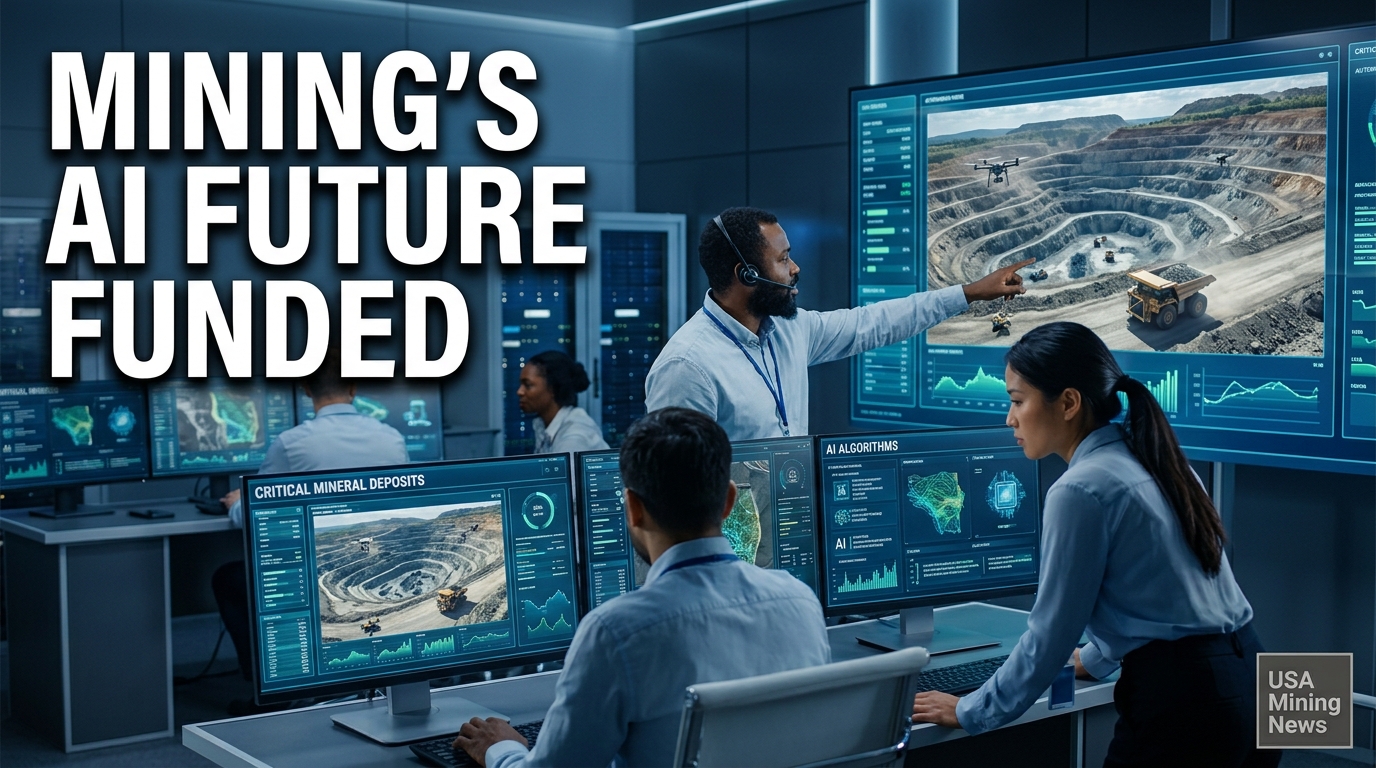
- Exploration: AI algorithms can analyze vast datasets from geological surveys, satellite imagery, and historical drilling records to identify promising new deposits with greater accuracy and speed, reducing exploration costs and timeframes.
- Mining Operations: Predictive maintenance for heavy machinery, optimization of drill and blast patterns, and automation of autonomous vehicles can significantly improve efficiency, safety, and energy consumption.
- Mineral Processing: AI can enhance ore sorting, comminution, and beneficiation processes, leading to higher recovery rates, reduced waste generation, and lower energy and water usage. This is particularly crucial for complex, low-grade critical mineral deposits.
- Recycling and Urban Mining: AI-powered sorting systems can efficiently identify and separate critical materials from electronic waste and other end-of-life products, closing the loop on material supply chains.
- Supply Chain Optimization: AI can provide real-time insights into global supply and demand dynamics, help identify potential disruptions, and optimize logistics from mine to market.
advanced manufacturingtouches upon the mining sector in significant ways. Improvements in metallurgy through AI-driven process control, the development of new materials for mining equipment, and optimizing additive manufacturing processes for parts can lead to more robust machinery, reduced downtime, and enhanced operational efficiency across the mining value chain. Furthermore, AI can aid in the digital twin development for entire mining operations, allowing for real-time monitoring and simulation to optimize performance and prevent failures.
Funding Structure and Application Timeline
The DOE's RFA delineates a two-phase funding structure designed to nurture both nascent concepts and more developed projects:
- Phase I Awards: These grants will range from $500,000 to $750,000 and will support a nine-month project period. This phase is intended to fund foundational research and proof-of-concept development, allowing interdisciplinary teams to test innovative ideas.
- Phase II Awards: Projects under Phase II will receive substantial funding, ranging from $6 million to $15 million, over a three-year project period. These larger awards are designed to support the scaling, development, and deployment of more mature AI solutions.
Mining industry stakeholders and their potential partners should note the following critical dates for the RFA, officially designated as NOFO: DE-FOA-0003612:
- RFA Announcement Date: March 17, 2026
- Informational Webinar: March 26, 2026 (Registration instructions and other details will be posted on the official DOE website.)
- Phase I Applications and Phase II Letters of Intent Due: April 28, 2026
- Phase II Applications Due: May 19, 2026
Strategic Implications for the Mining Sector
The Genesis Mission represents a paradigm shift in how the U.S. government is catalyzing innovation in vital industrial sectors. For the mining industry, it is not merely a funding opportunity but a strategic signal. The emphasis on AI-driven solutions for critical materials and advanced manufacturing directly aligns with the industry's imperative to modernize, enhance competitiveness, and secure domestic supply chains.
Companies involved in exploration, extraction, processing, and even equipment manufacturing should consider how AI can transform their core operations. This could involve developing AI models for predictive maintenance of haul trucks and crushers, leveraging machine learning for real-time ore grade control, or designing intelligent automation systems for remote mining operations. The funding also creates an impetus for partnerships between traditional mining companies and cutting-edge AI research firms or academic institutions. Such collaborations could lead to:
- Development of autonomous solutions for challenging mining environments.
- Advanced data analytics platforms for environmental monitoring and compliance.
- Optimization tools for energy consumption across the mining value chain, leading to reduced operational costs and carbon footprint.
- New methodologies for recovering economically viable critical minerals from waste streams, such as mine tailings or acid mine drainage.
A Call to Action for Industry Stakeholders
The DOE's Genesis Mission is a direct call for engagement from the U.S. mining industry. Leaders in exploration, production, and processing of critical minerals, along with equipment manufacturers and technology providers, are strongly encouraged to review the official NOFO: DE-FOA-0003612. Forming consortia that bring together the practical experience of mining operations with the scientific expertise of National Laboratories and the innovative research capabilities of academia will be key to developing compelling and successful proposals.
This is an opportune moment for U.S. mining to secure a leading position in the global AI-driven economy. By proactively participating in initiatives like the Genesis Mission, the industry can accelerate the adoption of transformative technologies, enhance its operational efficiency, improve its environmental stewardship, and ultimately contribute significantly to the nation's energy security and economic resilience.
The Broader Context: Securing a Sustainable Future
In a geopolitical and economic landscape increasingly defined by technological competition and the energy transition, the U.S. Department of Energy’s Genesis Mission is more than a research funding program; it is a strategic maneuver to cement American leadership. By investing heavily in AI as a tool to solve complex challenges in critical materials, advanced manufacturing, and other vital sectors, the DOE is laying the groundwork for more resilient supply chains, a cleaner energy future, and sustained economic growth. For the U.S. mining sector, this represents a unique window to transition from conventional practices to an AI-powered future, securing its relevance and competitive edge for decades to come.