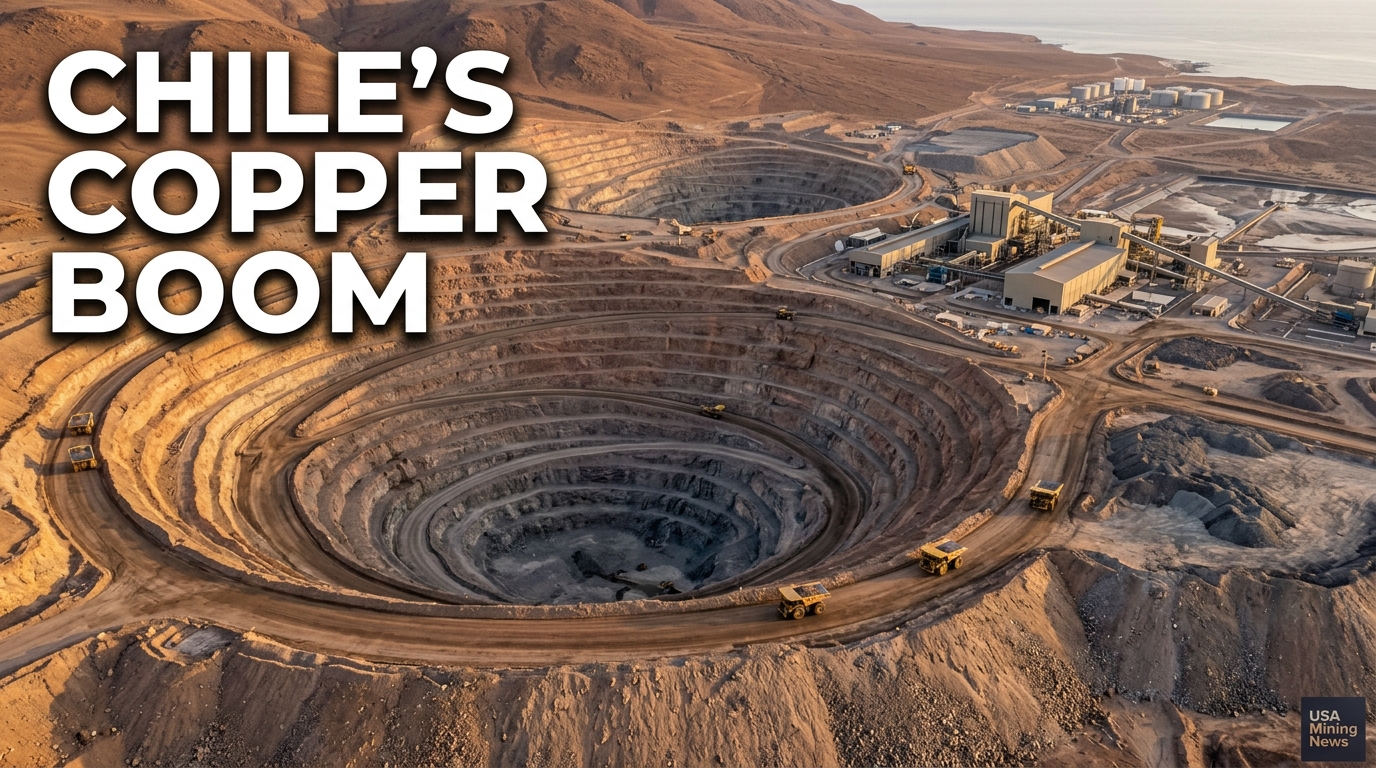
Freeport-McMoRan, a leading global copper producer, is poised to significantly expand its footprint in Chile with a proposed $7.5 billion investment at its El Abra copper mine. The US-based company has officially applied for environmental approval for the ambitious project, which aims to substantially increase copper production in response to burgeoning global demand. This initiative, if greenlighted, represents not only a massive capital injection into Chile's economy but also a strategic maneuver to secure future copper supply amidst unprecedented industry challenges.
El Abra Expansion: A Multi-Billion-Dollar Vision for Copper Growth
The core of Freeport-McMoRan's extensive plan for El Abra centers on the construction of several critical new facilities. As reported on March 20, 2026, the proposed expansion includes a new concentrator plant, a new desalination plant, and significantly expanded tailings storage capacity. These components are fundamental to modern, large-scale copper mining, particularly in regions like Chile's Atacama Desert, known for its arid conditions and the increasing complexity of ore bodies at mature mines.
The new concentrator plant is designed to process greater volumes of ore, likely of lower grades than historically mined, which is a common trend across the global mining industry. Modern concentrators employ advanced flotation technologies to efficiently extract copper minerals, maximizing recovery rates even from leaner deposits. Complementing this, the proposed desalination plant is a crucial investment, addressing the critical issue of water scarcity in Chile's northern mining regions. Utilizing desalinated seawater in operations reduces reliance on scarce fresh water resources, a growing imperative for sustainable mining and securing social license to operate. Lastly, additional tailings storage facilities are essential for managing the waste material from the ore concentration process safely and responsibly, adhering to stringent environmental standards.
If the environmental approvals are granted and a final investment decision is made by Freeport-McMoRan, operations for the expanded El Abra mine could commence in 2033. This timeline underscores the significant lead times involved in developing such large-scale mining projects, from initial permitting and engineering to construction and commissioning. Upon full operationalization, the project is projected to boost annual copper output by more than 300,000 tonnes. To put this in context, an increase of 300,000 tonnes would represent a substantial addition to global copper supply, equivalent to a mid-to-large-sized copper mine's total annual production.
A Strategic Partnership: Freeport-McMoRan and Codelco
The El Abra mine operates as a joint venture, with Freeport-McMoRan holding a 51% controlling stake and Chile’s national copper company, Codelco, owning the remaining 49%. This long-standing partnership combines Freeport’s extensive international operational expertise with Codelco’s deep understanding of the Chilean mining landscape and its role as the world’s largest copper producer. Codelco's involvement is particularly significant, as the company is a cornerstone of the Chilean economy, and its strategic decisions often align with national development goals. The shared investment in such a massive expansion project highlights the collective confidence in Chile’s mineral endowment and the long-term outlook for copper.
For Freeport-McMoRan, such a significant investment in a co-owned asset demonstrates its commitment to its Chilean operations and its strategy of growing production from established, high-quality mining districts. For Codelco, participation in the expansion provides an opportunity to indirectly increase its copper output and benefit from the projected rise in copper prices, without necessarily bearing the full capital expenditure burden of a new, wholly-owned project.
Addressing Soaring Global Copper Demand
The timing of Freeport's proposed El Abra expansion is highly strategic, aligning with a period of unprecedented global demand for copper. The source material highlights two primary drivers: the widespread adoption of electric vehicles (EVs) and the proliferation of AI data centers. Copper is a critical component in both these transformational technologies due to its superior electrical conductivity and thermal properties.
- Electric Vehicles: EVs require significantly more copper than traditional internal combustion engine vehicles, with estimates ranging from 80 kg to over 100 kg per vehicle, compared to 20-30 kg. As the global automotive industry transitions towards electrification, the demand for copper for motors, batteries, charging infrastructure, and wiring harnesses is set to skyrocket.
- AI Data Centers: The exponential growth of artificial intelligence requires massive computing power, housed in energy-intensive data centers. Copper is essential for power distribution, cooling systems, and high-speed data transmission within these facilities. As AI capabilities expand, so too will the energy and infrastructure requirements, placing further upward pressure on copper demand.
Beyond EVs and AI, copper is also a vital metal for renewable energy infrastructure, including solar panels, wind turbines, and the smart grids necessary to integrate these intermittent energy sources. The global push for decarbonization and electrification across various sectors underscores copper's designation as a "future-facing" commodity.
However, miners face significant challenges in meeting this escalating demand. The source notes declining ore quality and more complex and costly mining conditions. Over decades of mining, many easily accessible, high-grade deposits have been depleted, forcing companies to extract copper from deeper, lower-grade ore bodies. This requires more energy for crushing and grinding, more water for processing, and more sophisticated metallurgical techniques, all of which drive up operational costs and extend project development timelines. The El Abra expansion, with its focus on modern processing and water management, directly addresses some of these inherent industry challenges.
Chile's Evolving Investment Climate and Regulatory Framework
Freeport-McMoRan's significant investment proposal also comes at a pivotal moment for Chile's mining sector and broader economy. The development is part of a broader industry movement in Chile, which is being actively encouraged by President Jose Antonio Kast’s administration. President Kast has pledged to streamline permitting processes, which have historically been a significant bottleneck, causing delays and uncertainty for major mining projects in the country. This commitment from the highest levels of government signals a more favorable environment for foreign direct investment in the mining sector.
In this context, Freeport executives met with Chile’s new Economy and Mining Minister, Daniel Mas, in Santiago. Minister Mas has publicly urged business leaders and investors to actively contribute to tackling sluggish economic growth. In his initial public address earlier this week, he emphasized that accelerating environmental approvals could unlock significant investments and generate more than 20,000 jobs. This figure highlights the substantial socio-economic benefit that a project of El Abra's scale could bring to local communities and the national workforce.
The Chilean government's proactive stance on streamlining permits is a critical factor for all mining companies operating in or looking to invest in the country. A predictable and efficient regulatory environment is essential for de-risking large capital projects and attracting the necessary investment to develop new mines or expand existing ones. As the world's largest copper producer, Chile's ability to facilitate new projects will have a profound impact on global copper supply.
Freeport's Broader Global Strategy: Grasberg and Beyond
The El Abra expansion is part of Freeport-McMoRan's broader global strategy to optimize its asset portfolio and secure future production. The company's operations extend beyond Chile, most notably to its iconic Grasberg minerals district in Indonesia – one of the world's largest copper and gold mines. Just last month, Freeport signed a memorandum of understanding with the Indonesian Government to extend operating rights for PT Freeport Indonesia in the Grasberg district. This secures Freeport’s long-term presence in another top-tier copper producing region, demonstrating its commitment to major, long-life assets.
However, Freeport's Indonesian operations have not been without recent challenges. In September 2025, the company declared force majeure at its Grasberg block cave mine in Indonesia following a substantial mud rush incident that affected operations. Such incidents underscore the inherent geological and operational complexities of underground mining and the continuous need for robust safety and operational risk management. Juxtaposing the El Abra expansion with the Grasberg developments showcases Freeport's dynamic approach: pursuing growth and long-term stability in some regions while managing operational hurdles in others.
Future Outlook and Industry Implications
While the environmental approval application for El Abra represents a significant step forward, Freeport-McMoRan's decision-making process is ongoing, with a final investment decision yet to be made. This decision will hinge on various factors, including the outcome of the environmental review, prevailing copper market conditions, global economic outlook, and the continued stability of Chile's investment climate.
If the El Abra expansion moves forward, it will have far-reaching implications for the global mining industry. It would solidify Chile’s position as a dominant force in copper production for decades to come, contribute materially to addressing the anticipated copper supply deficit, and underscore the critical role of major mining companies in supporting the world's energy transition and technological advancement. For investors, it signifies a robust long-term outlook for copper and a confidence in the ability of integrated producers like Freeport-McMoRan to deliver on large-scale projects, even in challenging environments.
The El Abra project, with its substantial investment and significant production increase, stands as a testament to the mining industry's commitment to meeting the world's growing demand for essential raw materials, navigating complex operational and regulatory landscapes to do so.