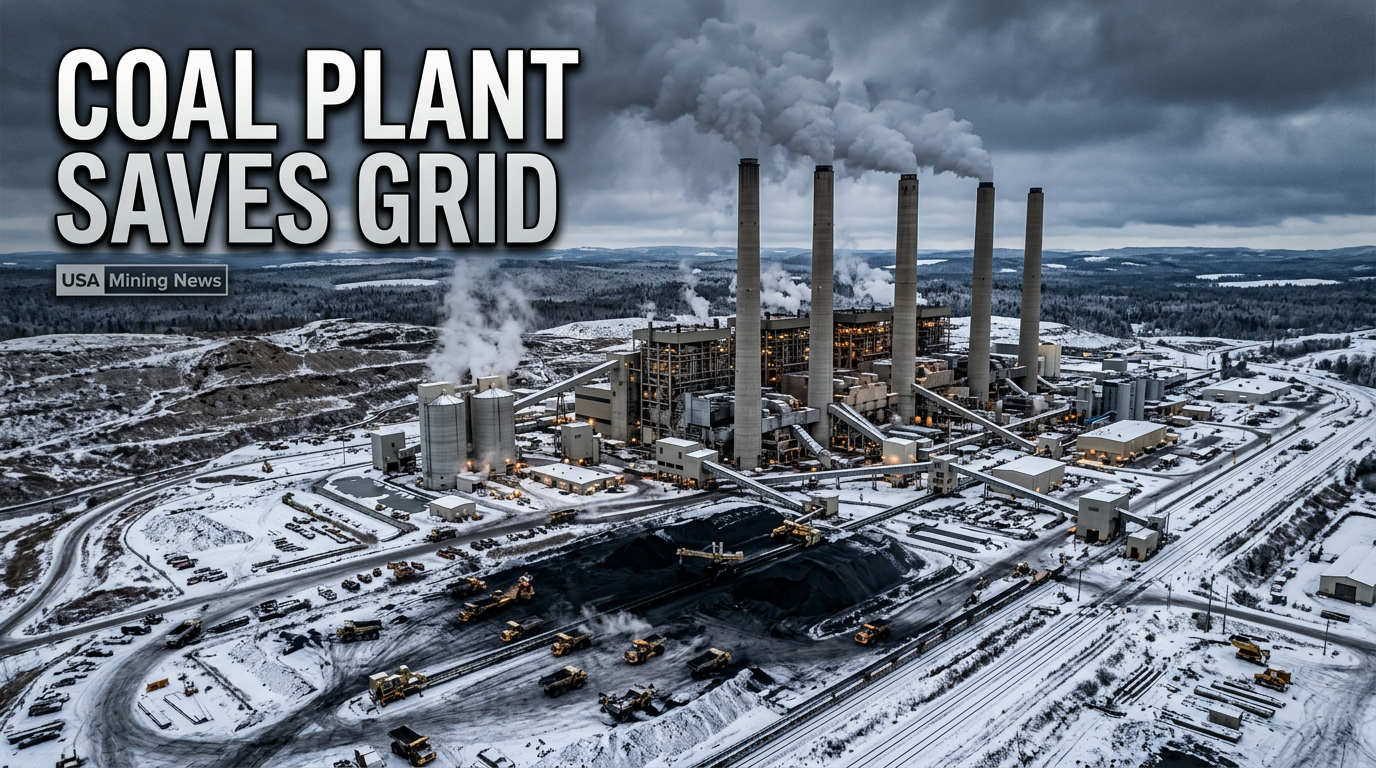
U.S. Energy Secretary Chris Wright has issued an emergency order to keep Consumers Energy's J.H. Campbell coal-fired power plant in West Olive, Michigan, operational through May 18, 2026. This directive aims to mitigate critical grid reliability issues in the Midwestern region, following the plant's essential role in stabilizing the power supply during recent winter storms. The decision underscores growing concerns about the premature retirement of dispatchable generating assets and their impact on energy security amidst the ongoing energy transition.
U.S. Energy Secretary Renews Order to Preserve Critical Coal-Fired Power: J.H. Campbell Plant Remains Online Amidst Grid Reliability Concerns
WASHINGTON D.C. – In a move reflecting escalating concerns over grid stability across the United States, U.S. Secretary of Energy Chris Wright on February 17, 2026, renewed an emergency order directing the Midcontinent Independent System Operator (MISO), in coordination with Consumers Energy, to ensure the continued operation of the J.H. Campbell coal-fired power plant in West Olive, Michigan. This latest directive mandates that the Campbell Plant take all necessary steps to remain available to operate, utilizing economic dispatch principles to minimize costs for consumers. The plant, originally slated for shutdown on May 31, 2025—a full 15 years before the end of its scheduled design life—has now secured an operational reprieve extending through May 18, 2026. This intervention highlights the critical role of dispatchable generation, particularly coal, in maintaining grid resilience during extreme weather events and underscores a growing tension between decarbonization efforts and immediate energy security needs.
Responding to Grid Fragility: The Mandate for J.H. Campbell
The Secretary's emergency order is a direct response to what the Department of Energy (DOE) describes as critical grid reliability issues facing the Midwestern region. This is not the first intervention for the Campbell Plant; previous orders were issued on May 23, 2025, August 20, 2025, and November 18, 2025, all designed to secure the plant's availability. Each order has been driven by persistent concerns over resource adequacy, particularly during periods of high demand and low output from intermittent renewable energy sources.
Secretary Wright emphasized the indispensable value of reliable energy sources, stating, "The energy sources that perform when you need them most are inherently the most valuable—that's why beautiful, clean coal was the MVP of recent winter storms." He directly linked the plant's continued operation to safeguarding American lives and economic stability, particularly referencing President Trump's broader policy actions aimed at preserving coal generation nationwide. This policy stance has, according to the Secretary, contributed to saving more than 17 gigawatts (GW) of coal-powered electricity generation in 2025 alone, ahead of critical periods like Winter Storm Fern. The renewed order for J.H. Campbell is consistent with this strategy, aiming to "mitigate the risk of blackouts and maintain affordable, reliable, and secure electricity access across the region."
The J.H. Campbell Plant: A Pillar During Winter Storms
The J.H. Campbell plant’s performance during Winter Storm Fern, which impacted the region from January 21 to February 1, 2026, served as a stark demonstration of its essential role. During this period, the plant operated consistently at over 650 megawatts (MW) every day, providing critical baseload power when other, less dispatchable sources struggled. This operational stability, delivering more than a quarter of its nearly 2,000 MW capacity across its four units, reinforced the DOE's assertion that its premature cessation would "needlessly contribute to grid fragility."
The plant's continued operation since the original May 2025 order has proven critical to MISO’s operational reliability, frequently being called upon during periods of peak energy demand when intermittent energy production, such as wind or solar, was insufficient. The narrative surrounding the Campbell Plant underscores a broader industry challenge: balancing the economic and environmental pressures to retire older, fossil-fuel-based generating units against the imperative of maintaining grid stability and preventing catastrophic power outages. With 15 years of design life remaining, the argument for its preservation extends beyond just emergency conditions, touching upon the significant sunk capital investment and the inherent value of a fully depreciated, reliable asset.
Broader Landscape of Grid Reliability: MISO and NERC Warnings
The emergency conditions necessitating the Campbell Plant’s continued operation are not isolated to Michigan but reflect systemic challenges across MISO's vast service area, which spans 15 U.S. states and the Canadian province of Manitoba. MISO’s own assessments, particularly the "Planning Resource Auction Results for the 2025-2026 Planning Year" released in April 2025, indicated significant resource adequacy problems. For the northern and central zones, which include Michigan, the report explicitly noted that "new capacity additions were insufficient to offset the negative impacts of decreased accreditation, suspensions/retirements and external resources." This shortfall points to a troubling trend where new generation, often renewable, is not coming online quickly enough or with sufficient reliability to replace retiring dispatchable assets.
MISO's resource adequacy concerns have evolved from being primarily a "summer peak" issue to a year-round challenge. As early as November 30, 2021, MISO filed a request with the Federal Energy Regulatory Commission (FERC) for approval to revise its resource adequacy construct, proposing to establish seasonal capacity requirements rather than relying solely on annual, summer-peak-determined capacity. This request, approved by FERC on August 31, 2022, was justified by MISO's explicit statement that "Reliability risks associated with Resource Adequacy have shifted from ‘Summer only’ to a year-round concern."
Further substantiating these concerns are multiple warnings from the North American Electric Reliability Corporation (NERC), the international regulatory authority whose mission is to assure the effective and efficient reduction of risks to the reliability and security of the North American bulk power system.
- The 2024–2025 NERC Winter Reliability Assessment and the 2023–2024 NERC Winter Reliability Assessment both assessed the MISO region as an "elevated risk" area, with the "potential for insufficient operating reserves in above-normal conditions."
- NERC’s 2025 Long-Term Reliability Assessment provided a stark warning: "The continuing shift in the resource mix toward weather-dependent resources and less fuel diversity increases risks of supply shortfalls during winter months."
These assessments collectively paint a sobering picture of a grid under stress, where the retirement of traditional, dispatchable power is outpacing the reliable integration of new capacity, leading to increased vulnerability during extreme weather or periods of low renewable output. The DOE's own "Resource Adequacy Report" echoes this, projecting that power outages could increase by 100 times by 2030 if the U.S. continues to take reliable power offline without adequate replacements.
Implications for the Coal Mining Sector
For the U.S. coal mining industry, these ongoing grid reliability issues and the subsequent governmental interventions carry significant implications. The direct impact of the J.H. Campbell order is a continued, albeit temporary, demand for thermal coal to fuel its operations through May 18, 2026. This translates into a predictable supply contract for coal miners serving Consumers Energy's needs, offering a degree of stability in a market otherwise characterized by long-term decline.
More broadly, the recurring emergency orders and official warnings from grid operators like MISO and NERC signal a potential recalibration of the nation's energy transition strategy. The source material highlights that "coal plants across the country are reversing plans to shut down," with over 17 GW of coal capacity saved in 2025. This trend, if sustained, could slow the pace of coal plant retirements, offering a crucial lifeline to miners producing thermal coal. It reinforces the argument that reliable, dispatchable power sources like coal-fired plants are indispensable, especially as the grid integrates more intermittent renewables. This does not necessarily signify a resurgence for coal, but rather a recognition of its strategic importance in ensuring energy security during what is proving to be a challenging and complex transition phase. Coal producers and investors should keenly observe these developments as they impact long-term demand forecasts and investment decisions in mining infrastructure and operations. The continued need for fuel diversity and the physical characteristics of energy stored in coal demonstrate its enduring value for grid resilience.
The Path Forward: Navigating Energy Security and Transition
The current emergency order for the J.H. Campbell plant is effective from February 17, 2026, through May 18, 2026. What transpires after this date remains uncertain for the plant and for the broader MISO region. The DOE’s statement explicitly notes that "The emergency conditions that led to the issuance of the original orders persist. MISO’s service area will continue to face emergency conditions both in the near and long term." This suggests that more interventions, or a more permanent policy solution, may be required to address the foundational issues of resource inadequacy.
The situation with the J.H. Campbell plant is a microcosm of the larger challenge facing the North American power grid: how to balance ambitious decarbonization goals with the fundamental need for reliable, affordable, and secure electricity. For the mining industry, particularly thermal coal producers, these developments underscore a potential, albeit perhaps temporary, extension of demand for their products. As policymakers and grid operators confront the realities of an evolving energy landscape, the role of existing, dispatchable thermal generation, including coal, is being re-evaluated not just for its cost, but for its essential contribution to system resilience. The coming months will be critical in discerning whether these emergency measures evolve into a more structured policy framework that recognizes the enduring value of fuel diversity and baseload reliability in a rapidly changing energy ecosystem.