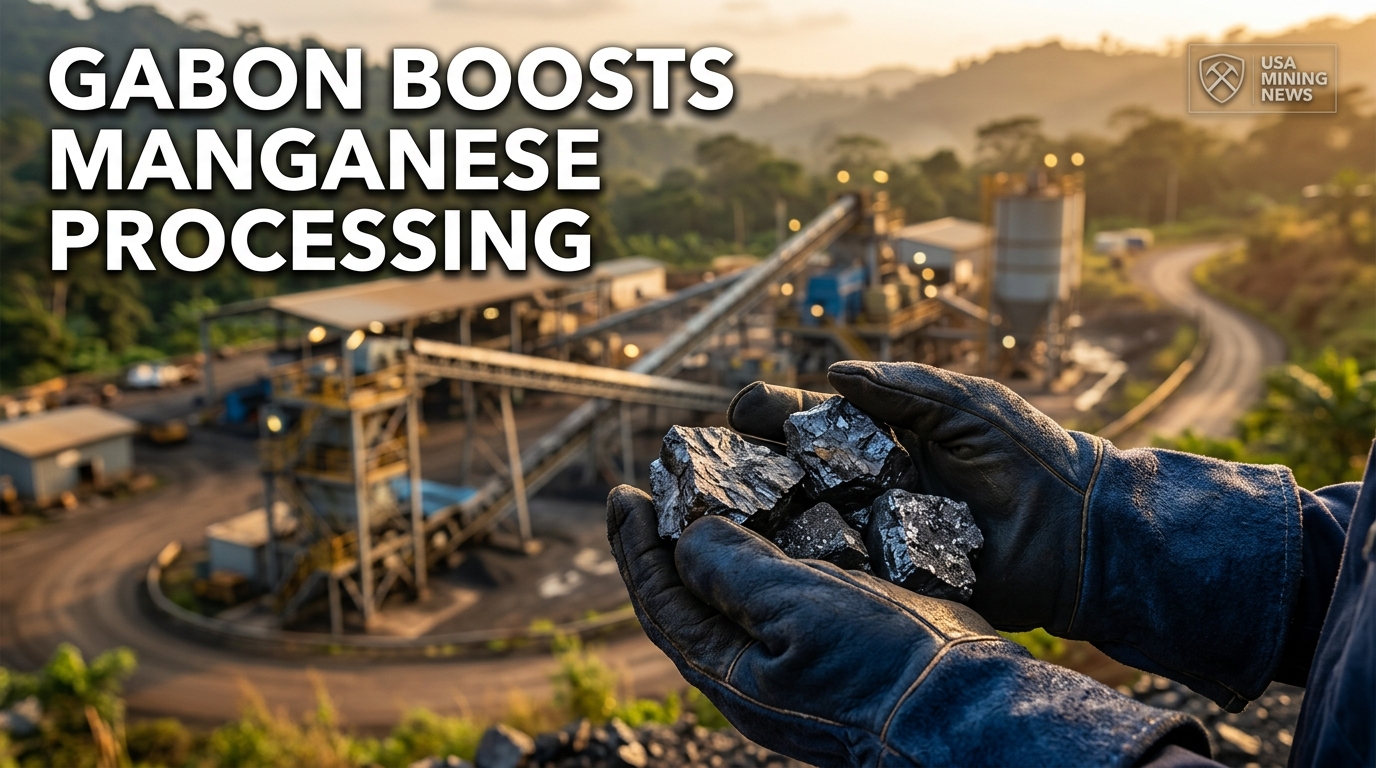
Paris, France – In a significant move set to redefine Gabon's role in the global manganese supply chain, French multinational mining and metallurgical company Eramet, along with its Gabonese subsidiary Eramet Comilog, has signed a Memorandum of Understanding (MoU) with the Government of the Gabonese Republic. The agreement, inked on July 21, 2026, in the diplomatic heart of Paris, outlines a comprehensive framework to substantially increase the local processing of manganese ore within Gabon, signaling a pivotal shift towards industrial value addition in the Central African nation.
A Strategic Partnership for Value Addition
The signing ceremony, which took place in the distinguished presence of Gabonese President Brice Clotaire Oligui Nguema and French President Emmanuel Macron, underscored the high-level political backing and strategic importance of this collaboration. This high-profile endorsement highlights the mutual commitment of both France, as a key partner, and Gabon, as a resource-rich nation, to fostering sustainable economic development through industrial growth.
At its core, the MoU establishes a detailed plan to evaluate and implement industrial solutions capable of transforming up to 700,000 tonnes per annum (tpa) of manganese ore within Gabon by the end of 2031. This ambitious target represents a substantial increase in domestic processing capacity, aligning with a broader trend among commodity-producing nations to capture more value from their natural resources through local beneficiation rather than solely exporting raw materials. For Gabon, a major global producer of high-quality manganese, this initiative is a critical step towards diversifying its economy, creating skilled employment opportunities, and enhancing its position in international markets through value-added products.
Three-Pronged Industrial Strategy
The signed document sets forth a concrete roadmap that will systematically study three distinct industrial projects, each designed to contribute to the overarching goal of increased local processing. These projects reflect a multi-faceted approach, addressing different market segments and leveraging both new construction and existing infrastructure.
Project 1: New Manganese Oxide Plant for Battery & Steel Sectors
The first scenario under consideration involves the construction of a new manganese oxide plant in the strategically important Libreville region. This facility is envisioned with an initial capacity of 10,000 tpa of manganese oxide, requiring approximately 20,000 tonnes of raw manganese ore annually. The target for this ambitious project is to commence production by 2028, contingent upon positive investment decisions and validation from all involved parties.
- Capacity and Input: Initial production of 10,000 tpa of manganese oxide from around 20,000 tpa of ore.
- Location: Libreville region, likely chosen for its port access and potential logistical advantages.
- Target Timeline: Production could commence by 2028.
- Market Focus: Significantly, this plant aims to serve both the burgeoning battery sector and the traditional steel industry.
- Future Growth: The MoU also allows for the consideration of additional production units if market demand for manganese oxide expands beyond initial projections.
This particular project holds immense significance for the mining industry. Manganese oxide is a crucial precursor material for various chemical and metallurgical applications, including the production of high-purity manganese required for lithium-ion batteries—a rapidly growing market driven by electric vehicles (EVs) and renewable energy storage. The development of such a plant in Gabon would position the country to tap into the global battery supply chain, moving beyond its traditional role as an ore exporter. For the steel sector, manganese remains essential as a deoxidizer, desulfurizer, and alloying agent, improving the strength, hardness, and workability of steel, making this facility relevant to both existing and future industrial demands.
Project 2: Upgrading the Moanda Metallurgical Complex
The second key project focuses on enhancing the existing Moanda Metallurgical Complex, a site where Eramet Comilog already conducts a portion of its ore processing operations. This element of the MoU emphasizes optimizing current assets to boost efficiency and output.
- Existing Infrastructure: Leveraging Eramet Comilog’s established, operational metallurgical complex in Moanda.
- Objectives: To increase profitability and potentially expand production capacity.
- Capacity and Input: The planned revamp aims to increase production to up to 70,000 tpa of manganese alloys, utilizing approximately 150,000 tonnes of ore.
- Target Recommissioning: This upgraded facility is targeted for recommissioning by 2029.
Upgrading an existing facility like the Moanda Metallurgical Complex represents a pragmatic approach to industrial expansion. It allows for leveraging existing infrastructure, reducing greenfield development risks, and potentially accelerating time-to-market for increased production. Manganese alloys, such as ferromanganese and silicomanganese, are foundational components in steel manufacturing, indispensable for enhancing steel's strength, corrosion resistance, and other critical properties. Increasing local alloy production directly translates into higher value retention within Gabon and a stronger national industrial base, while strengthening Eramet's position as a key supplier to the global metallurgical industry.
Project 3: New Coastal Manganese Alloy Plant
The third proposed scenario is a significant greenfield endeavor: the construction of an entirely new manganese alloy plant situated near the Gabonese coast. This project represents the largest proposed expansion in terms of scale and ore consumption.
- Location: A coastal site, suggesting strong logistical advantages for international shipping and material import/export.
- Capacity and Input: This large-scale facility is projected to have a capacity of 265,000 tpa of manganese alloys, requiring an estimated 530,000 tonnes of ore.
- Target Start: The potential start of operations for this venture is slated for 2031.
- Key Requirements: Successful realization of this project would necessitate a separate investment agreement and a robust assurance of competitive energy provision and comprehensive logistics infrastructure.
Developing a major new metallurgical plant, especially one with a coastal location, aligns with a long-term vision for Gabon to become a more prominent player in the processed manganese market. Coastal access is paramount for efficient bulk material handling, reducing transportation costs for both raw materials and finished products destined for international markets. The scale of this project would significantly elevate Gabon’s overall alloy production capacity, making it a substantial contributor to the global steel industry's raw material needs. However, the substantial requirements for a separate investment agreement, competitive energy sources, and extensive logistics infrastructure underscore the considerable capital expenditure and strategic planning involved in such a large-scale industrial undertaking.
Ensuring Project Viability: Energy and Infrastructure
A critical aspect of the MoU, and indeed for any heavy industrial development in a resource-rich nation, is the commitment to providing competitive energy. The Gabonese government has explicitly committed to supporting the provision of competitive energy, which is a cornerstone for the financial viability and long-term sustainability of energy-intensive metallurgical operations.
For large-scale mineral processing, energy costs can account for a significant portion of operational expenses. Access to reliable, affordable, and ideally, sustainably sourced energy is therefore not just a preference but a fundamental requirement. Furthermore, the development of these projects, particularly the new coastal alloy plant, will necessitate substantial investment in logistics infrastructure. This includes improvements or expansions to rail networks for ore transport from mines like Moanda, port facilities for shipping processed alloys, and reliable road networks. Gabon’s commitment to facilitating these crucial elements demonstrates a proactive approach to creating an attractive investment climate for industrial growth.
Eramet's Strategic Vision and Commitment
Christel Bories, Eramet's Chair and CEO, articulated the company's enthusiasm and dedication to the initiative. "We are delighted by the signing of this memorandum of understanding, which gives concrete form to the Group’s commitment alongside the Gabonese state to develop the Gabonese industrial sector," Bories stated. She further emphasized, "For over a year, our teams have been strongly mobilised to identify the best industrial solutions and support Gabon’s sovereign ambition to increase the local processing of its manganese resources."
This statement underscores Eramet's long-standing operational presence in Gabon through Comilog and its alignment with national development priorities. By investing in local processing, Eramet reinforces its social license to operate, potentially secures long-term access to high-quality ore, and diversifies its product portfolio to include higher-value materials demanded by evolving industries like electric vehicle manufacturing. The collaboration reflects a strategic foresight to navigate the global shift towards responsible sourcing and localized value creation.
Broader Market Implications and Future Outlook
The MoU between Eramet, Eramet Comilog, and Gabon carries significant implications for various stakeholders and the global mining industry:
- For Gabon: This initiative represents a profound step towards economic diversification, reducing reliance on raw commodity exports. It promises job creation, skill development, and increased revenue through the export of higher-value processed products. It solidifies Gabon's position as a key player in the global manganese market, moving it up the value chain.
- For Eramet: The agreement strengthens Eramet's foothold in a critical manganese-producing region and enhances its strategic resilience. By expanding into battery-grade manganese precursors, Eramet diversifies its product offering, reducing its exposure to solely traditional metallurgical markets and positioning itself for growth in future-facing industries. This move also aligns Eramet with the growing global emphasis on sustainability and localized production within complex supply chains.
- For the Manganese Market: An increase of up to 700,000 tpa in processed manganese in Gabon by 2031 would represent a notable shift in the global supply landscape. This could influence pricing dynamics for both raw ore and processed alloys/chemicals, potentially reducing the dominance of a few processing hubs and creating a more diversified supply picture. The focus on battery-grade manganese also directly addresses the accelerating demand from the EV sector, which is increasingly seeking secure and ethically sourced inputs.
- Global Context: This partnership exemplifies a growing global trend where resource-rich nations are demanding greater control and value capture from their mineral wealth. It emphasizes the importance of stable regulatory frameworks, competitive energy supply, and robust infrastructure as critical enablers for large-scale industrial investment in emerging markets. For international investors and mining houses, it highlights the strategic imperative of aligning corporate objectives with host government development agendas.
Conclusion
The Memorandum of Understanding signed between Eramet, Eramet Comilog, and the Gabonese Republic marks a watershed moment for Gabon's industrial ambitions and Eramet's strategic growth. By outlining a clear roadmap for processing up to 700,000 tpa of manganese ore across three distinct projects by 2031, the agreement lays the groundwork for significant economic transformation. With high-level political support and dedicated efforts to ensure competitive energy and logistical infrastructure, this initiative is poised to deliver substantial benefits, impacting not only the local economy of Gabon but also reshaping a portion of the global manganese supply chain for decades to come, particularly in the rapidly expanding battery and steel sectors.