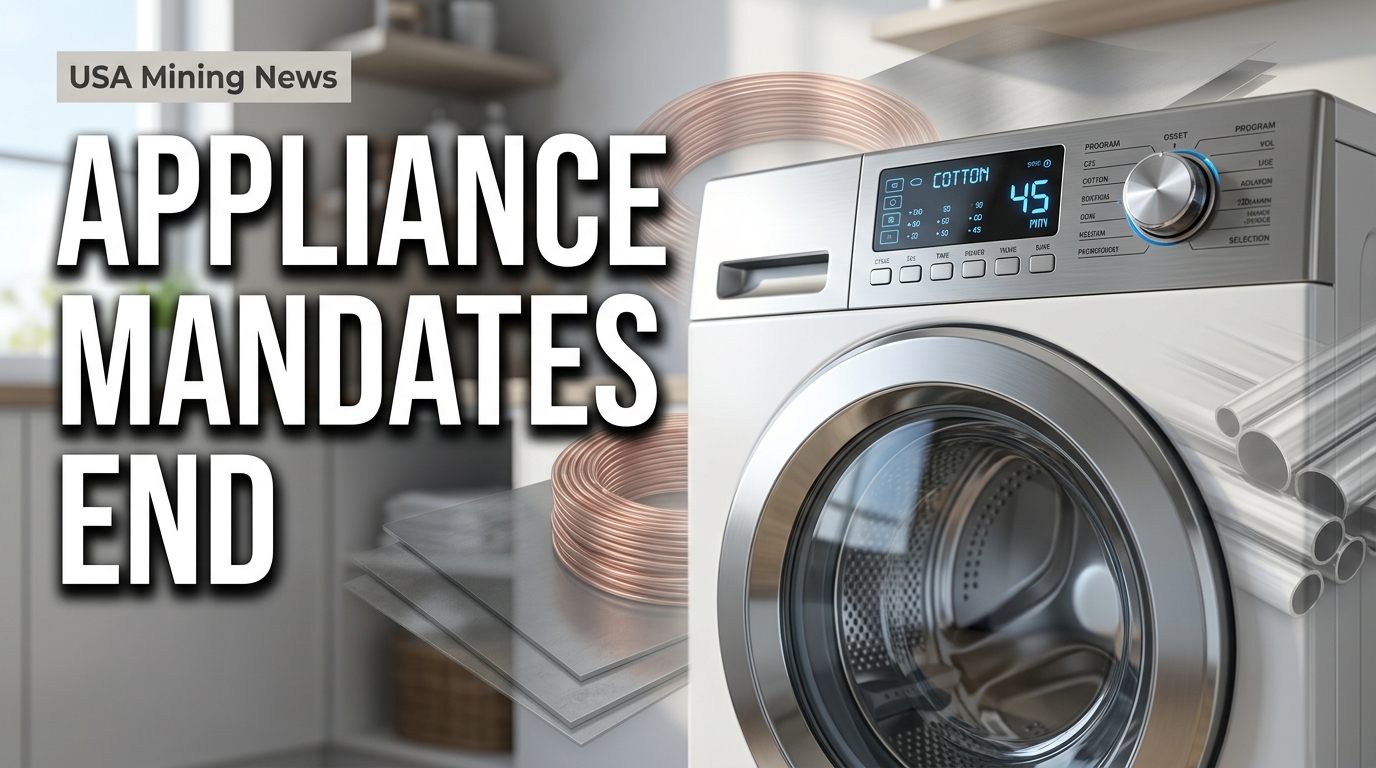
WASHINGTON D.C. – In a significant move set to ripple through manufacturing, consumer markets, and potentially the raw materials sector, the U.S. Department of Energy (DOE) today, July 2, 2026, announced a Notice of Proposed Rulemaking aimed at permanently rescinding a suite of home appliance and equipment mandates. This action, spearheaded by U.S. Secretary of Energy Chris Wright, signals a clear policy shift designed to reduce consumer costs and broaden product choice, aligning with the Trump Administration's overarching deregulatory objectives.
Deregulatory Action Targets Appliance Standards
The core of today's announcement revolves around updating the Department’s “Process Rule,” a foundational framework that guides the establishment of energy conservation standards for a wide array of household appliances and equipment. According to Secretary Wright, these efficiency mandates, developed by previous administrations, have imposed undue costs on American consumers and restricted their purchasing options. The proposed changes are intended to foster market-driven innovation and allow consumers greater flexibility in selecting products that best meet their needs and budgets, rather than being dictated by federal efficiency benchmarks.
The list of products directly impacted by this initiative is extensive, covering essential items that are ubiquitous in American homes. These include:
- Air conditioning units
- Gas stoves
- Washing and drying machines
- Water heaters
- Refrigerators
- Other various household equipment
The DOE's move is expressly framed as a direct implementation of President Donald Trump’s Executive Order, titled “Unleashing Prosperity through Deregulation.” This order has served as a central tenet of the administration’s economic strategy, emphasizing the removal of perceived governmental overreach that could impede economic growth and entrepreneurial freedom.
Leadership Perspective: Prioritizing Choice and Affordability
Secretary of Energy Chris Wright underscored the administration's rationale with a candid assessment of previous regulatory approaches. “In America, you should be able to choose a dryer that dries clothes on the first try rather than one that takes multiple cycles—unfortunately, past administrations thought otherwise,” Wright stated. He elaborated on the perceived burden these mandates have placed on consumers: “For too long, the American people paid the price for mandates that restricted consumer choice and drove up costs. President Trump promised to end this nonsense and that is exactly what we are doing. This proposed rule will preserve the American people’s ability to choose home appliances and equipment that actually work — at prices they can afford. It’s called common sense.”
Echoing this sentiment, Assistant Secretary of Energy (EERE) Audrey Robertson highlighted the forward-looking nature of the proposal. “From day one, the Trump Administration has offered relief to consumers, businesses, and industries through bold deregulatory action,” Robertson commented. She emphasized, “This proposal is about the future. It will ensure that new regulations promote affordability, preserve consumer choice, and meet the highest standards for transparency and due diligence.” This framing suggests a broader philosophical shift in regulatory philosophy, moving away from prescriptive efficiency standards towards a market-oriented approach.
Implications for the Mining Industry: A Material Shift?
While the immediate focus of the DOE's announcement is on consumer products and energy policy, the proposed changes hold significant, albeit indirect, implications for the global mining industry. Appliance manufacturing is a substantial consumer of mined raw materials, and shifts in design parameters or market demand can directly influence the demand for key metals and minerals.
Demand for Base Metals and Specialty Materials
Appliance efficiency standards often dictate material selection and design complexity. More stringent efficiency often necessitates advanced materials or larger quantities of conductive metals. For instance, highly efficient motors in refrigerators and washing machines may utilize more rare earth elements and precision-engineered copper windings. Air conditioning units, designed for optimal heat transfer, typically require extensive use of copper and aluminum in their coils and fins.
Should the proposed rule lead to relaxed efficiency requirements, manufacturers might face fewer constraints on material usage, potentially allowing for the adoption of more cost-effective, though perhaps less efficient, designs. This could influence:
- Copper Demand: Less emphasis on ultra-high efficiency could reduce the need for larger or more intricate copper coils in some applications, affecting demand for this critical electrical conductor.
- Aluminum Demand: Similarly, changes in heat exchange requirements could alter aluminum consumption, widely used for its lightweight and conductive properties.
- Steel and Iron Ore: As the primary structural material for most appliances, shifts in overall production volumes or product longevity could influence demand for iron ore and its derivatives. If consumers opt for more durable, perhaps less efficient, appliances, this could potentially stabilize or even increase demand for these foundational metals.
- Nickel: Used extensively in stainless steel for corrosion resistance in components like washing machine drums and refrigerator linings, demand could be linked to overall appliance production and material specifications.
- Rare Earth Elements: High-efficiency motors often rely on permanent magnets containing rare earth elements such as Neodymium. A less stringent efficiency landscape might reduce the incentive for their use in some mass-market appliances, potentially impacting a niche but strategically important segment of the mining supply chain.
Conversely, if removing mandates leads to a surge in appliance sales due to lower upfront costs, the overall volume increase could still drive demand for these materials, irrespective of individual product efficiency. The balance between unit volume and per-unit material intensity will be a crucial factor for mining companies to monitor.
Energy Sector Interdependencies
Another significant connection to mining lies in the energy generation sector. Products like air conditioning units, water heaters, and refrigerators are major consumers of household electricity. If new appliances, without strict efficiency mandates, are indeed less energy-efficient, the cumulative effect across millions of homes could lead to increased overall electricity demand. This heightened demand could, in turn, influence the demand for primary energy sources, many of which are derived from mining operations.
- Coal Mining: A sustained increase in electricity demand, particularly in regions relying on thermal power generation, could bolster demand for metallurgical and thermal coal.
- Uranium Mining: Nuclear power plants provide baseload electricity. Increased overall demand could indirectly support the long-term viability and expansion of nuclear energy, impacting uranium demand.
- Natural Gas Extraction: As a significant fuel for electricity generation, increased power demand would likely support sustained or increased natural gas extraction activities, considered part of the broader extractive industries.
The policy change could therefore indirectly influence investment decisions for energy-related mining projects and the long-term outlook for these commodity markets.
Regulatory Process and Public Engagement
The DOE’s proposed rulemaking is now open for public commentary, a standard procedure designed to gather feedback from stakeholders, industry, and the public. Comments for the Notice of Proposed Rulemaking will be accepted for 30 days following its publication in the Federal Register. This window allows manufacturers, consumer advocacy groups, environmental organizations, and other interested parties to submit their perspectives and data, which the DOE will consider before finalizing the rule.
In addition to the NOPR, the DOE also issued a separate Request for Information (RFI). This RFI specifically seeks public input on the methodologies currently used in developing energy conservation standards for covered products and equipment. The comment period for the RFI is longer, extending for 60 days after its Federal Register publication. This dual approach indicates a comprehensive review not just of specific mandates, but of the underlying processes by which such standards are formulated.
Broader Deregulatory Context
Today’s action is presented by the Trump Administration as part of its well-established commitment to deregulation across various sectors. The focus on “Promoting Affordability and Consumer Choice” is a recurring theme within the administration’s energy policy announcements.
Other recent press releases from the DOE illustrate the breadth of this agenda:
- On July 2, 2026, the Energy Dominance Financing Office Celebrates One Year Since Passage of the Working Families Tax Cuts Act, underscoring efforts to stimulate economic activity through tax policy and energy independence.
- On July 1, 2026, the U.S. Department of Energy Meets President Trump’s Goal, Delivers Third Advanced Reactor Criticality, highlighting progress in nuclear energy development.
These actions collectively paint a picture of an administration dedicated to fostering a less regulated business environment, with a particular emphasis on traditional energy sources and consumer-driven market dynamics.
Future Outlook
The full impact of this proposed rule, if finalized, will unfold over time. For the mining industry, the key will be to closely monitor manufacturing responses, consumer purchasing patterns, and the subsequent shifts in demand for a range of raw materials. While the direct effect on individual commodity prices may not be immediately discernible, the cumulative influence on long-term demand trends and investment strategies, especially concerning base metals, specialty minerals for motors, and energy fuels, cannot be overlooked. Mining companies and investors should stay abreast of the public discourse and the DOE’s final decision, as it could signal significant underlying shifts in the material economy.