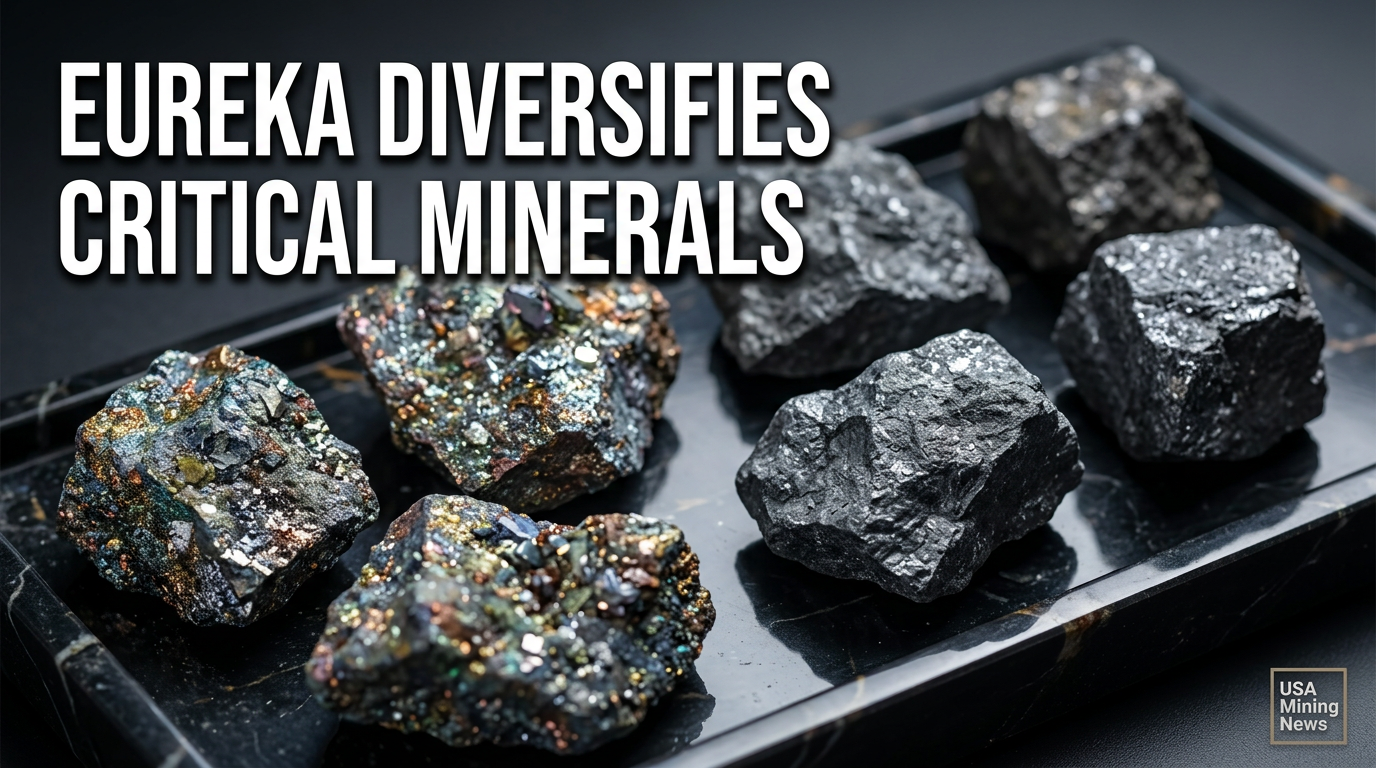
Eureka Lithium has significantly diversified its asset base by acquiring 100% stakes in the polymetallic Cabin Lake Project in British Columbia and the titanium-vanadium Tyee Project in Quebec. This strategic move, completed through the purchase of Stairway Mining for 9.1 million common shares and potential C$1 million in milestone payments, expands Eureka's exposure beyond lithium into critical minerals essential for defense, electrification, and advanced manufacturing within mining-friendly Canadian jurisdictions. The acquisition signals Eureka's intent to grow into a multi-commodity exploration company, leveraging the geological potential and existing infrastructure of these promising Canadian assets.
Eureka Lithium Diversifies Portfolio with Strategic Canadian Polymetallic and Titanium-Vanadium Acquisitions
In a notable move to broaden its exploration footprint beyond the burgeoning lithium sector, Eureka Lithium has announced the successful acquisition of two promising Canadian mineral projects: the Cabin Lake Polymetallic Project in British Columbia and the Tyee Titanium-Vanadium Project in Quebec. This strategic expansion marks a significant step for Eureka Lithium, positioning the company as a more diversified player in the critical minerals landscape, with assets now spanning base metals, precious metals, and strategic elements vital for global industrial demands.
The acquisition, formally concluded on February 27, 2026, involved the purchase of all issued and outstanding shares of Stairway Mining, the previous owner of the two Canadian properties. This transaction, executed as per an amended share purchase agreement (SPA) finalized earlier in February, reflects Eureka’s calculated pivot towards a multi-commodity strategy within robust mining jurisdictions.
Strategic Asset Expansion: Cabin Lake and Tyee Projects
The core of Eureka Lithium's latest corporate maneuvering lies in the integration of the Cabin Lake and Tyee Projects into its portfolio. Under the terms of the revised share purchase agreement, Eureka Lithium exchanged 9,100,000 common shares with Stairway Mining’s shareholders. Crucially, the agreement also includes a potential milestone cash payment totaling C$1,000,000 (approximately US$730,576), contingent upon specific development achievements at the newly acquired properties. These milestones are designed to drive the technical de-risking and advancement of the projects, including the filing of technical reports on SEDAR+, the disclosure of a maiden mineral resource estimate, and the completion of a preliminary economic assessment (PEA) within predefined timeframes. The common shares issued as part of the consideration are subject to a standard four-month-and-one-day hold period from their issuance date, a common regulatory practice in Canadian capital markets to ensure orderly trading.
It is noteworthy that the final terms of the acquisition underwent revisions from initial negotiations, which had proposed a consideration of 12,000,000 common shares without any milestone payments. This adjustment was necessitated by Canadian Securities Exchange (CSE) policy restrictions, highlighting the important role regulatory frameworks play in shaping corporate transactions. The adjusted consideration was the outcome of arm’s length negotiations between Eureka and Stairway, with the valuation grounded in the exploration potential of the properties and analysis of industry comparables, rather than solely on original acquisition costs. This disciplined approach underscores a focus on future value generation and strategic fit.
The Cabin Lake Project: Polymetallic Potential in British Columbia
The Cabin Lake Project is situated in British Columbia’s highly prospective Omineca Mining District, an area known for its diverse mineral endowment. Comprising six adjoining mineral claims, the project spans an approximate area of 2,363 hectares (ha). Geologically, Cabin Lake is characterized by a polymetallic system, indicating the potential presence of multiple metals within the same deposit. Specifically, the project shows strong potential for zinc, lead, copper, molybdenum, and silver.
Polymetallic deposits are highly valued in the mining industry due to their ability to provide multiple revenue streams, offering a degree of resilience against single-commodity price fluctuations. Zinc and lead are foundational base metals essential for galvanized steel, batteries, and construction. Copper remains an indispensable metal for electrification, wiring, and renewable energy technologies. Molybdenum is a critical element, primarily used as an alloying agent in steel to enhance strength and corrosion resistance, finding applications in construction, defense, and aerospace. Silver, a precious metal, is widely used in electronics, photovoltaics, and as an investment commodity.
The exploration potential at Cabin Lake is supported by several historic showings, suggesting a legacy of mineral occurrences within the area. Furthermore, previous exploration activities have delineated a target area roughly 600 meters by 1,000 meters in size, providing a clear focus for Eureka’s upcoming exploration programs. British Columbia is recognized globally as a mining-friendly jurisdiction, benefiting from strong regulatory frameworks, established infrastructure, and a skilled workforce, all of which enhance the attractiveness and operational feasibility of projects like Cabin Lake.
Tyee Project: Tapping into Quebec's Titanium-Vanadium Riches
Complementing its base and precious metal prospects, Eureka Lithium’s acquisition of the Tyee Project introduces significant exposure to strategic critical minerals: titanium and vanadium. The Tyee Project consists of 189 adjoining mineral claims, covering a substantial area of approximately 10,136 ha. It is strategically located within Quebec’s Havre-St-Pierre Anorthosite Complex, a geological formation renowned as a major titanium-bearing district.
The geological setting of the Tyee Project is particularly compelling due to its proximity to established operations. The area hosts the prominent Lac Tio Mine deposit, a high-grade, hard-rock titanium operation, providing an immediate geological analogue and demonstrating the proven potential of the region for significant titanium mineralization. Previous geological surveys and exploration efforts have consistently indicated prospective titanium and vanadium mineralization across the Tyee Project claims.
Titanium and vanadium are metals of increasing strategic importance. Titanium is prized for its exceptional strength-to-weight ratio and corrosion resistance, making it essential in aerospace, defense, medical implants, and high-performance industrial applications. Vanadium is primarily used as an alloying agent in steel to increase strength and toughness, particularly in high-strength low-alloy (HSLA) steels critical for structural applications, automotive manufacturing, and rebar. Increasingly, vanadium redox flow batteries (VRFB) are gaining traction for large-scale energy storage solutions, positioning vanadium as a key component in the global energy transition and electrification efforts. Quebec, like British Columbia, is celebrated for its robust mining sector, supportive governmental policies, and well-developed infrastructure, ensuring favorable conditions for mineral exploration and development.
Motivations Behind the Diversification Strategy
Eureka Lithium CEO Dave Bowen articulated the strategic rationale behind these acquisitions, stating, “The acquisition of the Cabin Lake and Tyee Projects represents a strategic expansion of Eureka’s asset base beyond lithium and into high-conviction polymetallic and titanium-vanadium prospective projects.” This statement underscores a deliberate shift by Eureka to mitigate risks associated with single-commodity exposure and capitalize on the broader demand for critical minerals.
Bowen further highlighted the advantages of these new assets: “Both projects are located in mining-friendly jurisdictions with strong infrastructure and district-scale geological potential. These projects give Eureka exposure to mineral projects targeting exploration for important materials necessary for defence, electrification and advanced manufacturing.” This emphasis on the geopolitical and economic significance of the targeted metals aligns with global trends. Governments worldwide are increasingly designating certain minerals as "critical" due to their economic importance and supply chain vulnerability, spurring investment and policy support for their domestic production. By targeting metals like zinc, copper, molybdenum, silver, titanium, and vanadium, Eureka Lithium is aligning its growth strategy with these strategic imperatives. Diversification not only spreads operational and market risk but also broadens a company’s appeal to a wider range of investors interested in various segments of the commodity market.
Financial Structure and Future Milestones
The structure of the acquisition, involving a mix of shares and contingent cash payments, is a common mechanism in resource sector transactions. Issuing shares conserves cash while aligning the interests of the acquiree’s shareholders with the long-term success of the acquirer. The milestone payments are particularly salient, as they tie a portion of the payment directly to the technical advancement and de-risking of the projects. The requirements for filing technical reports on SEDAR+ (System for Electronic Document Analysis and Retrieval), disclosing a mineral resource estimate, and conducting a preliminary economic assessment are critical stages in the mining project lifecycle. These steps are essential for validating the geological potential, quantifying the economic viability, and ultimately enhancing the market valuation of mineral assets, providing transparency and confidence for investors. The initial proposed terms without milestone payments, adjusted due to CSE policy, further illustrate the practical realities and regulatory adherence required in such corporate actions within Canadian markets.
Outlook: Charting a Course for Multi-Commodity Growth
With these acquisitions, Eureka Lithium is charting a new course towards becoming a multi-commodity mineral exploration and development company. The immediate next steps for Eureka will involve comprehensive exploration programs at both the Cabin Lake and Tyee Projects, aimed at validating historical data, expanding known mineralization, and ultimately moving towards the milestone achievements that trigger the contingent payments. This will likely include detailed geological mapping, geochemical sampling, geophysical surveys, and targeted drilling campaigns.
The successful advancement of these projects could significantly enhance Eureka Lithium's asset base and market profile. It signals to the market a robust strategy for growth, capitalizing on strong fundamentals across a spectrum of essential commodities. For the broader mining industry, Eureka Lithium’s strategy highlights a growing trend among junior explorers to diversify beyond single-commodity focus, especially as the demand for a wider array of critical minerals continues to surge driven by global efforts in electrification, advanced technology, and national security. This proactive approach by Eureka Lithium positions it to potentially capture value from multiple future mineral demand cycles, demonstrating a forward-looking strategy in a dynamic global mining landscape.