Bunker Hill Mining Completes First Stope Blast, Nears Commercial Production at Historic Idaho Mine
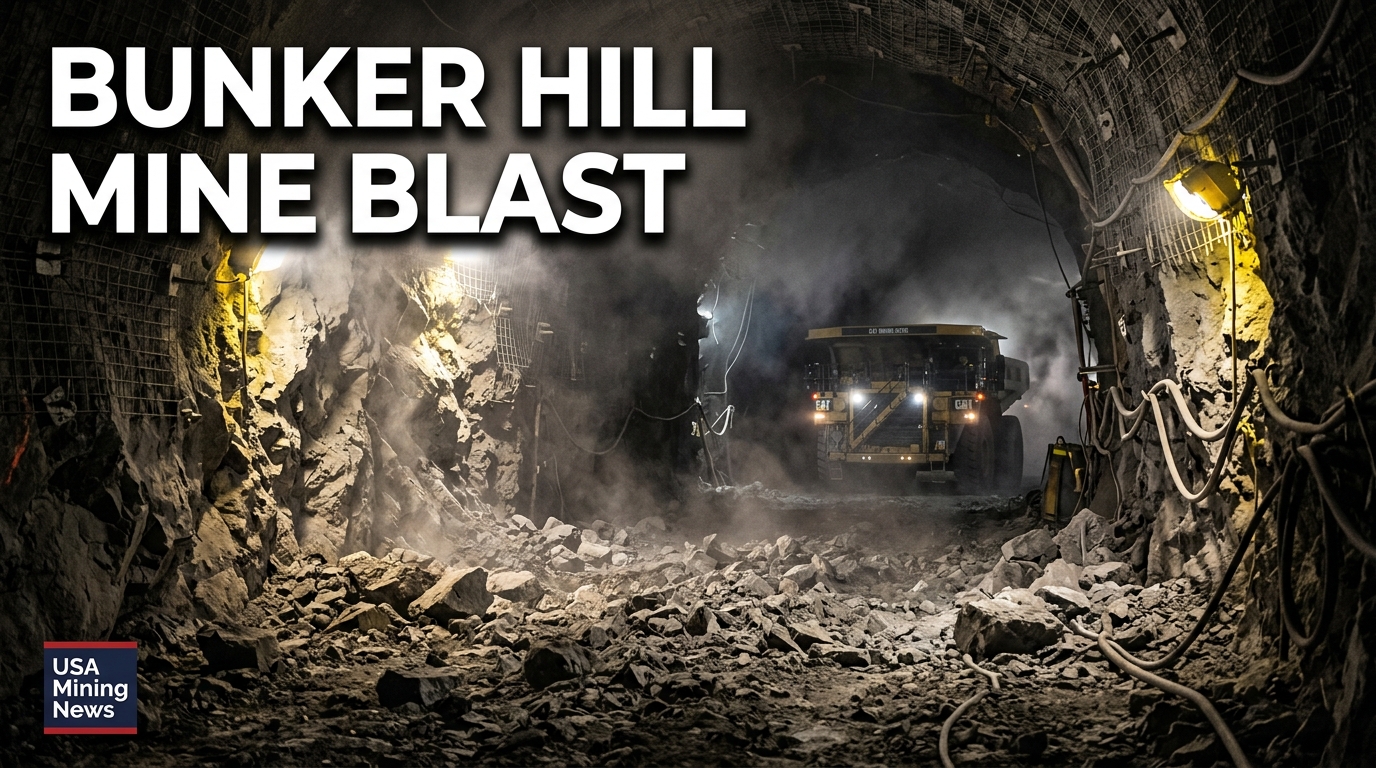
Idaho, USA – In a significant operational milestone, Bunker Hill Mining has announced the completion of the first production stope blast at its fully owned Bunker Hill Mine in Idaho, US. This pivotal development, achieved on August 18, 2026, propels the company closer to its objective of reaching commercial production by the end of 2026, marking a new chapter for one of America’s most historically significant mining properties.
The successful blast represents a critical transition for the Bunker Hill Mine, moving it from a phase of extensive redevelopment and preparation into active, ongoing underground production. This re-establishment of mining activities follows years of dedicated effort in rehabilitation and the installation of modern infrastructure essential for a safe and efficient restart.
A New Era for a Historic Mine: The Stope Blast Milestone
The completion of the inaugural stope blast is a testament to Bunker Hill Mining’s methodical approach in bringing a long-dormant asset back into operation. For mining professionals and investors, a first production blast signals the culmination of substantial capital expenditure, engineering design, and operational readiness. It signifies that the mine has advanced beyond surface preparation and rehabilitation, moving into the active extraction phase that defines a productive mining operation.
The journey to this point has involved comprehensive efforts to upgrade the mine’s facilities. The source material indicates that the initial stope blast followed the installation of updated infrastructure specifically designed to support the restart of mining activities. Such infrastructure typically includes enhanced ventilation systems, modernized hoisting capabilities, improved electrical networks, and upgraded water management systems, all crucial for ensuring safe and efficient underground operations in a mine that has seen intermittent activity over many decades.
This milestone directly aligns with Bunker Hill Mining’s strategic objective to achieve commercial production by the close of 2026. Attaining this target would firmly re-establish the Bunker Hill Mine as a significant contributor to the regional mining landscape and to the broader US mining sector. The transition to commercial production involves not just blasting ore, but also consistently processing it to produce saleable concentrate, a step the company has already demonstrated proficiency in, having produced its first concentrate in June 2026.
Advanced Mining Techniques and Environmental Stewardship
Bunker Hill Mining is deploying modern and efficient mining methods tailored to the ore body’s characteristics. The company is utilizing transverse longhole stoping, a technique favored for its efficiency and safety in specific geological settings. This method involves drilling long holes from horizontal access drifts into the ore body, which are then blasted. The fragmented ore falls into a draw point, from which it is extracted. The primary-secondary sequence mentioned by the company is a common refinement of this method, where initial, or primary, stopes are mined and then stabilized, allowing for the subsequent safe extraction of adjacent secondary stopes. This approach maximizes ore recovery while managing ground stability.
A cornerstone of Bunker Hill Mining’s operational strategy, and a critical component for modern mining, is its innovative use of a paste backfill system. Once an underground stope has been mined and the ore extracted, the empty cavity is filled. Bunker Hill’s system mixes processed mill tailings, which are residual materials from the ore processing plant, with cement. This mixture is then transported underground and carefully pumped into the excavated areas. The benefits of this approach are multi-faceted and reflect contemporary best practices in mining:
- Geotechnical Stability: The paste backfill provides structural support to the surrounding rock mass, enhancing the overall stability of the mine and allowing for safer extraction of adjacent ore bodies, particularly the secondary stopes. This is paramount in ensuring the long-term integrity of the underground workings.
- Environmental Footprint Reduction: A key advantage of paste backfill is its ability to significantly reduce the mine’s environmental impact. By utilizing processed tailings as a backfill material, the need for a traditional surface tailings facility, which can occupy large tracts of land and pose environmental risks, is eliminated. This aligns with Bunker Hill Mining’s stated corporate objectives of limiting its environmental footprint and underscores a commitment to sustainable mining practices that are increasingly demanded by regulators, communities, and investors alike.
- Operational Efficiency: The integration of tailings management directly into the mining cycle streamlines operations and can reduce costs associated with surface tailings disposal and reclamation.
The adoption of such advanced and environmentally conscious techniques is a strong indicator of a forward-thinking management team and positions Bunker Hill Mining as a responsible operator in the US mining sector.
Operational Momentum and Production Targets
With the successful completion of the first stope blast, Bunker Hill Mining is now accelerating its operational efforts. The company is committed to further stope development and increasing its production efforts with a clear target: an underground mining rate of 1,800 tonnes per day. Achieving this daily throughput is essential for reaching the economic scales outlined in the mine’s feasibility studies and fulfilling its commercial production objectives.
The pathway to this target involves a continuous cycle of mining, processing, and optimization. The company’s earlier announcement in June 2026 of producing its first concentrate at the Bunker Hill Mine was an equally critical step, demonstrating that not only can ore be extracted, but it can also be successfully processed into a marketable product. This initial concentrate production provided valuable data for refining the processing circuits and ensuring that the final product meets commercial specifications.
Looking ahead, Bunker Hill Mining intends to progressively increase underground mining rates, building momentum from the initial stope blast. Concurrently, efforts will focus on optimizing processing circuits to ensure maximum recovery and efficiency as throughput volumes increase. The ultimate goal is to achieve and sustain the production levels outlined in its comprehensive mine plan, thereby realizing the full economic potential of the Bunker Hill deposit.
A Culture of Safety and Operational Excellence
Beyond the technical and operational achievements, Bunker Hill Mining has demonstrated a profound commitment to safety, a paramount concern in the mining industry. The company reported an impressive safety record: four consecutive years without a lost-time incident (LTI) and one full year without a recordable safety incident at the mine. These statistics are not merely numbers; they represent a deeply embedded culture of safety and operational discipline. An LTI is an incident that results in an employee being unable to perform their normal work duties for a period beyond the day or shift on which the injury occurred, while a recordable incident includes any work-related injury or illness that requires medical treatment beyond first aid, results in lost time, restricted work, or transfer to another job.
Sam Ash, President and CEO of Bunker Hill Mining, underscored the significance of these achievements, stating: “These are significant achievements for Bunker Hill and, most importantly, for our people. Four years without a lost-time incident demonstrates the strength of our team and their commitment to operating safely.”
The company attributes its strong safety performance to a proactive approach centered on identifying risks early, diligently addressing hazards, and committing to ongoing improvements in its safety protocols. These efforts are underpinned by established protocols and processes that reflect current industry standards in mining operations. For investors and industry observers, such a safety record is a robust indicator of sound management, operational efficiency, and a reduced risk profile, all of which contribute positively to a company’s long-term sustainability and shareholder value.
Market Implications and Future Outlook
The successful restart and progression of a historic mine like Bunker Hill carries significant implications for the broader mining industry and regional economy. The Bunker Hill Mine has a storied past, and its re-emergence signals renewed confidence in the economic viability of domestic mineral resources. For Idaho, the mine’s re-establishment will likely bring job creation, stimulate local businesses, and contribute to state revenues.
For the mining sector at large, Bunker Hill Mining’s journey serves as an example of how legacy assets can be revitalized through modern mining techniques, strong environmental commitment, and a relentless focus on safety. As global demand for various raw materials continues to fluctuate, the ability to bring reliable, responsibly sourced domestic supply to market is increasingly valued.
The future outlook for Bunker Hill Mining is now firmly focused on consistent operational execution. The company’s immediate next steps involve scaling up the current mining rates to achieve the 1,800 tonnes per day target, optimizing its processing plant for sustained performance, and ensuring that its safety record remains pristine. As commercial production nears, the market will keenly observe the mine's consistent output and financial performance, which will ultimately determine its long-term success and potential for expansion within the Coeur d'Alene Mining District.
In conclusion, the first stope blast at the Bunker Hill Mine is more than a technical achievement; it is a clear signal of revitalization, strategic foresight, and a steadfast commitment to modern, responsible mining practices that are setting a new standard for historic mining districts across the United States.