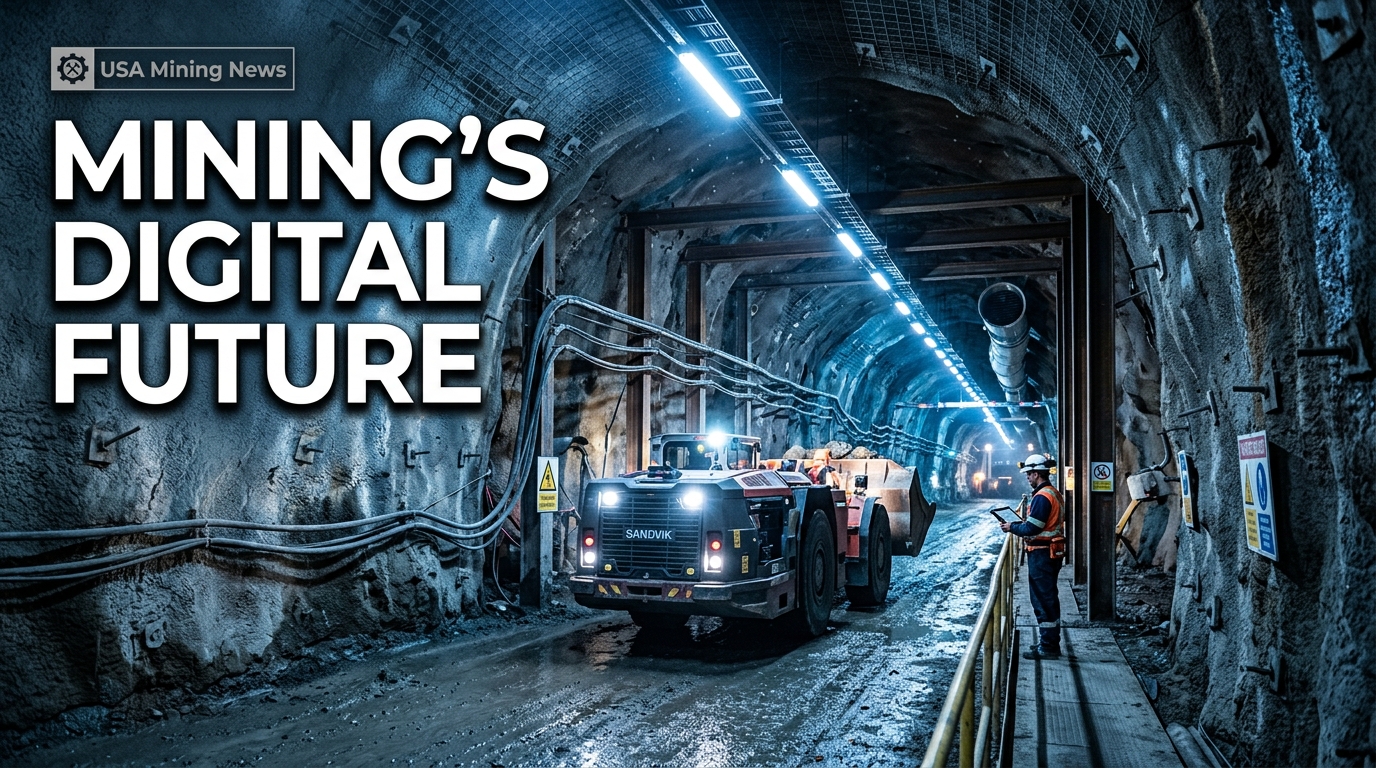
In an era defined by rapid technological advancement, the global mining industry stands at a critical juncture. Faced with unrelenting pressures—including volatile commodity prices, increasingly shorter production cycles, ever-more stringent safety regulations, and escalating environmental expectations—mining companies are making substantial investments in digitalization. This includes the deployment of autonomous equipment, Industrial IoT (IIoT) sensors, sophisticated analytics, and artificial intelligence-driven solutions. However, a pervasive challenge remains: many operations struggle to extract the full, transformative value from these high-tech investments.
The core impediment, as increasingly recognized by industry leaders, often lies not in the digital tools themselves, but in the underlying communication infrastructure. Modern mines generate continuous, massive streams of data—from critical air quality metrics and real-time equipment health diagnostics to precise ore grade analysis and dynamic structural stability assessments. Processing and leveraging this data effectively demands continuous, high-bandwidth, low-latency, and highly reliable connectivity, a demand that traditional mining communication systems are simply not built to meet. The industry is actively seeking robust alternatives to legacy systems like VHF/UHF radio, scattered Wi-Fi hotspots, and isolated monitoring platforms, which fundamentally limit the promise of the digital mine.
The Imperative for Digital Transformation in Mining
The drive towards digitalization in mining is not merely about adopting cutting-edge technology; it is a strategic response to fundamental operational and market challenges. Mining operations today are more complex, geographically dispersed, and data-intensive than ever before. Realizing the vision of smarter, safer, and more productive mines hinges on the seamless integration and operation of diverse digital technologies. Without a dependable communication backbone, the efficacy of these initiatives crumbles. Personnel tracking systems lose visibility in signal dead zones, critical environmental sensors fail to transmit real-time data, equipment monitoring initiatives become unreliable, and production optimization stalls. Crucially, safety systems cannot protect all personnel comprehensively, and autonomous equipment, which relies on continuous communication for safe operation, is prone to disruptive stoppages.
Connectivity: The Achilles' Heel of Digital Dreams
The limitations of legacy communication systems are profound and widespread across the mining sector. Many mines operate with an infrastructure that has been layered together over decades, comprising VHF/UHF radio for voice communication, Wi-Fi added somewhat haphazardly for data transfer, and various independent monitoring platforms managed in silos. Such systems were never designed for the demands of real-time operations, highly mobile equipment, or complex autonomous workflows that characterize modern mining.
This fragmented connectivity results in a critical lack of comprehensive situational awareness. Personnel tracking may function in some operational zones but not others. Environmental sensors might report data inconsistently or with significant delays. Mandown detection, a vital safety feature, functions only where connectivity is present. These limitations are exacerbated exponentially in vast underground environments, where tunnel networks can stretch from 30 to an astonishing 600 kilometers.
Even more robust wired solutions, like Industrial Ethernet, fall short due to their inability to support mobility—a critical limitation in mines where production zones constantly shift. Recabling infrastructure to adapt to changing conditions is not only costly and slow but often logistically impossible in active mining areas. Wi-Fi, while offering a degree of mobility, also presents significant challenges at scale. Its performance is often degraded by large metal structures, heavy machinery, and signal interference common in mine environments. Crucially, access-point handovers, which cause momentary drops in connectivity, can bring autonomous systems to a halt. When remote or autonomous machines lose connectivity, they typically need to reboot, leading to stalled production and significant revenue losses.
A Strategic Alliance: Ericsson and Becker-Lasec Forge the Digital Blueprint
Recognizing these critical gaps, a powerful strategic partnership has emerged to provide a unified solution for the digital mine. Ericsson, a global leader in telecommunications technology, and Becker-Lasec, a prominent provider of mining-specific digital tools and connectivity solutions, have joined forces to offer operators a single, scalable path toward safer, smarter, and more productive mining operations. This collaboration, highlighted in an industry insight dated April 14, 2026, combines industrial-grade 5G connectivity with purpose-built mining digitalization frameworks.
LASEC, a division of Becker Mining Systems, brings extensive, specialized expertise to this partnership. With over 35 years of global underground experience, LASEC has been at the forefront of solving complex connectivity challenges in underground mining operations across three-quarters of the world’s major mining countries. Their Smartflow platform is a flexible, purpose-built digitalization framework engineered specifically to meet the unique demands and operational realities of mining environments.
Ericsson complements this with a robust, business-critical network foundation. Ericsson Private 5G, built on universally recognized 3GPP standards, ensures the high reliability, seamless interoperability, and superior performance essential for modern mining applications. This integrated approach eliminates the need for mining companies to independently source and stitch together disparate vendor components, offering an end-to-end solution that is both streamlined and highly effective.
LASEC Smartflow: The Intelligent Core of the Mine
While robust connectivity forms the essential foundation, it is sophisticated software that truly transforms raw data into actionable insights and informed decisions. LASEC’s Smartflow platform acts as the digital brain of the mine, consolidating all operational data into a single, unified platform. This eliminates problematic data silos and empowers mines to scale their digitalization efforts at their own pace, ensuring a phased and manageable transition.
The capabilities of Smartflow are extensive and directly address core mining challenges:
- Comprehensive Situational Awareness: Smartflow provides a dynamic 3D digital twin visualization, allowing supervisors to simultaneously monitor the real-time movement of equipment through tunnels, precise personnel locations and statuses, environmental conditions, and ongoing production activities. Its simulation capabilities further enable operational changes to be tested in a virtual environment before costly implementation.
- Enhanced Safety Protocols: The platform integrates real-time personnel tracking, advanced man-down detection, sophisticated collision avoidance systems, and intelligent evacuation guidance. During emergency situations, Smartflow can instantly identify personnel in affected areas, guide them through the safest available escape routes, and provide responding teams with critical situational awareness.
- Optimized Operational Logistics: Smartflow applications meticulously coordinate material movement throughout the entire operation. This includes tracking ore from extraction through processing, optimizing haulage routes, and ensuring consistent, efficient material flows. Equipment dispatch systems dynamically assign vehicles based on real-time conditions, minimizing delays and maximizing utilization.
- Proactive Environmental Management: The platform continuously monitors vital environmental parameters such as air quality, gas concentrations, temperature, humidity, and airflow. Its advanced ventilation-on-demand systems adjust airflow based on actual needs, significantly reducing energy consumption while rigorously maintaining safe atmospheric conditions.
- Predictive Maintenance and Efficiency: Equipment telemetry tracks operating hours, consumption patterns, and performance metrics. Leveraging this data, predictive analytics identify equipment components likely to fail before breakdowns occur, dramatically reducing unplanned downtime and improving overall asset availability.
- Advanced Interaction and Automation: Smartflow incorporates natural language interfaces, enabling conversational queries for operational data. Furthermore, computer vision technology digitalizes visual processes, such as precise blast-hole counting, enhancing accuracy and efficiency.
From Theory to Practice: Real-World Digital Mine Deployments
The efficacy of the Ericsson-Becker-Lasec solution is already being demonstrated in significant real-world deployments:
Case Study 1: Latin American Gold Mine (Open Pit)
A major gold mining operation in Latin America successfully implemented a Private 4G/5G infrastructure across its extensive surface operations. This robust deployment delivered immediate and tangible benefits:
- Enabled remote drilling teleoperation from climate-controlled facilities, improving worker safety and comfort.
- Provided real-time fleet tracking and dynamic dispatch, optimizing material flow and operational efficiency.
- Supported advanced meteorological monitoring and sophisticated water management systems.
The comprehensive connectivity infrastructure eliminated previous equipment coordination limitations and enabled data-driven optimization across the vast site. Notably, drilling operations could now continue safely during weather conditions that previously mandated shutdowns. This operation is now progressively advancing towards full autonomous equipment deployment and is in the process of migrating its legacy VHF communications to advanced LTE-based systems, underscoring the long-term vision and scalability of the solution.
Case Study 2: Latin American Underground Complex
In another critical deployment, a large underground mining complex, also in Latin America, has implemented full connectivity throughout its extensive network of tunnels. While specific details on this deployment are ongoing, the strategic importance of this initiative cannot be overstated. By ensuring ubiquitous high-bandwidth, low-latency connectivity underground, the complex is laying the groundwork for a truly integrated digital operation. This capability is paramount for real-time safety monitoring, autonomous vehicle navigation, optimized ventilation, and comprehensive operational visibility across vast subterranean distances, directly addressing the core challenges inherent in underground mining environments.
The Future: A Fully Connected, Autonomous Mining Landscape
The partnership between Ericsson and Becker-Lasec represents a pivotal moment for the global mining industry. By providing a unified, end-to-end solution for industrial-grade 5G connectivity and mining-specific digitalization, they are not only solving current operational bottlenecks but also laying the foundation for the next generation of mining. This future is characterized by even greater levels of automation, predictive intelligence, and enhanced safety for every worker.
The ability to transform raw, continuous data streams—"signals"—into actionable "insights" is the distinguishing factor for successful mining operations moving forward. As the case studies from Latin America illustrate, robust private 5G networks, combined with intelligent platforms like Smartflow, are tangible accelerators for operational efficiency, safety, and sustainability. The mining sector is rapidly moving towards a fully connected, autonomous, and intelligently managed landscape, and solutions like those offered by Ericsson and Becker-Lasec are proving to be the essential blueprint for this transformative journey.