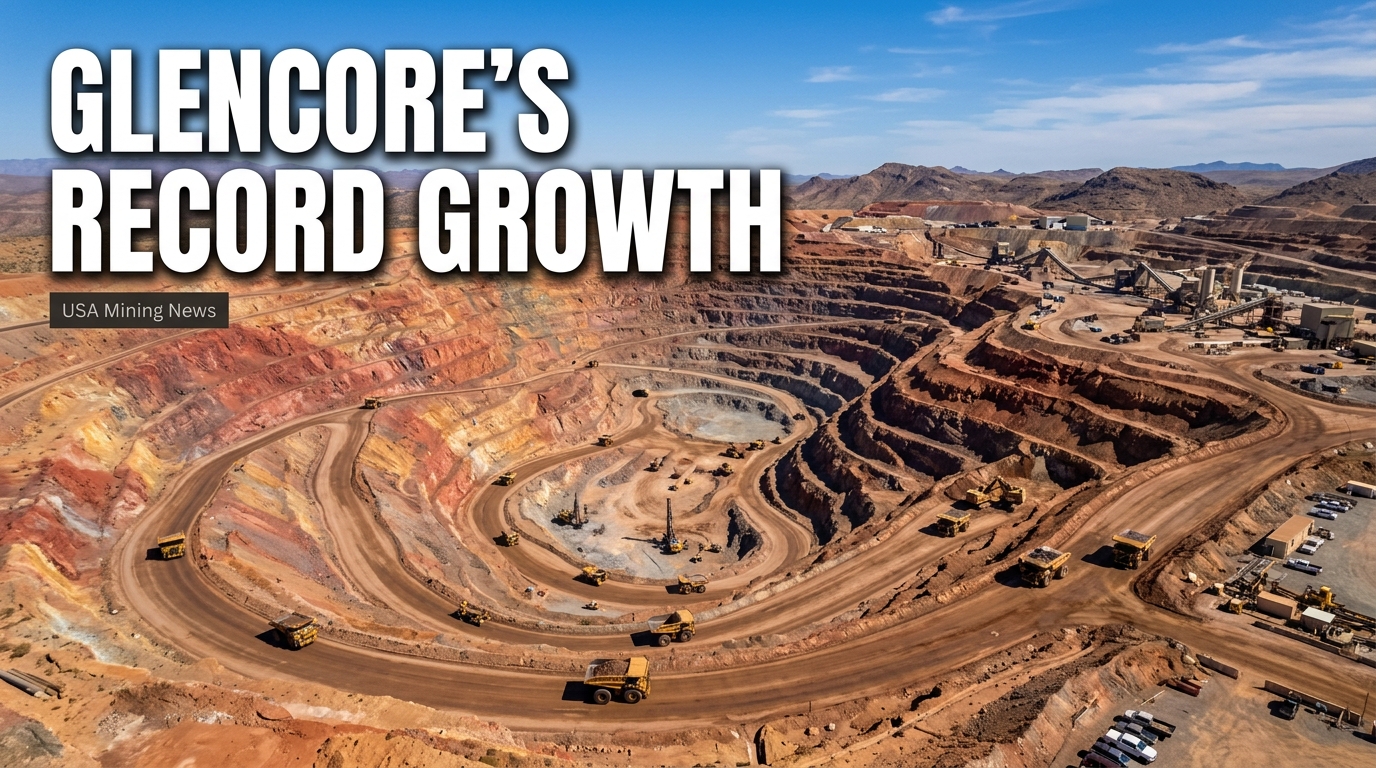
In a powerful demonstration of resilience and strategic positioning within dynamic global commodity markets, Glencore, one of the world's largest diversified natural resource companies, announced a significant uplift in its financial performance for the first half of 2026 (H1 2026). The results, reported on August 6, 2026, underscored a period of substantial growth, propelled by robust commodity prices and exceptional contributions from its marketing segment. These figures not only highlight Glencore's operational efficiencies and market acumen but also provide valuable insights into the broader health and direction of the global mining industry.
H1 2026 Financial Highlights: A Robust Performance
Glencore’s H1 2026 financial report revealed a commanding surge across key metrics, far exceeding its performance in the prior year. Total revenue for the period reached an impressive $174.43 billion, marking a substantial 49% increase from the $117.39 billion recorded in H1 2025. This growth signals a period of heightened commodity demand and pricing, which Glencore, with its integrated production and trading model, was uniquely positioned to leverage.
Further underscoring this strong performance, the company’s overall group adjusted earnings before interest, taxes, depreciation, and amortisation (EBITDA) reached $10.1 billion, an 86% rise from the previous year. Breaking down this figure, the industrial adjusted EBITDA saw a 72% increase to $6.5 billion, a direct reflection of higher commodity prices for its mined products. Complementing this, Glencore's formidable marketing segment delivered a near record high adjusted earnings before interest and taxes (EBIT) of $3.3 billion, climbing 142% year-over-year. This segment's exceptional performance demonstrates the efficacy of Glencore's unique trading capabilities in navigating and capitalizing on market volatility.
The company also reported a substantial increase in funds from operations (FFO), which were up 158% to $8.1 billion (SFr6.55 billion), indicating robust cash generation from its core operations. Net income attributable to equity holders stood at $4.4 billion. This figure reflected gains from the disposal of non-current assets and the recognition of deferred tax assets, although these positive impacts were partially offset by certain impairments.
Capital expenditures for the net cash purchase and sale of property, plant, and equipment also saw an increase, rising to $4 billion from $3.2 billion in the prior period. A significant portion of this capital was strategically invested in Glencore's copper portfolio, aimed at enhancing growth and operational flexibility. This commitment to copper aligns with broader industry trends focusing on materials critical for the global energy transition.
Strategic Drivers: Commodity Markets and Operational Efficiency
Glencore CEO Gary Nagle commented on the results, stating, "We delivered another strong operational and financial performance for the first half of the year. Our assets performed in line with market guidance, which alongside substantially higher period-over-period average prices for our core commodities and a favourable marketing backdrop, underpinned a material increase in earnings." This statement encapsulates the twin engines of Glencore's success in H1 2026: efficient operational execution and astute market timing.
The "substantially higher average prices" for core commodities played a pivotal role. The mining sector, particularly for base metals and energy commodities, has experienced a period of robust demand, driven by post-pandemic economic recovery, supply chain disruptions, and the accelerating global energy transition. Glencore's diversified portfolio, spanning copper, cobalt, zinc, nickel, ferroalloys, aluminum, oil, and coal, allowed it to capture value across various segments experiencing price appreciation.
Operational efficiency was also a critical factor, as evidenced by the healthy adjusted EBITDA mining margins reported: 52% for copper, 38% for steel-making coal, and 19% for energy coal. These margins are indicative of effective cost management and high-quality assets, allowing the company to translate elevated commodity prices into significant profitability. Copper, a critical metal for electrification and renewable energy infrastructure, continues to be a high-margin business for Glencore, reflecting its strategic importance.
Investment in Growth and Portfolio Enhancement
Glencore's capital expenditure strategy for H1 2026 highlights a forward-looking approach, with a notable allocation towards its copper assets. The increase in Capex to $4 billion, up from $3.2 billion, suggests a deliberate effort to strengthen its position in a commodity vital for the clean energy transition. Copper is fundamental to electric vehicles, renewable energy systems, and grid infrastructure, making sustained investment in this metal a strategic imperative for major miners.
Beyond organic growth, Glencore also engaged in strategic partnerships to secure future supply. In June 2026, Larvotto Resources signed a binding off-take agreement with Glencore for the sale of gold concentrate from the Hillgrove Antimony-Gold Project in New South Wales, Australia. This agreement showcases Glencore's commitment to diversifying its portfolio and securing access to key minerals, including precious metals, through strategic alliances. Such off-take agreements are common in the industry, providing producers with market access and financial certainty, while granting traders like Glencore supply security for their marketing operations.
Expanding Investor Reach: The ASX Secondary Listing
A significant corporate development announced alongside the financial results was Glencore's intention to apply for a secondary listing on the Australian Securities Exchange (ASX), targeting admission in October 2026. CEO Gary Nagle articulated the rationale behind this move, stating it follows "a detailed review of opportunities to broaden our investor base and enhance trading liquidity."
Australia is a global hub for mining investment and a key jurisdiction for many of Glencore's operational assets, particularly in coal. A secondary listing on the ASX could significantly increase Glencore's visibility and accessibility to a wider pool of institutional and retail investors, especially those with a strong focus on the Asia-Pacific region. This move could potentially unlock further capital, improve stock liquidity, and align Glencore more closely with a market that deeply understands the dynamics of the resources sector.
Outlook and Future Projections for H2 2026
Looking ahead, Glencore anticipates continued strong cash generation for the remainder of 2026, predicated on current commodity prices. The company also projects an expected increase in volumes, particularly in steel-making coal during the second half of the year. This indicates confidence in sustained demand for metallurgical coal, which remains essential for global steel production, despite ongoing global decarbonization efforts.
Based on these assumptions and market stability, Glencore projects its full-year 2026 illustrative adjusted EBITDA to be approximately $19.7 billion. This forecast signals a continued positive trajectory and reflects management's confidence in both commodity market strength and the company's operational capabilities to deliver against its targets. For investors, such a robust projection provides a strong signal of future profitability and potential shareholder returns.
Broader Industry Context and Implications
Glencore's H1 2026 performance is not just a testament to its own corporate strategy but also serves as a significant bellwether for the broader mining industry. The substantial revenue and earnings growth underscore the current strength of commodity markets, driven by a confluence of factors including global economic recovery, inflationary pressures, and the increasing demand for critical minerals required for the energy transition. For instance, the high copper margins and significant investment in the copper portfolio reflect the commodity's pivotal role in the future economy.
The strong performance of Glencore's marketing arm highlights the continued value of integrated models in the commodities space. Its ability to navigate complex global supply chains and capitalize on price differentials provides a competitive edge that pure-play miners may lack. Moreover, the decision to pursue an ASX listing demonstrates a strategic understanding of capital markets and the importance of investor diversification in a globalized economy.
In conclusion, Glencore's H1 2026 results paint a picture of a company firing on all cylinders. Driven by buoyant commodity markets, efficient operations, and a savvy marketing division, Glencore has not only delivered impressive financial figures but has also laid clear strategic markers for future growth and investor engagement. As the global economy continues to evolve and the demand for natural resources remains robust, Glencore’s integrated model and strategic investments position it strongly for continued success in the competitive mining landscape.