Great Southern Copper Initiates Key Scout Drilling at Artemisa South, Chile, Eyes Porphyry Potential
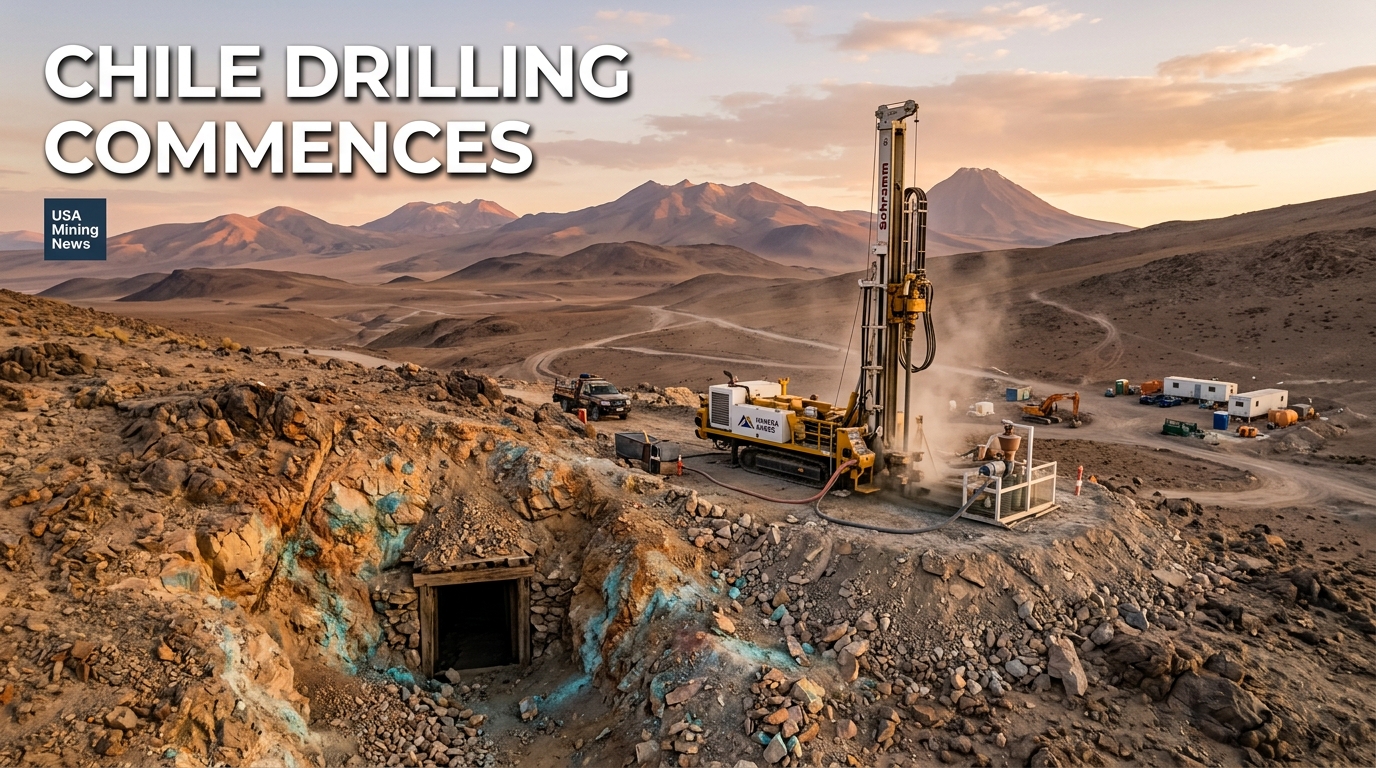
Santiago, Chile – June 16, 2026 – Great Southern Copper (GSC) has announced the commencement of scout reverse circulation (RC) drilling at its Artemisa South copper-gold target, a pivotal component of its extensive Especularita Project located in Chile. This development signifies a crucial step in the company's systematic exploration strategy in a region renowned for its prolific copper endowments, positioning Artemisa South as the final target in the current porphyry exploration campaign. The program seeks to probe beneath historic mine workings, which have already revealed compelling evidence of vein and disseminated copper-gold mineralization within granodiorite rock.
The initiation of drilling at Artemisa South follows a successful initial round of RC drilling at the adjacent Victoria prospect. According to GSC, preliminary findings from Victoria indicate the potential presence of a large-scale porphyry copper-type alteration system, providing a significant boost to the overall prospectivity of the Especularita Project. Industry professionals and investors will be closely monitoring the forthcoming geochemical assay results from Artemisa South, which are anticipated within the next two to four weeks, to gauge the extent and tenor of mineralization.
The Especularita Project: Strategic Positioning in Chile's Metallogenic Belt
The Especularita Project's strategic location within Chile’s Cretaceous coastal metallogenic belt at a relatively low altitude is critically important for its exploration potential. This geological setting is well-established as a host to some of the world's most significant copper-gold deposits. Structural trends within this belt are understood to play a crucial role in controlling the emplacement of mineral systems, linking the Especularita area directly to major, globally recognized copper operations. These include the extensive Los Pelambres copper-molybdenum mine, the Altar porphyry copper-gold deposit, and the El Pachon copper-molybdenum project, all of which underscore the region's immense geological prospectivity for large-scale deposits.
Great Southern Copper holds the rights to own 100% of both the Artemisa South and Artemisa North targets, providing the company with full control over the exploration and potential development pathways of these promising areas. This sole ownership model simplifies decision-making and allows for a more focused allocation of resources as the company systematically advances its understanding of the Especularita Project's mineral potential.
Artemisa South: Targeting Undrilled Historic High-Grade Mineralization
The scout RC drilling campaign at Artemisa South is specifically designed to investigate areas characterized by historic artisanal mine workings. These old operations, which often followed high-grade veins, have left behind surface expressions of significant copper-gold mineralization, hosted within granodiorite. A key aspect distinguishing the Artemisa South target is the notable absence of any previous modern drilling, making these initial RC holes a crucial first assessment of the subsurface potential.
The current drilling plan comprises three RC holes, strategically positioned to evaluate structurally controlled zones. These zones exhibit a suite of alteration minerals and commodities indicative of hydrothermal activity, including chlorite-sericite alteration, copper oxides, trace sulphides, and localized quartz veins. By targeting mineralisation directly beneath these former artisanal mines, GSC aims to establish the potential continuation of these mineralized structural trends at depth, which could point to a much larger, untapped resource.
Victoria Prospect’s Promising Porphyry Indicators
Ahead of the Artemisa South campaign, Great Southern Copper completed an initial phase of RC drilling at the nearby Victoria target. This program involved drilling five RC holes, totaling 662 meters, positioned beneath the La Colorada lithocap – a typically barren, leached cap often found above porphyry systems. The results from Victoria have been particularly encouraging for GSC’s broader porphyry exploration objectives.
The company reported a notable increase in porphyry-style alteration towards the center of the system encountered in the Victoria drill holes. This systematic strengthening of characteristic alteration signatures—such as potassium-silicate, phyllic, or argillic assemblages—is a significant geological indicator often associated with the core of large porphyry copper-gold deposits. This observation strongly suggests that the Victoria prospect could indeed host a substantial porphyry copper-gold target at depth. Core samples from all five holes drilled at Victoria have been dispatched to ALS Laboratories in Santiago, Chile, for comprehensive geochemical analysis, with results expected in due course to further characterize the mineralization.
Exploration Methodology, Technical Protocols, and Ongoing Geophysical Work
Great Southern Copper’s choice of RC drilling for this initial exploration phase is a pragmatic decision well understood within the mining industry. RC drilling is favored for its efficiency and cost-effectiveness compared to diamond drilling, particularly during the scout and reconnaissance stages. It allows for rapid penetration and collection of representative rock chip samples, enabling explorers to quickly determine the presence and rough distribution of mineralization over significant areas.
The company adheres to rigorous technical protocols, with samples collected at 2-meter intervals. These samples undergo stringent quality assurance and quality control (QA/QC) processes before being sent to ALS Laboratories for precise geochemical assay. Such meticulous attention to sampling and analytical integrity is critical for generating reliable data that can inform future exploration decisions and potential resource estimations.
In parallel with the drilling activities, GSC is also actively engaged in processing and interpreting geophysical data. Specifically, audio-frequency magneto-telluric (AMT) geophysics data covering the La Colorada lithocap is currently undergoing detailed interpretation. Geophysical surveys like AMT provide valuable subsurface information by mapping variations in electrical resistivity, which can delineate altered zones and structural features often associated with mineral deposits. Furthermore, the company continues to plan for additional geophysical surveys and further drilling across other promising prospects within the Especularita Project, including Cerro Negro and Viuda, signaling a comprehensive and phased exploration approach.
Leadership Perspective and Strategic Program Goals
Sam Garrett, CEO of Great Southern Copper, articulated the strategic importance of the current drilling operations, stating, “Artemisa South is the final of four targets to be tested with scout RC drilling in the current porphyry exploration programme.” This statement highlights the systematic nature of GSC’s approach, moving through multiple prospects to identify and prioritize the most prospective areas within the Especularita land package.
Mr. Garrett further elaborated on the dual objectives of this program: “This programme is testing beneath high-grade copper-gold-silver mineralisation identified in old workings, providing an opportunity to assess both the broader porphyry potential and the higher-grade mineralised structures observed at Artemisa South.” This reflects a pragmatic exploration strategy that acknowledges both the immediate potential of high-grade, historically exploited zones and the longer-term objective of discovering large-scale porphyry systems—the true prize in many copper exploration ventures.
Market Implications and Future Outlook for Copper and Gold
The exploration efforts by Great Southern Copper are taking place against a backdrop of robust global demand for both copper and gold. Copper, often referred to as "Dr. Copper" for its perceived ability to forecast economic health, is an indispensable metal for the ongoing global energy transition. Its superior electrical conductivity and thermal properties make it critical for renewable energy infrastructure, electric vehicles, and modern electronics. Analysts project a persistent supply deficit for copper in the coming years, driven by electrification trends and inadequate new discoveries, making every potential new source, however early-stage, relevant to the market.
Gold, conversely, continues to serve as a traditional safe-haven asset, store of value, and sought-after commodity in jewelry and technology. Its price is influenced by macroeconomic factors, geopolitical tensions, and inflationary pressures. For a junior explorer like GSC, the presence of both copper and gold enhances project economics and provides a more diversified commodity exposure, potentially attracting a broader range of investors.
For Great Southern Copper, the anticipated geochemical assay results from the current scout drilling phase at Artemisa South, expected within two to four weeks, will be a critical near-term catalyst. Positive results, particularly high-grade intercepts or evidence of broad mineralization, could significantly de-risk the project, leading to increased investor interest and potentially attracting further funding for more extensive follow-up drilling, detailed resource estimation, and feasibility studies. Conversely, weaker results would necessitate a re-evaluation of the target and potentially a shift in exploration focus. This systematic, data-driven approach is essential for advancing exploration projects in a capital-intensive industry.
Conclusion: Advancing Key Exploration Targets in a World-Class Mining Jurisdiction
Great Southern Copper's ongoing exploration program at the Especularita Project, highlighted by the scout drilling campaigns at Victoria and now Artemisa South, demonstrates a methodical and strategic approach to unlocking value in a world-class mining jurisdiction. By leveraging the geological insights gleaned from historic workings and modern geophysical techniques, and adopting cost-effective drilling methods, GSC is systematically de-risking and prioritizing its exploration targets.
The potential for a large-scale porphyry system at Victoria, coupled with the investigation of undrilled, high-grade historic mineralization at Artemisa South, places Great Southern Copper in an intriguing position within the Chilean mining landscape. As the industry awaits the key assay results, the outcomes of these initial drilling phases will undoubtedly shape the future trajectory of the Especularita Project, potentially contributing new valuable resources to meet the ever-growing global demand for critical metals like copper and gold.