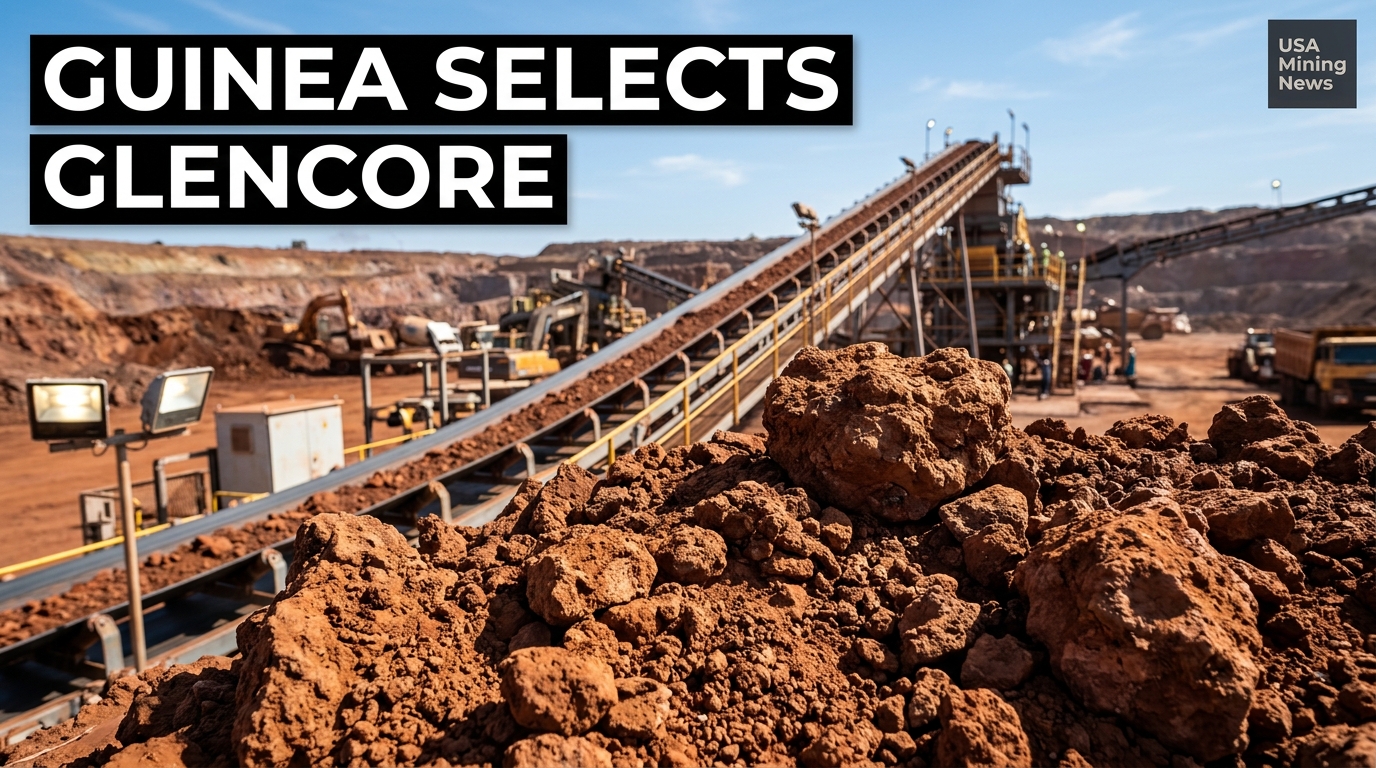
Conakry, Guinea – August 7, 2026 – In a significant move set to reshape the dynamics of global bauxite supply, the Government of Guinea has officially selected Glencore, one of the world's largest diversified natural resource companies, as the exclusive offtaker for bauxite produced by its newly established state-owned entity, Nimba Mining. This strategic decision, reported by Bloomberg, underscores Guinea's deepening resolve to exercise greater oversight over its vast bauxite export volumes, a critical raw material for the aluminium industry.
The selection of Glencore through a competitive international tender process was confirmed by Guinea’s Minister of Mines and Geology, Bouna Sylla, in an interview. This agreement represents a pivotal moment for Guinea, which stands as the undisputed leading global supplier of bauxite, having exported an impressive 183 million tonnes (mt) in the previous year alone. For industry professionals and investors, this development signals not only a shift in Guinea's resource management strategy but also potentially influences the long-term stability and pricing within the global aluminium supply chain.
Guinea’s Strategic Bauxite Initiative Takes Shape
The decision to appoint Glencore as the offtaker is a cornerstone of Guinea's broader initiative to nationalize and streamline its bauxite sector. Minister Bouna Sylla emphasized that the international tender process ensures transparency and competitive engagement, ultimately aiming to secure optimal terms for the nation's most valuable mineral export. This strategy is part of a concerted effort by Guinean authorities to gain more direct control over the extraction, processing, and export of its bauxite, moving away from past models that often granted greater autonomy to international mining companies.
Guinea's bauxite deposits are among the largest and highest-grade in the world, making the nation indispensable to the global aluminium industry. Aluminium production is an energy-intensive process that begins with bauxite, which is refined into alumina and then smelted into primary aluminium. Any significant shift in Guinea's export policy or operational control therefore has far-reaching implications for major aluminium producers worldwide, including those in China, Europe, and North America, who rely heavily on Guinean ore. The government's proactive stance, including discussions initiated in March with various mining companies to manage domestic supply and mitigate the impact of potential downturns in global prices, highlights a sophisticated approach to safeguarding its economic interests.
Nimba Mining: A New State-Owned Champion
At the heart of Guinea's reasserted control is Nimba Mining, a company fully owned by the Guinean state. Nimba Mining was officially established and took over a significant bauxite mining concession in August 2025. This concession was previously held by Guinea Alumina, a subsidiary of Emirates Global Aluminium (EGA). The transfer of the concession followed a publicly acknowledged disagreement regarding the construction of a domestic alumina refinery—a long-standing point of contention between Guinea and various international mining firms. The government's desire to promote value-addition within its borders, rather than merely exporting raw materials, has been a consistent policy objective.
Since its inception, Nimba Mining has quickly ramped up operations, demonstrating its capacity and strategic importance. The company has already exported four million tonnes (4mt) of bauxite so far during the current year. Looking ahead, Nimba Mining has set aggressive but achievable targets: it aims to increase its export volume to between 8mt and 10mt by the end of this year, with an even more ambitious target of 12mt by 2027. These figures underscore the company's operational capabilities and Guinea's commitment to maintaining its dominant position in the global bauxite market, albeit under new terms of engagement.
The establishment and rapid growth of Nimba Mining reflect a broader trend observed in many resource-rich nations, where governments are seeking to leverage their mineral endowments for greater national benefit, including direct revenue generation, job creation, and the development of local industrial capabilities. By taking direct ownership and operational control, Guinea aims to ensure that the economic benefits of its bauxite wealth are maximized for its citizens.
The Glencore Offtake Agreement: Details and Implications
The selection of Glencore as the bauxite offtaker for Nimba Mining is a critical component of this new strategy. While Minister Sylla noted that "talks to finalise the terms of the contract are ongoing," the public announcement itself signals a strong commitment from both parties. An offtake agreement in the mining industry typically involves a long-term contract where a buyer commits to purchasing a predetermined portion, or sometimes the entirety, of a producer's output. For Nimba Mining, this agreement with a global trading giant like Glencore offers several key advantages:
- Guaranteed Market Access: It provides Nimba Mining with a secured buyer for its bauxite, reducing market uncertainty and price volatility risks.
- Financial Stability: A stable revenue stream from guaranteed sales can significantly improve Nimba Mining’s financial planning and operational efficiency.
- Operational Focus: By offloading the complexities of global marketing and logistics to Glencore, Nimba Mining can concentrate its efforts on mining operations and production expansion.
- Potential for Expertise Transfer: While primarily a commercial agreement, collaboration with a company of Glencore's scale and experience may indirectly offer insights into global best practices in logistics and supply chain management.
For Glencore, securing an offtake agreement with Guinea's state-owned bauxite producer is a strategic coup. It guarantees a reliable supply of high-quality bauxite from the world's largest producer, strengthening Glencore's position in the global aluminium value chain. This move enhances Glencore's portfolio of critical raw materials, aligning with its extensive global trading and marketing network across a diverse range of commodities, including copper, cobalt, zinc, and coal. The ability to secure long-term access to essential raw materials is paramount for trading houses and industrial consumers alike, providing stability in an often volatile commodity market.
Diversification Beyond Bauxite: Nimba’s Broader Ambitions
Nimba Mining's strategic vision extends beyond its foundational bauxite operations. Minister Sylla also revealed the company’s ambitious plans to diversify into other key mineral sectors, specifically gold, iron ore, and metals refining. This diversification strategy is crucial for de-risking the company's revenue streams from over-reliance on a single commodity and for fostering a more robust, multi-faceted national mining industry.
To spearhead its gold ambitions, Nimba Mining has established a new subsidiary, Nimba Gold. This entity has already made significant strides, reaching a Memorandum of Understanding (MoU) with Resolute Mining, an established gold producer with operations across Africa and Australia, to pursue joint gold projects. This partnership is expected to combine Nimba Gold's local knowledge and government backing with Resolute Mining’s technical expertise and operational experience. The company plans to introduce these additional operations in phases, commencing with exploration work and gradually progressing to full-scale production at a later stage, reflecting a prudent and systematic approach to resource development.
The pursuit of iron ore and metals refining also underscores Guinea’s commitment to value addition. Developing domestic refining capabilities would allow Guinea to process raw minerals into higher-value products, thereby capturing a larger share of the commodity's final market price. This strategy is consistent with the government's earlier disagreements with Guinea Alumina regarding an alumina refinery, highlighting a sustained national objective to move up the value chain in its mineral sector. The existing "Nimba Iron Ore Mine" and "Nimba Iron Ore Project" mentioned in industry reports further suggest a long-term vision for this critical industrial metal.
Market Context and Global Repercussions
Guinea's actions with Nimba Mining and Glencore are not isolated but reflect a broader trend of resource nationalism and increased state intervention in the global mining industry. Governments in commodity-rich nations are increasingly seeking to optimize returns from their natural resources, driven by desires for greater economic sovereignty, local content development, and enhanced revenue collection.
For the global aluminium market, these developments ensure a continued, if more tightly controlled, flow of bauxite from Guinea. However, they also signal an evolving landscape where access to critical raw materials may come with new conditions, including demands for local processing, technology transfer, or equity participation. The partnership with Glencore, a major global trader, suggests a pragmatic approach by Guinea to leverage international market expertise while retaining ultimate control. This balance is critical for maintaining investor confidence while achieving national development objectives.
The government's announcement in March about ongoing discussions with mining companies to manage domestic supply and protect against price downturns further illustrates a proactive and sophisticated approach to market management. This indicates a willingness to engage strategically with the private sector but on terms that prioritize national interests and long-term economic resilience.
Future Outlook and Investment Considerations
The coming months will be crucial for the finalization of the Glencore offtake contract and the accelerated ramp-up of Nimba Mining's bauxite production towards its 2027 target of 12mt. Simultaneously, the progress of Nimba Gold's joint projects with Resolute Mining and the broader diversification into iron ore and metals refining will be closely watched by the industry.
Challenges remain, particularly in scaling up operations efficiently, navigating potential market volatility, and securing the significant capital and technical expertise required for metals refining. However, Guinea's clear strategic direction, coupled with its immense mineral wealth and the backing of established global partners like Glencore and Resolute Mining, positions it for continued prominence in the global mining sector. For investors, these developments underscore the importance of understanding geopolitical dynamics and evolving resource policies in key mining jurisdictions. Guinea is clearly asserting itself as a nation determined to maximize the value of its mineral heritage, and the industry will be watching closely as this strategic vision unfolds.