Leviathan Metals Advances Exploration with Strategic EM Survey in Botswana's Kalahari Copper Belt
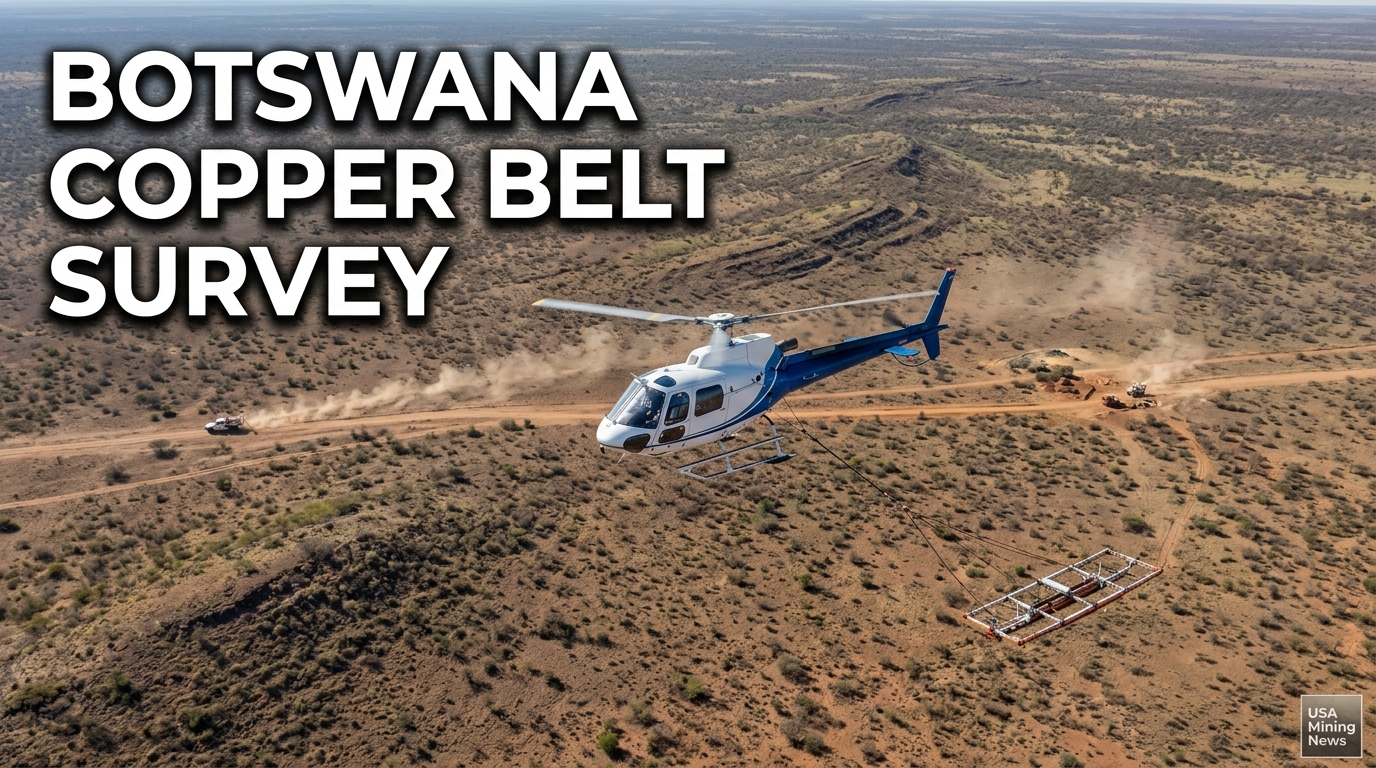
April 24, 2026 – Leviathan Metals has announced the successful completion of a high-resolution helicopter-borne electromagnetic (EM) survey at its 100% owned Central Project, located within the highly prospective Kalahari Copper Belt (KCB) of Botswana. This significant milestone marks a pivotal early step in the company's aggressive exploration strategy to unlock potential sediment-hosted stratiform copper mineralization in one of Africa's most promising copper frontiers.
The comprehensive survey, which concluded recently, gathered approximately 580 kilometers of critical electromagnetic data. Conducted with precision, the survey flew at 300-meter line intervals and maintained a ground clearance of approximately 35 meters. This methodical approach to data acquisition is designed to provide the Leviathan geoscientific team with detailed subsurface information, essential for identifying and mapping conductive markers that are typically associated with base metal mineralization, particularly stratiform copper deposits.
The completion of this survey underscores Leviathan's commitment to employing leading-edge exploration technologies to efficiently and effectively advance its projects. The KCB, recognized globally for its significant copper potential, continues to attract considerable investment, and Leviathan's systematic approach is poised to capitalize on the region’s geological promise.
Advanced Geophysical Techniques for Targeted Exploration
The helicopter-borne EM survey represents a sophisticated and efficient method for subsurface imaging, particularly in vast and often geologically complex terrains like the KCB. Electromagnetic surveys work by inducing electrical currents into the ground using an electromagnetic transmitter. Conductive materials, such as those often associated with sulfide mineral deposits like copper, respond by generating secondary electromagnetic fields. These fields are then detected by sensitive receivers, providing insights into the geological structure and potential mineralized zones beneath the surface.
For the Central Project, the survey was expertly executed by New Resolution Geophysics of Noordhoek, South Africa, utilizing their advanced Xcite system. The deployment of an AS350 B-series helicopter ensured optimal ground clearance and precise data acquisition over the project's target area. Leviathan Metals’ geoscientific team maintained daily oversight of the survey operations, ensuring quality control and adherence to the project's technical specifications. The 300-meter line spacing employed for this survey is considered high-resolution for regional exploration, allowing for detailed mapping of geological features and the accurate delineation of conductive anomalies.
The primary objective of this data collection is to precisely map conductive markers, which are critical indicators for identifying mineralisation controls along the D’Kar-Ngwako Pan Formation (DKF-NPF) contact. This particular geological contact is widely recognized by geologists as a primary host for sediment-hosted stratiform copper deposits within the Kalahari Copper Belt. By mapping these conductive zones, Leviathan aims to pinpoint areas where copper sulfides may have accumulated, setting the stage for subsequent, more targeted exploration activities, specifically drilling.
Strategic Proximity to World-Class Deposits
One of the most compelling aspects of Leviathan's Central Project is its strategic location within the KCB. The project directly borders the significant Khoemacau deposits, now owned by MMG Limited. MMG acquired these assets for a substantial 1.9 billion USD (approximately 2.66 billion AUD) in 2023, a transaction that highlights the immense value and potential recognized within this mineral district. The Khoemacau assets include the well-known Banana Zone, Zone 6, and Ophion deposits, which together represent one of the largest copper producers in Botswana.
The resource endowment at MMG’s Khoemacau operations provides a clear benchmark for the potential within Leviathan’s adjacent Central Project. The combined measured and indicated mineral resources at Khoemacau stand at an impressive 94 million tonnes (mt) grading 1.8% copper and 22 grams per tonne (g/t) silver. Furthermore, inferred resources add another 188 mt at 1.6% copper and 20 g/t silver. These figures underscore the substantial scale and high-grade nature of the sediment-hosted stratiform copper mineralization found in this part of the KCB.
Critically, Leviathan's Central Project possesses similar geological features to Khoemacau, including the presence of the D’Kar-Ngwako Pan Formation (DKF-NPF) contact, which hosts a prominent domal structure. Such domal structures are often associated with structural traps and fluid pathways that facilitate the deposition of stratiform copper mineralization. The domal structure analyzed by Leviathan's survey sits directly south of MMG’s Khoemacau deposits, reinforcing the geological analogous nature and indicating a strong potential for significant copper finds within Leviathan’s tenure.
The Kalahari Copper Belt: A Global Hotspot for Copper
The Kalahari Copper Belt has garnered international attention from the mining industry and geological surveys alike. The US Geological Survey, a highly respected authority, has identified the KCB as a prime area for sediment-hosted copper deposits. This classification is significant as sediment-hosted stratiform copper deposits are typically large-tonnage, lower-cost operations, contributing substantially to global copper supply. These deposits are characterized by their consistent grades over vast areas, making them economically attractive for long-term mining ventures.
The KCB spans parts of Botswana and Namibia and is geologically analogous to other world-class sediment-hosted copper belts, such as the Central African Copperbelt in Zambia and the Democratic Republic of Congo, and the Kupferschiefer deposits in Eastern Europe. The style of mineralization is typically characterized by copper sulfide minerals (such as chalcocite, bornite, and chalcopyrite) disseminated within sedimentary rocks, often at lithological contacts or within structural traps. The presence of these characteristics within Leviathan's Central Project, particularly the DKF-NPF contact, makes it a highly attractive exploration target.
With global demand for copper projected to rise significantly due to the accelerating energy transition and electrification initiatives, the discovery and development of new copper resources are of paramount importance. Projects within well-established, high-potential belts like the KCB are strategically vital for meeting future supply needs, making Leviathan’s exploration efforts highly relevant to the broader industry.
A Clear Path Forward: From Geophysics to Drilling
Luke Norman, CEO of Leviathan Metals, expressed enthusiasm regarding the survey's completion and the company's strategic positioning within Botswana. "We are delighted to apply this efficient, leading-edge, high-resolution geophysical technology as our opening move in the exploration of our newly acquired Central Project on the Kalahari Copper Belt of Botswana – a land of outstanding discovery potential," stated Mr. Norman.
The successful collection of high-quality electromagnetic data represents a critical step in de-risking the project and focusing subsequent exploration efforts. Geophysical surveys, by providing a subsurface map, help to define priority targets more precisely, thereby optimizing the placement of drill holes and reducing the overall cost and risk of exploration. The data will now undergo rigorous interpretation by Leviathan's geoscientific team.
Mr. Norman further outlined the immediate next steps, emphasizing the rapid transition from data interpretation to active drilling. "With survey data in hand, our geoscientific team shortly expects to select a series of targets for near-term drill testing, for which preparations are already under way. Leviathan is in full swing in Botswana, and we look forward to an exciting 2026 exploration campaign," he affirmed.
This rapid progression from geophysical reconnaissance to drill target generation highlights the company's confidence in the project's prospectivity and its commitment to an accelerated exploration timeline. The 2026 exploration campaign is anticipated to be a pivotal year for Leviathan Metals as it aims to translate geophysical anomalies into confirmed copper mineralization through direct drilling. The industry will be closely watching Leviathan's progress, as successful drill results could not only validate the Central Project's potential but also further cement the KCB's reputation as a premier destination for copper discovery.