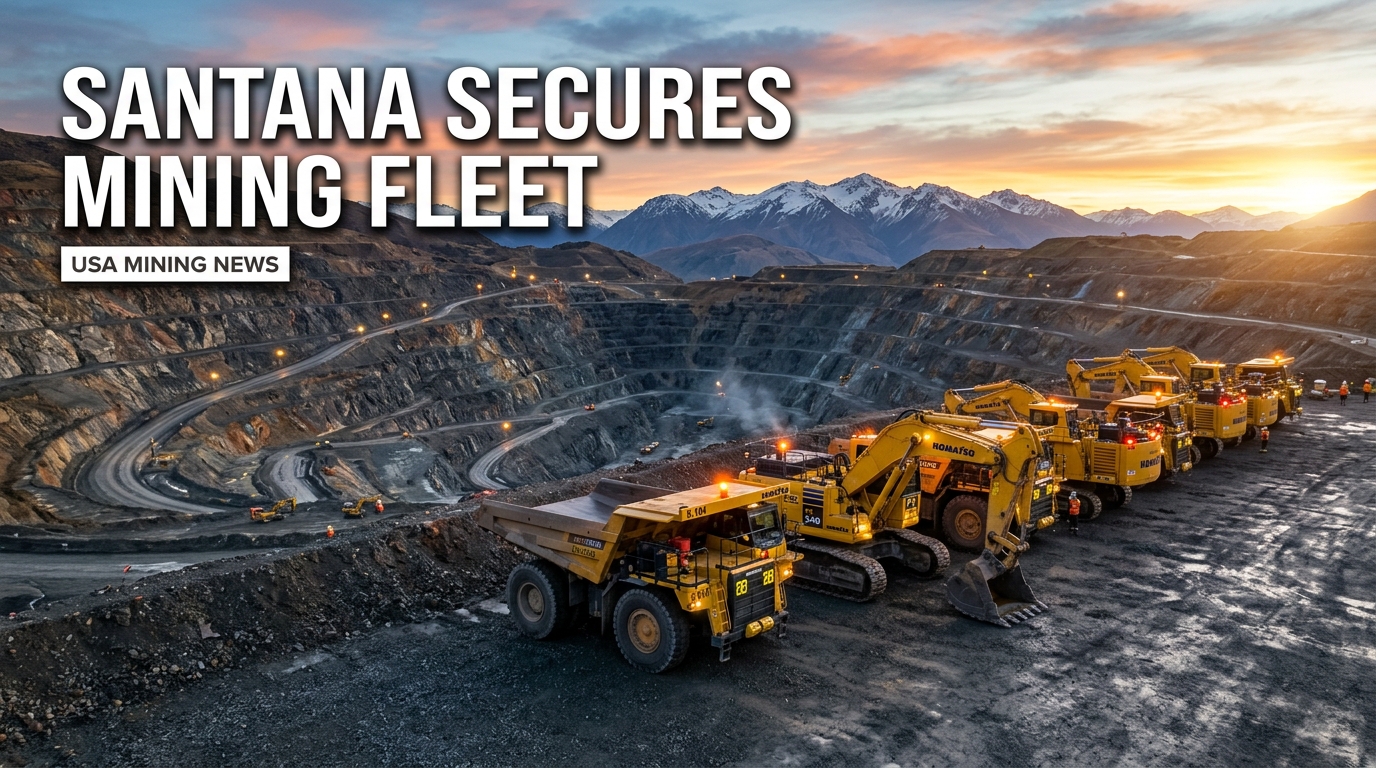
Dunedin, New Zealand – In a strategic move signaling significant progress for its flagship Bendigo-Ophir Gold Project, Santana Minerals has announced the securing of key mining fleet build slots with Komatsu New Zealand. Valued at NZ$115 million (approximately US$65.8 million), this agreement ensures the timely delivery of essential mobile equipment, a crucial prerequisite for the commencement of construction activities. The development places Santana Minerals firmly on a path toward potentially becoming a significant new gold producer in New Zealand, though the project’s progression remains contingent on a fast-track approval (FTA) decision anticipated in late 2026.
Santana Minerals Secures Key Equipment for Bendigo-Ophir
The securing of build slots with a major original equipment manufacturer (OEM) like Komatsu is a pivotal moment in the development lifecycle of any large-scale mining project. For Santana Minerals’ Bendigo-Ophir Gold Project, this represents a tangible commitment to operational readiness, effectively de-risking a critical component of the supply chain. The agreement, publicly announced on March 31, 2026, ensures that when all necessary regulatory clearances are granted, the company will have access to the heavy machinery required to initiate site development and subsequent mining operations.
This commitment from Komatsu New Zealand includes the provision of a comprehensive array of mobile equipment. Primary excavators, specifically the robust PC3400 and PC2000 models, known for their efficiency and capacity in large-scale earthmoving operations, form the backbone of the planned fleet. Complementing these will be 140-tonne class HD1500 haul trucks, designed for heavy-duty material transport within the mine site. Beyond these core machines, the agreement also covers additional support and ancillary equipment, including dozers, loaders, haul trucks, and graders, all essential for grading, loading, material handling, and general site maintenance tasks.
In the highly competitive and often logistically complex global mining industry, securing definitive supply arrangements for heavy equipment far in advance is a testament to prudent project planning and a strong indicator of a company’s confidence in its project timeline. It mitigates the risks associated with equipment lead times, manufacturing capacity constraints, and potential inflationary pressures on capital expenditure.
Strategic Partnership with Komatsu New Zealand
The relationship between Santana Minerals and Komatsu extends beyond a simple purchase agreement. The NZ$115 million fleet is being acquired through a leasing agreement, which is notably supported by Komatsu’s own OEM financing. This financial arrangement offers several strategic advantages. For Santana Minerals, it likely preserves capital that might otherwise be tied up in outright equipment purchases, allowing for more flexible allocation of funds to other critical project development areas. For Komaku, such agreements deepen their partnership, ensuring long-term engagement and support for their high-value equipment.
Such leasing and financing models are increasingly prevalent in the mining sector, providing operators with access to the latest technology and top-tier equipment without the immediate upfront capital outlay. This can significantly improve a project’s financial metrics, particularly in the pre-production phase when cash flow is often constrained.
The Fleet: A Closer Look at Operational Capability
The specified Komatsu models selected for the Bendigo-Ophir project highlight a clear strategy for efficient, large-scale open-pit mining operations. The PC3400 and PC2000 excavators are industrial workhorses, capable of moving significant volumes of earth and ore, which is paramount for achieving targeted production rates in bulk mining scenarios. Matching these with 140-tonne class HD1500 haul trucks indicates an optimized loading and hauling circuit, designed to minimize cycle times and maximize material movement efficiency.
- Primary Excavators: Komatsu PC3400 and PC2000 models. These multi-purpose excavators are critical for overburden removal and ore extraction, offering a balance of power, fuel efficiency, and reliability in demanding mining environments.
- Haul Trucks: Komatsu 140-tonne class HD1500 trucks. These large rigid-frame dump trucks are engineered for high-volume transport over rugged terrain, ensuring efficient movement of material from pit to processing plant or waste dumps.
- Support Equipment: An array of dozers, loaders, additional haul trucks, and graders. This auxiliary fleet is essential for infrastructure development, road maintenance, stockpiling, and other critical site support functions that contribute to overall operational continuity and safety.
The careful selection of this fleet underscores Santana's commitment to building a robust and efficient mining operation from the ground up, leveraging proven equipment technologies from a reputable global supplier.
Comprehensive Support: Ensuring Fleet Performance and Longevity
A significant component of the agreement with Komatsu is the extensive long-term support package accompanying the equipment. This is a critical factor for any mining operation, as the performance and reliability of heavy machinery directly impact productivity, operational costs, and ultimately, profitability. Komatsu’s commitment includes operational, technical, and financial assistance designed to maximize uptime and efficiency over the life of the assets.
Key elements of this comprehensive support package include:
- On-Site Technical Support: A five-year plan featuring dedicated personnel deployed on-site to provide immediate technical assistance and expertise. This proactive approach helps to pre-empt issues and rapidly resolve any mechanical or operational challenges.
- Extended Product Support: Beyond routine maintenance, this ensures the long-term integrity and performance of the equipment, reflecting Komatsu's confidence in its products and its commitment to customer success.
- Maintenance and Parts Support: Integrated through on-site parts capability and advantageous discounted pricing arrangements. This streamlines the procurement of essential spares and ensures quick repairs, minimizing costly downtime.
- Technology and Systems Support: Covering modern mining systems such as fleet management, condition monitoring, and performance tracking. These technologies are vital for optimizing operational workflows, predicting maintenance needs, and ensuring peak efficiency.
- Training Initiatives: Including both productivity training and simulator training programs. These are designed to equip Santana’s workforce with the skills necessary for a swift ramp-up of operations, ensuring efficient and safe machinery operation, which directly contributes to consistent performance levels and reduced operational risk.
This holistic support approach is invaluable for a new mine, providing the foundation for reliable operations and helping Santana Minerals to establish an effective maintenance regime from the outset.
The Value Proposition: Owner-Miner Model and Cost Efficiencies
Santana Minerals CEO Damian Spring articulated the strategic advantages underpinning the company’s operational model. He stated, “Operating as an owner-miner removes the contractor margin typically embedded in mining costs, setting us up as a lower-cost operation.” This decision to operate as an owner-miner, rather than relying solely on third-party mining contractors, is a significant strategic choice. While it entails greater capital expenditure and operational responsibility, it offers the potential for substantial long-term cost savings, direct control over mining processes, and greater flexibility in adapting to market conditions or orebody variations.
Further enhancing the project’s cost efficiency, Spring highlighted several other key factors:
- Residential Workforce Model: By recruiting a predominantly local workforce and avoiding the high costs associated with fly-in fly-out (FIFO) logistics and accommodation, Santana aims to reduce labor-related expenses significantly. This also fosters stronger community relations and local economic development.
- Strong OEM Support from Komatsu: As detailed, the comprehensive support package from Komatsu is expected to minimize maintenance costs, reduce unexpected downtime, and optimize equipment performance, all contributing to a lower overall operating cost per tonne.
- Grid-Connected Processing Infrastructure: The planned connection to New Zealand’s national electricity grid for processing infrastructure provides access to reliable and potentially lower-cost power. This stability across a key cost driver, particularly in an environment of volatile energy markets, offers a considerable advantage over projects reliant on costly and often less reliable diesel-generated power.
These combined strategies position Bendigo-Ophir as a project focused on achieving robust economic performance and resilience against market fluctuations, a highly attractive proposition for investors and stakeholders in the current gold market.
Navigating the Approval Pathway: The Fast-Track Decision
Despite the significant progress in equipment procurement, the commencement of construction at Bendigo-Ophir remains subject to a critical regulatory milestone: a fast-track approval (FTA) decision. This decision is anticipated on October 29, 2026. Fast-track approvals are typically designed to expedite the permitting process for strategically important projects, recognizing their potential economic and social benefits. However, they still involve rigorous environmental, social, and technical assessments by governmental authorities.
The 2026 deadline highlights the ongoing engagement between Santana Minerals and New Zealand’s regulatory bodies. Successful navigation of this approval process is paramount, as all capital commitments and operational plans are predicated on receiving the environmental and operational permits necessary to proceed. Investors will be closely watching this date, as a positive decision will fully de-risk the regulatory environment for the project’s development.
Foundation for Development: Land Acquisition and Project Integration
Adding another layer of foundational development, Santana Minerals, through its subsidiary Matakanui Gold, signed a binding agreement in July 2025 to acquire the integral Ardgour Station land. This land parcel is crucial for the Bendigo-Ophir gold project, likely providing essential surface rights for mine infrastructure, processing facilities, tailings storage, and access routes. Securing land tenure in advance is a vital step, eliminating potential future complications related to land access and ensuring a clear pathway for project layout and development.
This acquisition, coupled with the equipment build slots, demonstrates a systematic and comprehensive approach to project development, addressing both surface rights and operational hardware well ahead of the anticipated construction phase.
Market Implications and Future Outlook for New Zealand Gold
The advancement of the Bendigo-Ophir project holds significant implications for New Zealand's mining sector. While New Zealand has a history of gold production, new large-scale projects are relatively rare. Bendigo-Ophir, located in the historic Otago goldfields, represents a modern iteration of gold mining in the region, leveraging advanced exploration and extraction techniques.
The project’s potential to become a low-cost, owner-operated mine, supported by robust infrastructure and a local workforce, could establish it as a benchmark for future mining developments in the country. For the global gold market, a new producer with competitive cost structures could contribute to overall supply, though the initial scale of Bendigo-Ophir's output would likely have a localized rather than global impact on prices. However, it signals continued investment interest in established gold-producing regions and a confidence in the long-term fundamentals of gold as a commodity.
With the securing of equipment, strategic land acquisitions, and a clear path towards regulatory approval next year, Santana Minerals is methodically positioning Bendigo-Ophir to transition from a promising exploration asset to a significant operational gold mine. The coming months, particularly leading up to the October 2026 fast-track approval decision, will be critical in shaping the future of this ambitious project and its role in New Zealand’s mining landscape.