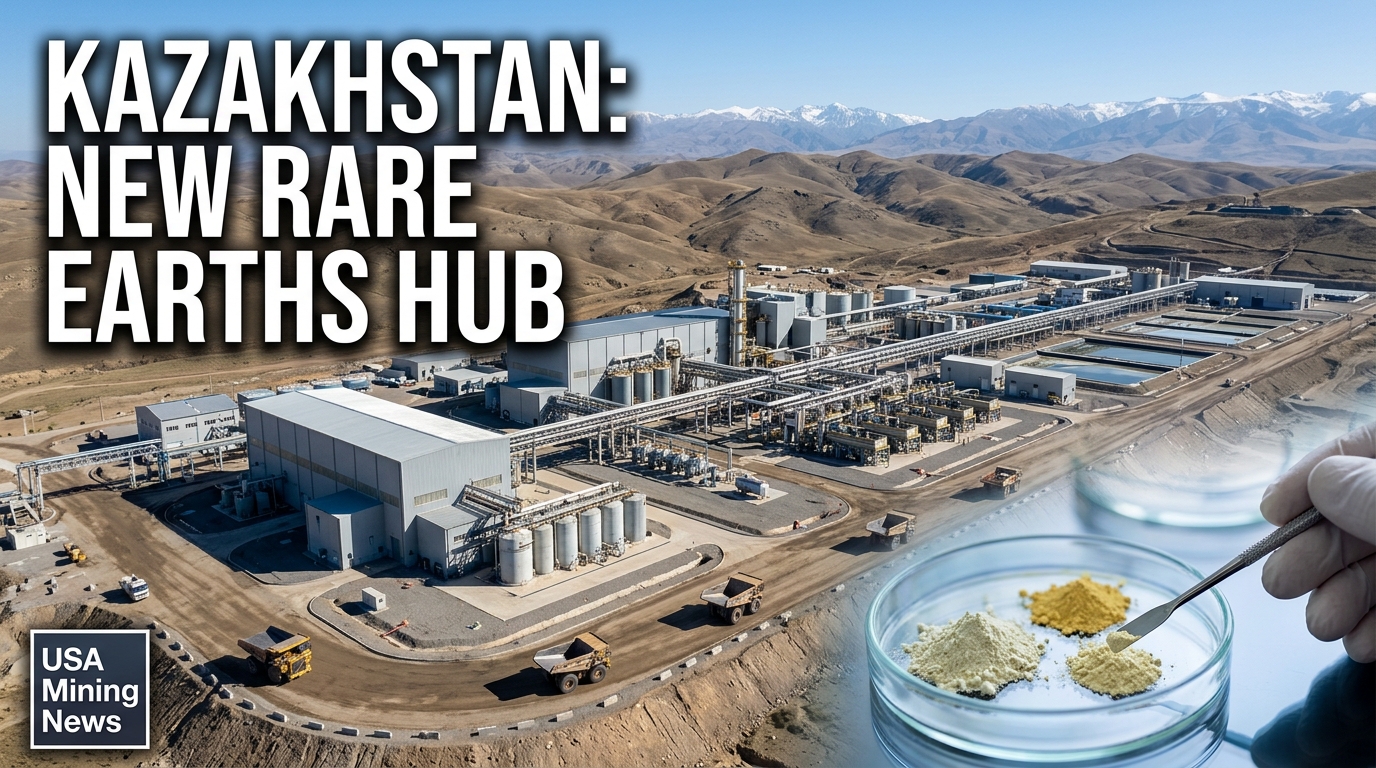
In a significant development for the global rare earth elements (REE) sector, Australian-listed Lindian Resources has entered into a definitive agreement with French specialty chemical company Carester to develop a substantial rare earth oxide (REO) separation facility in Stepnogorsk, Kazakhstan. This strategic partnership, announced on September 3, 2026, also includes a binding long-term offtake arrangement for heavy rare earth (HRE) products, marking a pivotal step towards establishing a diversified and integrated REE supply chain outside traditional concentrations.
Strategic Partnership Forges New Rare Earths Hub in Central Asia
The collaboration between Lindian Resources and Carester is designed to establish an 8,000 tonnes per annum (tpa) solvent extraction and oxide separation plant. This facility will play a critical role in processing mixed rare earth concentrates into high-purity separated rare earth oxides, which are indispensable for numerous advanced technologies, particularly high-strength permanent magnets. The agreement formalizes the provision of advanced technology and engineering services by Carester, a leader in rare earth separation processes.
As part of the initial phase, Carester, in conjunction with Australian consulting and engineering firm Tetra Tech Coffey, has been tasked with progressing a definitive feasibility study (DFS) for the Stepnogorsk facility. The completion of this crucial DFS is expected by the end of 2026, providing a detailed blueprint for the plant’s construction and operation. This meticulous planning phase is essential for de-risking the project and securing its long-term viability.
Robert Martin, Executive Chairman of Lindian, underscored the strategic importance of this venture, stating, “The agreement with Carester represents another significant step in Lindian’s strategy to move further downstream to expand our markets and to capture more of the value from the rare earths that we produce.” This sentiment was echoed by Carester President Frédéric Carencotte, whose company brings decades of specialized experience in rare earth processing to the partnership, aiming to optimize the efficiency and output of the planned facility.
Technical Blueprint: A Mine-to-Oxide Processing Chain
The proposed Stepnogorsk plant is engineered to produce separated rare earth oxides, including critical elements such as neodymium (Nd) and praseodymium (Pr), which are fundamental components of neodymium-iron-boron (NdFeB) permanent magnets. These magnets are vital for the burgeoning electric vehicle (EV) market, wind turbines, and various high-tech electronics. Beyond these light rare earth elements, the facility is also slated to produce a mixed heavy rare earth compound known as SEGH.
Lindian’s integrated approach envisions a comprehensive mine-to-oxide processing chain. The feedstock for the Stepnogorsk plant will primarily originate from Lindian’s Kangankunde monazite concentrate project. The company’s vision is to leverage its upstream mining assets to feed downstream processing facilities, thereby maximizing value capture across the entire supply chain. Furthermore, Lindian has indicated that the solvent extraction plant could potentially process additional rare earth feed sources from Kazakhstan, offering a pathway to expand its production platform and consolidate Kazakhstan’s role in the global REE market.
A key advantage of the Stepnogorsk location is its access to existing local infrastructure. This includes readily available power, water, rail transport, and a reliable supply of reagents, which are all critical inputs for a complex chemical processing facility. The company believes that utilizing these established resources will significantly help in reducing both capital expenditure (CapEx) and operating costs (OpEx) for the project, enhancing its economic competitiveness and operational efficiency.
Securing the Supply Chain: The Offtake and Downstream Integration
A cornerstone of this agreement is the binding ten-year offtake arrangement for the mixed HRE compound, SEGH. Under these terms, Carester is committed to purchasing at least 70% of the annual SEGH output from the Stepnogorsk plant, with two potential five-year extension options. This long-term commitment provides substantial revenue security for Lindian and ensures a stable market for the produced HREs, which typically command higher prices due to their scarcity and criticality in specialized applications.
Products from Lindian’s Kazakhstan operations, including the separated REOs and the SEGH compound, will be largely sent to Carester’s Caremag Refinery located in Lacq, France. The Caremag Refinery is itself a strategic joint venture, involving Carester, the Japan Organization for Metals and Energy Security (JOGMEC), and Iwatani, a major Japanese trading company specializing in energy and industrial materials. This refinery has garnered substantial financial backing, including €106 million from French sources and Y19.9 billion from Japanese sources, underscoring the international significance of securing diversified rare earth supply chains.
The Caremag Refinery in France has ambitious production targets, aiming to produce up to 600 tonnes per year of dysprosium (Dy) and terbium (Tb) oxides, along with 800 tonnes per year of neodymium and praseodymium oxides. Dysprosium and terbium are heavy rare earth elements that are crucial for high-temperature applications of NdFeB magnets, enhancing their performance and reducing demagnetization. By supplying magnet-related REOs such as dysprosium, terbium, and yttrium, Lindian is directly contributing to strengthening the European and Japanese industrial bases that rely heavily on these critical materials.
Financial Underpinnings and Local Support
The development of the Stepnogorsk facility is expected to be funded internally by Lindian. The company plans to leverage its existing operations and its robust closing liquidity, reported at $89.9 million (equivalent to A$125 million). This internal funding strategy highlights Lindian’s confidence in the project’s economic potential and its ability to finance growth without immediate reliance on external equity or debt markets, which can be advantageous in terms of retaining ownership and control.
Crucially, the project has received strong endorsement from the Kazakh government. Kazakhstan’s Ministry of Industry and Construction has expressed unequivocal support for the proposed rare earths separation facility, recognizing its strategic importance for the nation’s burgeoning rare earths sector. This governmental backing is a significant asset, potentially streamlining regulatory processes, providing local support, and reinforcing the project’s long-term stability within the country.
Lindian’s existing footprint in Kazakhstan includes its SARECO mixed rare earth concentrate (MREC) facility. Executive Chairman Robert Martin noted, “Following our acquisition of 100% of the SARECO MREC facility, we now have an established processing platform from which we can produce mixed rare earth concentrate and mixed rare earth carbonates as we move towards the realization of producing separated oxides.” Carester will also contribute its expertise by reviewing the SARECO facility for potential optimization and upgrades, ensuring that the entire processing value chain is as efficient and advanced as possible.
Industry Implications and Future Outlook
This project represents a critical step in reshaping the global rare earths landscape. The current rare earth supply chain is heavily concentrated, with a single dominant producer accounting for a significant majority of processed REOs. The establishment of new, robust processing capabilities in regions like Kazakhstan, backed by international partnerships with European and Japanese entities, directly addresses global concerns regarding supply chain resilience and diversification.
For the mining industry, this venture demonstrates the increasing strategic value of moving beyond raw material extraction into downstream processing. Companies that can control more of the value chain, from mine to separated oxide, are better positioned to capture higher margins and mitigate market volatility. The emphasis on magnet-related rare earths – neodymium, praseodymium, dysprosium, and terbium – underscores their indispensable role in the clean energy transition and advanced manufacturing sectors, making projects like Stepnogorsk vital for future technological development.
The expectation of completing the DFS by the end of 2026 sets a clear timeline for the project’s progression. Following a successful DFS, the next phases would involve detailed engineering, procurement, and construction, leading to the eventual commissioning and operation of the 8,000 tpa facility. The potential to expand production by processing additional rare earth feed sources from Kazakhstan also positions the country as an emerging hub for rare earth processing, potentially attracting further investment and development in its natural resource sector.
In conclusion, the Lindian-Carester agreement to build a rare earth oxide separation plant in Stepnogorsk, Kazakhstan, is more than just a corporate deal; it is a strategic maneuver that strengthens critical mineral supply chains, enhances value creation for producers, and fosters international collaboration in an increasingly vital industry. As the world transitions to a greener, more technologically advanced future, diversified and secure access to rare earth elements will be paramount, and this project places Kazakhstan and its partners at the forefront of this critical evolution.