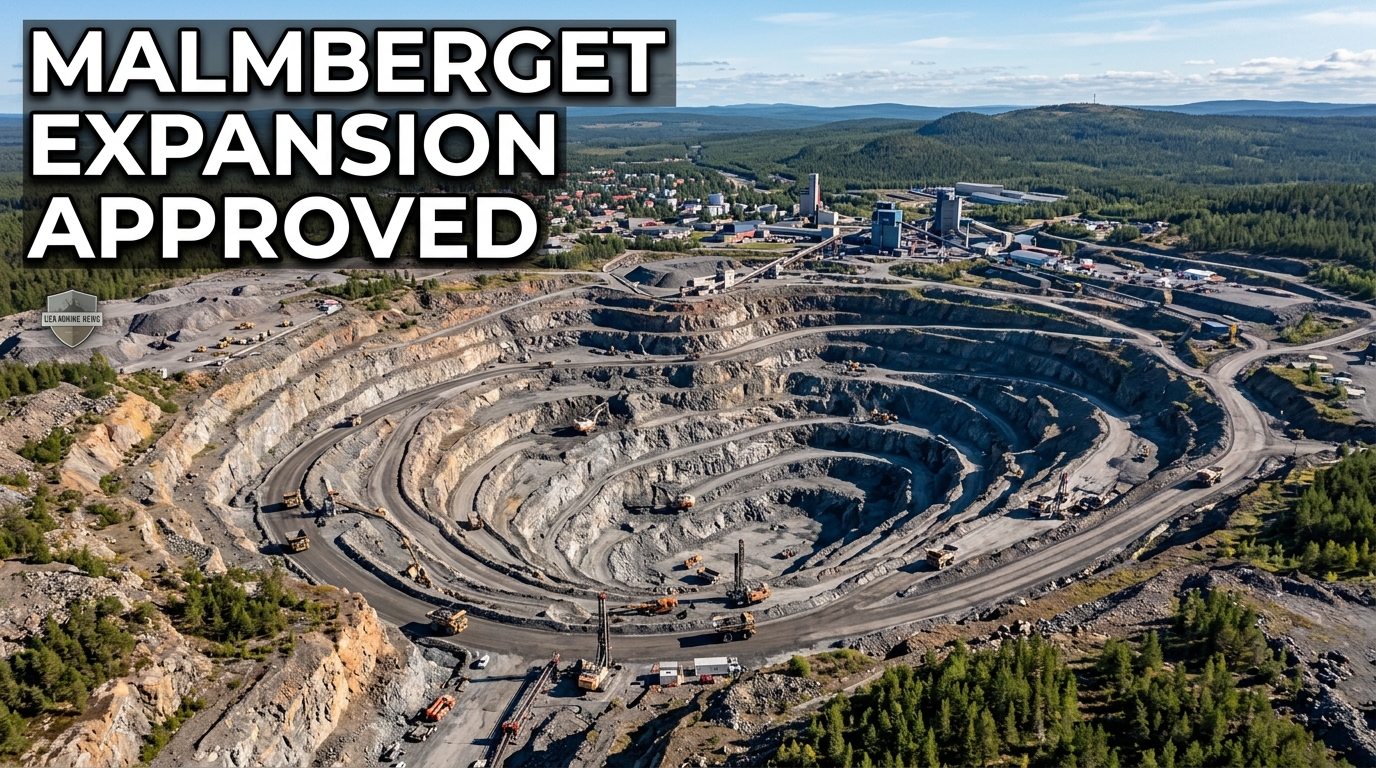
GÄLLIVARE, SWEDEN – In a landmark decision rendered on June 16, 2026, the Swedish Land and Environmental Court granted state-owned mining group LKAB a crucial permit to continue and significantly expand its mining and processing operations at the venerable Malmberget site in Gällivare. This ruling is heralded as profoundly important for the ongoing development and future trajectory of the 135-year-old mining complex, a cornerstone of the Swedish industrial landscape since its inception in 1890.
The permit is comprehensive, encompassing not only the existing extraction activities but also a suite of ambitious growth plans. These initiatives are meticulously balanced with measures aimed at bolstering environmental stewardship, specifically targeting reductions in environmental impact on air and water quality within the operational vicinity. Crucially, the approval paves the way for LKAB to establish a demonstration plant dedicated to the production of fossil-free sponge iron – a pivotal step in decarbonizing the steel industry – and to construct a new, state-of-the-art facility for processing apatite, a mineral rich in strategically important elements.
Expanding Operations and Securing Strategic Minerals
The Malmberget mine, steeped in history, is now positioned for a renewed era of productivity and strategic importance. Recent exploration efforts have unveiled a substantial increase in identified mineral resources at the site, now totaling more than two billion tonnes (2bt). This figure is not merely impressive in its own right; it significantly surpasses the entire quantity of material that LKAB has extracted from Malmberget since mining operations commenced over a century ago in 1890. This vast resource base underscores the long-term potential and continued economic viability of the operation.
Beyond its traditional role as a high-grade iron ore producer, Malmberget holds significant untapped reserves of other critical minerals, specifically phosphorus and rare earth elements (REEs). The new permit directly addresses the extraction and processing of these valuable commodities. LKAB’s plans include utilizing the apatite concentrate, derived from these new processing activities, at its envisioned industrial park in Luleå. This integrated approach aims to extract both phosphorus, a vital component for mineral fertilizers essential to global food security, and REEs, which are indispensable for a myriad of modern technologies.
The applications of REEs are far-reaching and underpin many industries critical to the global energy transition and defence. These elements are integral to the manufacturing of electric vehicles (EVs), the large magnets used in wind turbines, and advanced components within the defense sector. By developing an indigenous supply chain for these materials, Sweden and, by extension, the European Union, can significantly reduce their reliance on often concentrated and geopolitically sensitive external sources, enhancing supply chain resilience and strategic autonomy.
Leadership Perspective and Operational Imperatives
LKAB President and CEO Johan Menckel underscored the profound significance of the court’s decision. “At last, we have a ruling in place,” Menckel stated, adding, “We now need to review it and assess how to proceed. We operate in a time of major challenges and uncertainty, where it is crucial to gradually create better conditions for conducting and developing our operations.” Menckel's remarks highlight the complex interplay of regulatory hurdles, market dynamics, and environmental considerations that modern mining operations must navigate.
His further comment, "For us, this is not just about opportunities to grow and develop but about being able to continue mining operations at all," speaks volumes about the necessity of such permits for the very continuity of established, large-scale mining enterprises in an increasingly scrutinised regulatory environment. The ability to secure permits that allow for both existing operations and responsible expansion is paramount for ensuring the long-term sustainability and economic contribution of legacy mine sites like Malmberget.
Monika Sammelin, LKAB’s Malmberget area manager, emphasized the dual benefits of the expanded operations. “This enables us to contribute to reduced carbon emissions from iron and steel production, while also allowing us to implement concrete environmental improvements locally,” Sammelin noted. This statement succinctly encapsulates a core tenet of modern mining: balancing industrial growth and economic contribution with a steadfast commitment to environmental responsibility and sustainability.
Market Implications and the Green Transition
The permit for expanded operations at Malmberget carries substantial ramifications for several key commodity markets and broader industry trends, particularly those pertaining to the global green transition. LKAB is one of the world's leading producers of iron ore, and the ability to expand and extend the life of such a significant asset ensures a continued stable supply of high-quality iron ore for steel production. This is especially pertinent as the global steel industry seeks to decarbonize, with LKAB leading pioneering efforts in fossil-free steel production.
The development of a demonstration plant for fossil-free sponge iron is a critical step towards achieving a carbon-neutral steel value chain. Sponge iron, or direct reduced iron (DRI), produced using hydrogen instead of coal or natural gas, significantly reduces carbon emissions compared to traditional blast furnace methods. LKAB’s commitment to this technology positions Sweden at the forefront of sustainable steelmaking, offering a potential blueprint for industries worldwide striving to meet ambitious climate targets.
Furthermore, the increased domestic production of phosphorus and REEs from Malmberget addresses a critical supply chain vulnerability within Europe. Phosphorus is a non-substitutable element vital for agriculture, with secure access being a matter of national and regional food security. Europe currently imports a significant portion of its phosphate rock, making local sourcing strategically important.
Similarly, the supply chains for REEs are often complex, volatile, and dominated by a few key players globally. Securing a European source for these elements, particularly those essential for EVs and wind energy, aligns with the European Union's broader strategy to enhance its industrial sovereignty and support its climate ambitions. This move by LKAB is a clear demonstration of how responsible mining practices can contribute directly to the strategic objectives of national and continental economies, fostering resilience in crucial industrial sectors.
Future Outlook and Next Steps
With the permit secured, LKAB’s immediate focus will be on a detailed review of the ruling and the subsequent formulation of a comprehensive plan for implementation. This will involve significant engineering, procurement, and construction phases for both the fossil-free sponge iron demonstration plant and the new apatite processing facility. The planned industrial park in Luleå, a hub for further processing and value addition, is central to LKAB’s integrated strategy, aiming to maximize the economic benefits of extracted materials within the region.
The expanded operations at Malmberget are expected to consolidate LKAB's position as a multifaceted minerals provider, moving beyond its traditional role as an iron ore producer to become a key supplier of critical raw materials for the green transition. This strategic evolution not only ensures the longevity of a vital industrial asset in Northern Sweden but also contributes meaningfully to global efforts to combat climate change, enhance resource security, and drive sustainable industrial development. The 135-year journey of Malmberget is far from over; with this permit, it embarks on a new chapter defined by innovation, sustainability, and strategic resource provision.