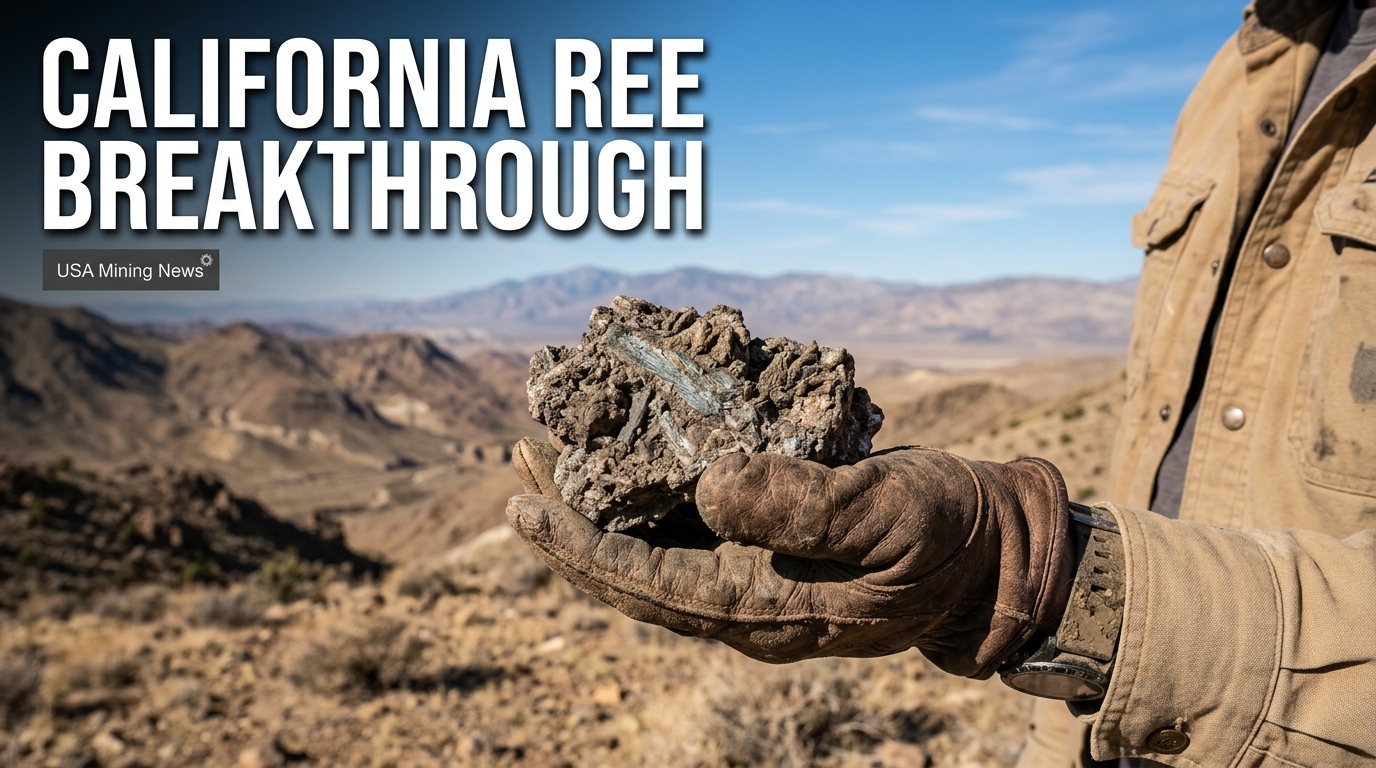
Unlocking Domestic Rare Earth Potential: Locksley Resources Confirms Significant REE Mineralisation at El Campo, California
San Francisco, CA – June 5, 2026 – In a significant development for the burgeoning domestic critical minerals sector, Locksley Resources has announced compelling assay results from its initial diamond drilling program at the El Campo prospect, part of its broader Mojave Project in California, US. The findings confirm the presence of high-grade, neodymium and praseodymium (NdPr)-enriched light rare earth element (LREE) mineralisation, an outcome that holds substantial implications for the nation’s strategic mineral independence.
The El Campo prospect’s strategic importance is immediately evident through its geographical placement: it lies approximately 5.5 kilometers south-east of MP Materials’ Mountain Pass Mine, which currently stands as the only operational rare earth element (REE) mine in the United States. This proximity to an established world-class REE deposit positions Locksley’s findings as potentially pivotal in the ongoing efforts to secure reliable domestic supplies of these indispensable materials.
High-Grade NdPr-Enriched Intercepts Signal Major Potential
The assay results, derived from diamond drill-holes, revealed several significant total rare earth oxide (TREO) intercepts. These included a peak value of 6.03% TREO over 0.7m from drill-hole ECDD0002. This same drill-hole also yielded another substantial intersection of 7.20m at 2.93% TREO, which incorporated a higher-grade zone of 3.75m at 4.45% TREO. Another drill-hole, ECDD0004, returned an intercept of 0.90m at 1.09% TREO.
Crucially, Locksley highlighted that the magnet rare earth oxides, neodymium and praseodymium, account for an estimated 25% of the TREO in these key intercepts. NdPr are considered among the most critical of the rare earth elements due to their irreplaceable role in the manufacturing of high-strength permanent magnets. These magnets are fundamental components in a vast array of advanced technologies, including:
- Electric vehicle (EV) motors
- Wind turbine generators
- Advanced electronics (e.g., smartphones, hard drives)
- Defense systems (e.g., precision-guided missiles, stealth technology)
The consistent presence of NdPr in significant concentrations at El Campo underscores the prospect’s potential to contribute substantially to the supply chain for these vital industrial and defense applications.
Geological Context and Proximity to Mountain Pass
The geological implications of Locksley's results are equally compelling. The drilling has confirmed that rare earth mineralisation extends beneath the surface and remains open both at depth and along strike within the broader El Campo corridor. This characteristic is highly encouraging for future resource expansion.
Moreover, the findings bolster existing geological interpretations suggesting that a larger carbonatite system may exist at depth at El Campo. This is a crucial detail because carbonatite systems are known to host world-class rare earth deposits, famously exemplified by the Mountain Pass Mine itself. A "Mountain Pass-style mineralisation" implies a geological setting common to many of the globe's largest and most economically viable rare earth deposits, characterized by alkaline igneous rocks rich in carbonate minerals. Discoveries that emulate this geological model are of immense interest to the industry, signifying considerable potential for scale and longevity.
The strategic location of El Campo, just south-east of the Mountain Pass Mine, is not merely a geographical coincidence but a significant geological and logistical advantage. For decades, Mountain Pass has been instrumental in supplying critical rare earths, and its continued operation by MP Materials is central to the US strategy for re-establishing its own rare earth processing capabilities. The potential for a new domestic source, especially one exhibiting similar geological characteristics to Mountain Pass, could profoundly enhance the resilience and capacity of the US critical minerals supply chain, reducing national reliance on often volatile foreign sources.
Strategic Perspective from Locksley Leadership
Ian Stockton, Locksley Resources' Non-Executive Technical Director, articulated the company's perspective on these encouraging results. “Diamond drilling at the El Campo prospect represents the first test of the depth extensions of known REE mineralisation exposed at surface. The results are encouraging and consistent with the observations from surface mapping and sampling,” Stockton stated. His remarks emphasize the methodical progression of the company's exploration strategy, building upon initial surface assessments with targeted drilling to define the three-dimensional extent of the mineralisation.
Stockton further elaborated on the company’s forward-looking approach, noting, “We are now evaluating the REE opportunity in the context of our evolving understanding of the Mountain Pass-style magmatic system at El Campo.” This statement underscores the company's commitment to a detailed, geologically informed evaluation of the prospect's potential scale and characteristics. The reference to a "magmatic system" again aligns El Campo with the large-scale igneous processes responsible for significant REE deposits.
Looking ahead, Locksley’s next steps will involve refining the understanding of the mineralisation. “Further work will focus on refining the extent and lithostructural controls on the REE mineralisation and integrating the results into ongoing drill targeting plans, supported by a high-resolution ground scintillometer survey across the entire permit footprint,” Stockton added. This systematic approach, combining geological modeling with advanced geophysical surveys, is standard practice in delineating economic mineral deposits and will be crucial for guiding subsequent drilling campaigns and, ultimately, resource estimation.
Broader Exploration Efforts: The Mojave Project and Desert Antimony Mine
While the rare earth results at El Campo form the centerpiece of Locksley’s announcement, the company also provided updates on its broader exploration activities within the Mojave Project. This includes assay results from its maiden drilling program at the Desert Antimony Mine. Antimony, another critical mineral, is valued for its use in fire retardants, lead-acid batteries, and as an alloying agent in various metals, including for defense applications.
At the Desert Antimony Mine, the final two of eight drill-holes intersected antimony mineralisation beyond historical underground workings, demonstrating continuity of stibnite mineralisation to the south of previous operations. Peak values recorded included 6.44% antimony over 0.3m and another intercept of 0.3m at 2.90% antimony in drill-hole DADD0007. These results indicate potential for renewed interest in historical antimony production areas.
Following the completion of both drilling programs, Locksley’s exploration at the Mojave Project has transitioned to regional targeting and assessment. This phase includes a detailed evaluation of recently acquired radiometric data and plans for the high-resolution ground scintillometer survey at El Campo. Such systematic regional exploration is vital for identifying new prospective targets within the vast and geologically complex Mojave region, which is known for its diverse mineral endowment.
Locksley's Expanding Portfolio: Geographies and Commodities
It is also worth noting that Locksley Resources is actively expanding its exploration footprint beyond California and rare earths. Just a month prior, the company secured a binding option agreement with Balmain Minerals, a subsidiary of Sky Metals, to acquire a complete stake in the Iron Duke Copper and Gold Project in New South Wales, Australia. This move signals Locksley’s strategic intent to diversify its commodity exposure and geographical presence, reflecting a broader corporate strategy to build a robust portfolio of base and critical mineral assets in Tier-1 mining jurisdictions. While distinct from the California REE news, this expansion illustrates Locksley's dynamic approach to resource development on a global scale.
Industry Implications and Future Outlook
The confirmation of NdPr-enriched rare earth mineralisation at El Campo by Locksley Resources is a significant development for the US mining industry. In an era where supply chain resilience and domestic sourcing of critical minerals are paramount national security and economic priorities, new domestic discoveries, particularly those located proximate to existing operations like Mountain Pass, carry considerable weight.
For investors and industry professionals, these results suggest that the Mojave Desert continues to hold untapped potential for critical minerals. The immediate next steps for Locksley will be to meticulously map out the extent of the mineralisation, integrating geophysical data with geological observations to refine future drilling targets. The ultimate goal will be to define a maiden mineral resource estimate for El Campo, a critical milestone that could unlock significant value and contribute meaningfully to the US rare earth supply.
As the global demand for rare earths continues to surge, driven by the clean energy transition and technological advancements, discoveries such as El Campo offer hope for a more diversified and secure supply landscape. The mining industry will be closely watching Locksley Resources as it progresses with its exploration and evaluation efforts at this promising Californian prospect.