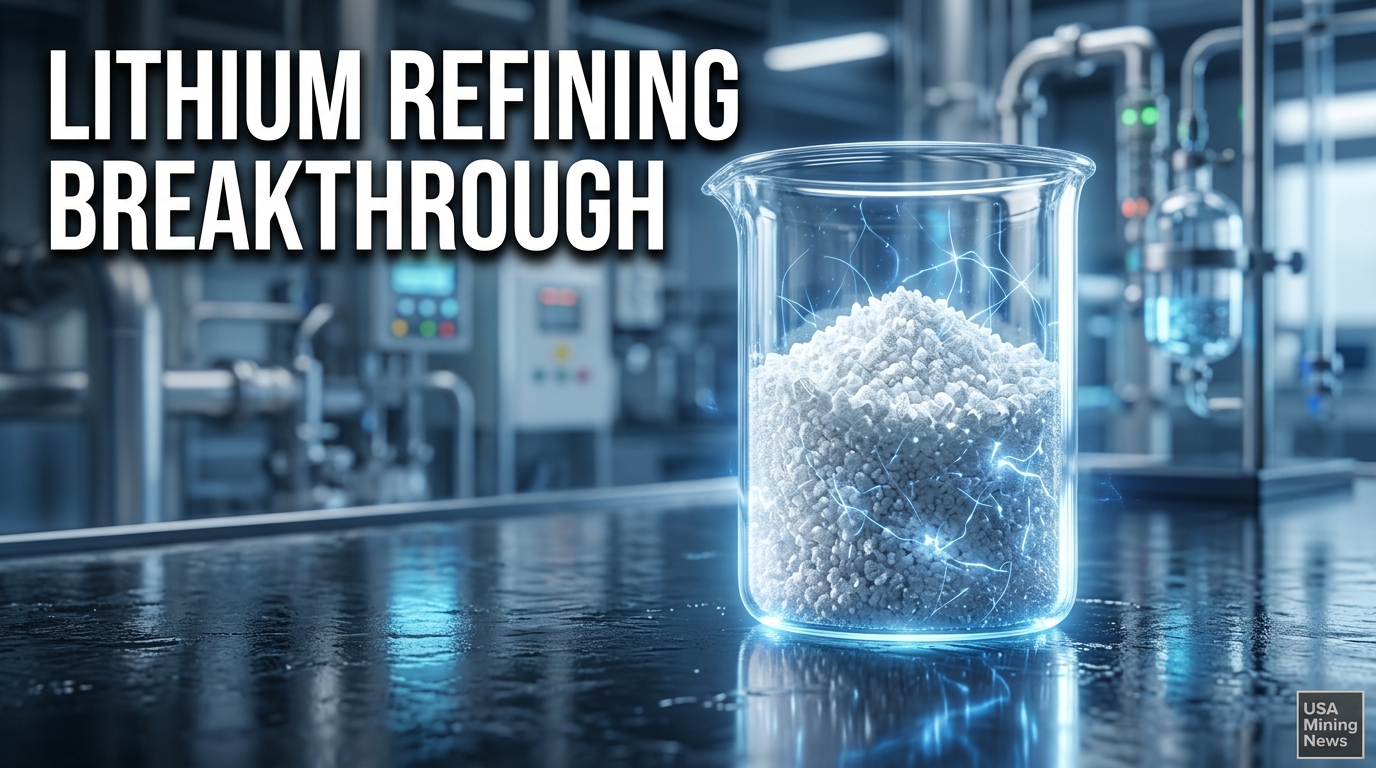
USA Mining News – April 18, 2026 – The landscape of North American lithium processing has been redefined with the official opening of Mangrove Lithium’s pioneering electrochemical refinery in Delta, British Columbia. This privately held company, on April 18, 2026, launched what is heralded as North America’s first commercial facility of its kind, signifying a monumental leap forward in Canada’s ambition to establish a fully integrated domestic battery supply chain. Located approximately 30 kilometers south of downtown Vancouver, this innovative plant marks a pivotal moment, addressing a long-standing void in the region’s capacity to convert raw lithium resources into battery-grade chemicals.
A Strategic Enabler for Canada's Battery Supply Chain
The new Delta facility boasts a production capacity of 1,000 tonnes per year of battery-grade lithium hydroxide, a critical material sufficient for powering approximately 25,000 electric vehicles (EVs). This output, while initially modest compared to global giants, represents a foundational step for North America in a segment of the battery supply chain overwhelmingly dominated by offshore processing. According to International Energy Agency data, the top three countries controlled a staggering 96% of global lithium refining in 2023, with Chinese companies alone holding more than two-thirds of the world's processing capacity in 2022, as reported by the US Energy Information Administration. This concentration highlights a significant geopolitical and supply chain vulnerability for nations like Canada and the United States.
Saad Dara, CEO of Mangrove Lithium, emphasized the strategic importance of this development. "What this facility and our next plant would allow us to do would be enabling a lithium mine to lithium chemical supply chain," Dara stated in an interview with The Northern Miner. He further elaborated on the broader vision: "The bigger prize is tying Canadian feedstock to Canadian battery chemicals, and eventually to battery material plants, cell makers and car assembly." This vision aligns perfectly with government efforts in Ottawa and Victoria to capture more value domestically from Canada’s vast mineral wealth.
The battery supply chain is broadly understood to comprise six main segments: mining, refining and processing, cathode manufacturing (or active materials manufacturing), battery assembly, EV assembly, and battery recycling. As Dara highlighted, Canada has historically shipped out most of its mineral resources for processing elsewhere, critically lacking refining capacity. The Delta plant, while not completing the entire chain, fills this crucial refining gap, setting the stage for a more robust and resilient domestic industry.
Innovative Technology Driving Cost-Competitiveness and Sustainability
A cornerstone of Mangrove’s strategy is its proprietary electrochemical technology, which senior director of operations, Ryan Day, detailed during a plant tour. This advanced process offers compelling advantages over conventional refining methods, particularly in terms of cost-competitiveness and environmental footprint. Mangrove's approach effectively swaps higher chemical inputs and complex waste handling associated with traditional processes for electricity cost, a significant differentiator.
The chemistry at the heart of Mangrove's operation is elegantly efficient. Conventional methods for converting lithium sulfate into lithium hydroxide typically involve the addition of sodium hydroxide, which generates a problematic sodium sulfate waste stream requiring disposal. In contrast, Mangrove’s process feeds lithium sulfate brine through an electrolyzer. Within this system, lithium ions are selectively pulled across a membrane, while the sulfate is intelligently recycled, being converted back into sulfuric acid for reuse at the front end of the process. This closed-loop system virtually eliminates sodium sulfate waste and significantly reduces water losses, yielding substantial environmental benefits.
Key technical and operational advantages of Mangrove’s electrochemical refining include:
- Strong cost-competitiveness against established facilities, enabled by optimized input management.
- Significantly reduced chemical consumption.
- Minimal waste generation, enhancing environmental performance.
- Lower carbon intensity compared to conventional lithium refining techniques.
- Exceptional feedstock flexibility, capable of refining lithium from diverse sources:
- Brines
- Hard rock (e.g., spodumene concentrates)
- Clays
- Geothermal direct lithium extraction (DLE) concentrates
- Recycled battery materials
Day further clarified that Direct Lithium Extraction (DLE) is not a competing process but rather a complementary feed option. DLE technologies efficiently extract lithium from brines into a concentrate, but this concentrate still requires further processing into battery-grade lithium hydroxide or carbonate—precisely where Mangrove’s refining capabilities become integral.
Strong Investment and Political Endorsement
The inauguration of the Delta facility is the culmination of substantial strategic investments and robust political backing. Just three months prior to the opening, the Canada Growth Fund spearheaded a significant financing package, committing up to C$116 million (approximately US$85 million) to Mangrove Lithium. This crucial investment was also supported by leading technology incubators and venture capital firms, including BMW i Ventures and Breakthrough Energy Ventures, underscoring the broad confidence in Mangrove's technology and strategic vision.
Further demonstrating governmental commitment, Ottawa conditionally approved up to C$21.9 million for engineering work related to Mangrove's next major project: a planned 20,000-tonne-per-year refinery in Eastern Canada. This financial support highlights Canada’s resolve to foster domestic innovation and secure its position in the global clean energy economy.
The political significance of Mangrove’s opening was palpable at the ceremony. Canada's Minister of Veterans Affairs and local Delta Member of Parliament, Jill McKnight, underscored the broader implications, stating, "Today, we are not simply opening a facility. We are signaling a clear new direction for Canada." Similarly, in a video message from Victoria, British Columbia Premier David Eby hailed the plant as "a critical step" towards building a resilient battery supply chain within the province, declaring, "The Delta refinery shows the future we're building for this province." Such high-level endorsements emphasize the strategic importance of this facility to both provincial and federal economic and environmental objectives.
Charting Towards a Comprehensive Domestic Supply Chain: The Path Ahead
The Delta plant, with its 1,000 tpa capacity, is intentionally designed as a stepping stone towards a much larger refining operation. Mangrove Lithium is actively planning a substantial refinery in Eastern Canada, specifically in Quebec. This ambitious next phase aims for a production capacity of 20,000 tonnes per year of battery-grade lithium hydroxide, which would be sufficient to supply approximately 500,000 EVs annually. This significant scale-up demonstrates Mangrove's commitment to becoming a major player in the North American lithium chemical sector.
To secure a reliable feedstock for its future operations, Mangrove has already signed a non-binding memorandum of understanding (MoU) with Elevra Lithium (ASX: ELV). This agreement paves the way for sourcing spodumene concentrate from the North American Lithium (NAL) mine, also located in Quebec. This strategic partnership is vital, as it directly addresses the "mine-to-chemical" aspect of the supply chain, linking Canadian raw material extraction directly with advanced domestic processing. Such integration reduces reliance on international supply chains, mitigates geopolitical risks, and ensures greater control over material quality and provenance.
The systematic development of both the Delta and planned Quebec facilities is critical for establishing the missing refining capacity, thereby enabling the full realization of Canada's battery supply chain ambitions. By building out robust refining capabilities, Canada can attract further investment into cathode manufacturing, battery assembly, and eventually, electric vehicle production, creating high-value jobs and bolstering national economic resilience.
Conclusion: Paving the Way for Lithium Independence
Mangrove Lithium’s opening of North America’s first commercial electrochemical lithium refinery represents a transformative moment for the continent’s aspiring cleantech landscape. By pioneering an environmentally superior and cost-effective refining process, Mangrove is not only addressing a critical bottleneck in the battery supply chain but also setting new industry standards for sustainability. The strong support from both government and private investors underscores the strategic significance of this project in securing domestic access to battery-grade lithium chemicals, a fundamental requirement for the burgeoning electric vehicle market and the broader energy transition.
As the company progresses with its plans for the Quebec mega-refinery and strengthens its partnerships with upstream mining operations, Mangrove Lithium is poised to play an indispensable role in diminishing North America’s reliance on foreign processing, fostering domestic value creation, and firmly establishing Canada as a formidable player in the global lithium chemical sector. This initiative positions Canada, and by extension, the broader North American market, closer to achieving true lithium independence and a fully integrated, resilient battery ecosystem.