Quebec, Canada – Bullion Gold Resources (BGD: TSX.V) has announced the completion of an extensive diamond drilling program at its 100% owned Langlade project, situated in the renowned Senneterre area of Quebec. This latest exploration phase, concluded as of April 10, 2026, represents a critical step for the company in de-risking and advancing its understanding of the geological and mineralogical characteristics within this promising region. The findings from this program, particularly the visual identification of key sulfide minerals and specific alteration styles, provide compelling early indicators for a potentially robust mineralized system.
Bullion Gold Concludes Key Drilling Program at Langlade
The recently concluded diamond drilling campaign at the Langlade project involved a total of 1,771 meters spread across 11 discrete drill-holes. This systematic approach was designed to gather critical subsurface data, aiming to assess the continuity and thickness of mineralized horizons previously identified, and to explore both lateral and depth extensions at what is known as the Langlade index. The Langlade project, located in a jurisdiction known for its rich mineral endowment and supportive mining policies, represents a strategic asset for Bullion Gold Resources.
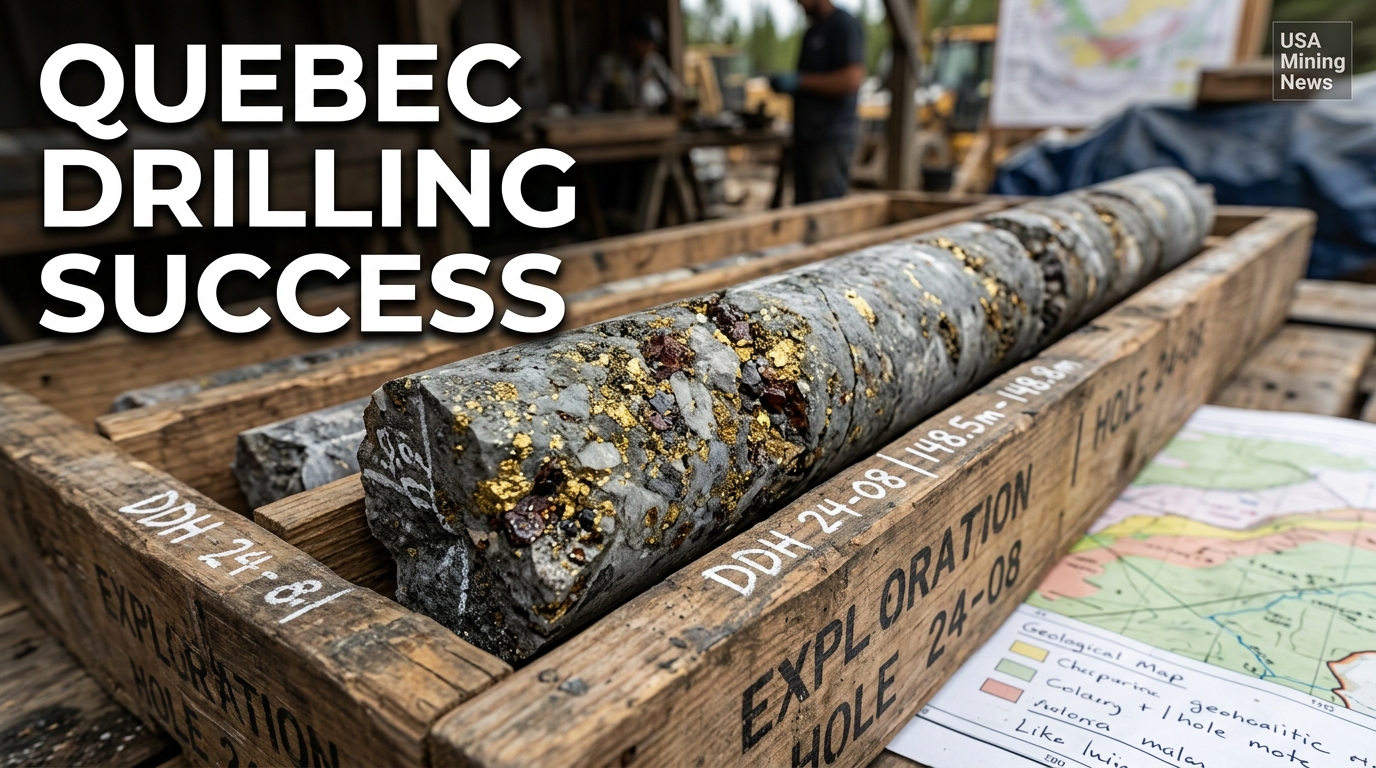
Initial examinations of the drill cores have yielded encouraging visual observations that are keenly watched by the exploration community. Geologists on-site have reported the presence of chalcopyrite, a copper iron sulfide mineral, and sphalerite, a zinc sulfide mineral. For investors and industry professionals, the visual presence of these sulfides is a significant early indicator. Chalcopyrite is the most abundant copper ore mineral, while sphalerite is the primary ore of zinc, both of which are critical industrial metals with strong market demand as the global economy transitions towards electrification and sustainable infrastructure.
Historically, the association of chalcopyrite and sphalerite has often been linked to valuable deposits of not only copper and zinc but also gold and silver. This historical correlation suggests that the Langlade project could hold potential for multi-metallic mineralization, significantly enhancing its economic prospectivity. The ultimate confirmation of metal grades, however, will hinge on the forthcoming assay results, which are vital for translating visual observations into concrete economic data.
Geological Indicators Point to Robust Hydrothermal System
Beyond the direct observation of ore minerals, the geological team noted significant scapolite alteration within quartz and feldspar veins. Scapolite alteration is a geological phenomenon where original minerals are replaced by scapolite-group minerals. In the context of mineral exploration, particularly for metallic deposits, scapolite alteration is often indicative of intense hydrothermal activity. This type of alteration typically occurs under elevated temperatures and pressures, often involving saline fluids rich in dissolved metals, which are characteristic of large-scale magmatic-hydrothermal or volcanogenic massive sulphide (VMS) mineralisation systems.
The presence of such ubiquitous alteration suggests that the Langlade property has experienced significant geological processes conducive to mineral deposition. Intense hydrothermal systems are the engines that drive the concentration of metals from diffuse sources into economic deposits. Understanding the nature and extent of this hydrothermal footprint is crucial for targeting further exploration and enhancing the probability of discovering substantial mineral resources.
Bullion Gold CEO Guy Morissette underscored the importance of these visual findings. “The visual observations from this campaign, particularly the association of chalcopyrite with scapolite alteration zones, are very encouraging,” Morissette stated. “These geological features will help us better understand the hydrothermal system present on the Langlade property.” His comments highlight the methodical approach Bullion Gold is taking, using every piece of geological evidence to build a comprehensive model of the project area.
Strategic Objectives and Advanced Geophysical Insights
The overarching aim of this drilling campaign was not merely to confirm the presence of mineralization but to systematically advance the understanding of its geological controls. Assessing the continuity and thickness of mineralized horizons is fundamental for eventual resource estimation, allowing geologists to project the shape, size, and grade distribution of potential ore bodies. Exploring both lateral and depth extensions is equally critical, as it expands the known footprint of mineralization and identifies potential new zones, increasing the overall potential of the property.
Complementing the drilling results, Bullion Gold has also incorporated a comprehensive analysis of its geophysical mapping data, integrating VG1 magnetic gradient and structural data. Geophysical surveys are indispensable tools in modern mineral exploration, providing subsurface information without the need for extensive drilling. The analysis reveals a structured system characterized by parallel and folded magnetic axes, predominantly trending from east-west to north-east/south-west. These magnetic signatures are often associated with variations in rock types and structural deformation.
Specifically, these signatures hint at the presence of mafic to intermediate volcanic units, geological settings that are well-established as hosts for volcanogenic massive sulphide (VMS) deposits. VMS deposits are polymetallic (often containing copper, zinc, lead, gold, and silver) and are highly sought after due to their potential for high grades and tonnage. The observed folds and structural hinges suggest significant deformation within the rock package, which is a common geological process that can concentrate mineral deposits by creating traps and pathways for mineral-rich fluids.
Furthermore, VLF (Very Low Frequency) conductive lineaments identified in the geophysical data highlight intersections and shear zones. These features are significant because they typically represent fractured and altered rock pathways that could facilitate the movement of hydrothermal fluids, thereby concentrating metals. Several magnetic contrasts within the favorable axes may also indicate altered or sulphide-enriched horizons, providing further direct exploration targets.
Geophysical Interpretation Guides Future Exploration Pathways
The comprehensive interpretation of the geophysical data provides Bullion Gold with a robust framework for future exploration. The analysis suggests that mineralization at Langlade may exist on the south-east side of a major folded structure, with potential repeats on the north-east side and along parallel axes. This structural complexity is often a strong indicator of favorable conditions for ore deposition, as folding and faulting can create conduits and depositional sites for mineralizing fluids.
These findings point to a substantial potential for discovering new mineralized zones. Specifically, exploration opportunities include:
- Lateral Extensions: Identifying and tracing mineralized horizons along strike, potentially expanding the known footprint of mineralization significantly.
- Structural Repetitions: Targeting areas where folds and faults have duplicated mineralized units, often leading to multiple stacked ore bodies. Such structural repetitions along magnetic axes and folds are well-known settings for concentrating massive sulphides.
- Conductive Structural Corridors: These areas represent priority targets for further exploration, as they are interpreted to be pathways for hydrothermal fluids and potential repositories for sulphide mineralization.
The integration of detailed geological mapping, core logging, and advanced geophysical interpretation provides a powerful toolkit for Bullion Gold to systematically explore the Langlade property. This multi-faceted approach minimizes exploration risk and maximizes the chances of making significant discoveries.
The Broader Context: Quebec's Position in Global Mining
The Langlade project is strategically located in Quebec, a province widely recognized as one of the world's most attractive mining jurisdictions. Quebec boasts a rich geological heritage, including the prolific Abitibi Greenstone Belt nearby, which hosts numerous world-class gold, copper, and zinc mines. The province is characterized by its stable political environment, robust regulatory framework, competitive fiscal regime, and strong infrastructure, all of which are crucial considerations for mining investors and operators.
Projects like Langlade, with their potential for multi-metallic mineralization (copper, zinc, gold, and silver), align well with the increasing global demand for critical minerals. Copper is essential for electrification and renewable energy technologies, while zinc is a vital component in galvanizing and various alloys. Discoveries of new, domestic sources for these metals are increasingly important for global supply chain security and the transition to a greener economy.
Bullion Gold’s methodical exploration in this region underscores the ongoing confidence in Quebec's mineral potential and its capability to host significant new discoveries. The fact that the Langlade project is fully owned by Bullion Gold allows the company complete control over its exploration strategy and offers full upside potential to its shareholders without the complexities of joint venture agreements at this early stage.
Anticipating Assay Results and Future Outlook
The crucial next step for the Langlade project will be the receipt and interpretation of the assay results, which are "anticipated next month" (May 2026). These laboratory analyses will quantitatively verify the metal grades of the chalcopyrite, sphalerite, and potentially gold and silver mineralization observed visually in the cores. Assay results are the definitive measure of a project’s economic viability and will be instrumental in informing Bullion Gold’s future exploration steps.
Depending on the assay results, Bullion Gold will outline its strategy, which could involve:
- Follow-up drilling: Delineating the extent of promising zones with tighter drill spacing.
- Detailed metallurgical testing: Understanding how the ore can be processed.
- Initial resource estimation: Calculating the potential tonnage and grade of identified mineralization.
- Preliminary Economic Assessments (PEA): Evaluating the potential economics of a future mining operation.
The conclusion of this drilling program marks a significant milestone for Bullion Gold Resources at its Langlade project. The encouraging visual observations, coupled with sophisticated geophysical interpretations, paint a picture of substantial mineral potential within a geologically favorable and mining-friendly jurisdiction. As the industry awaits the assay results, the Langlade project stands out as a promising early-stage exploration play with the potential to contribute to Quebec's rich mining legacy and the global supply of critical metals.