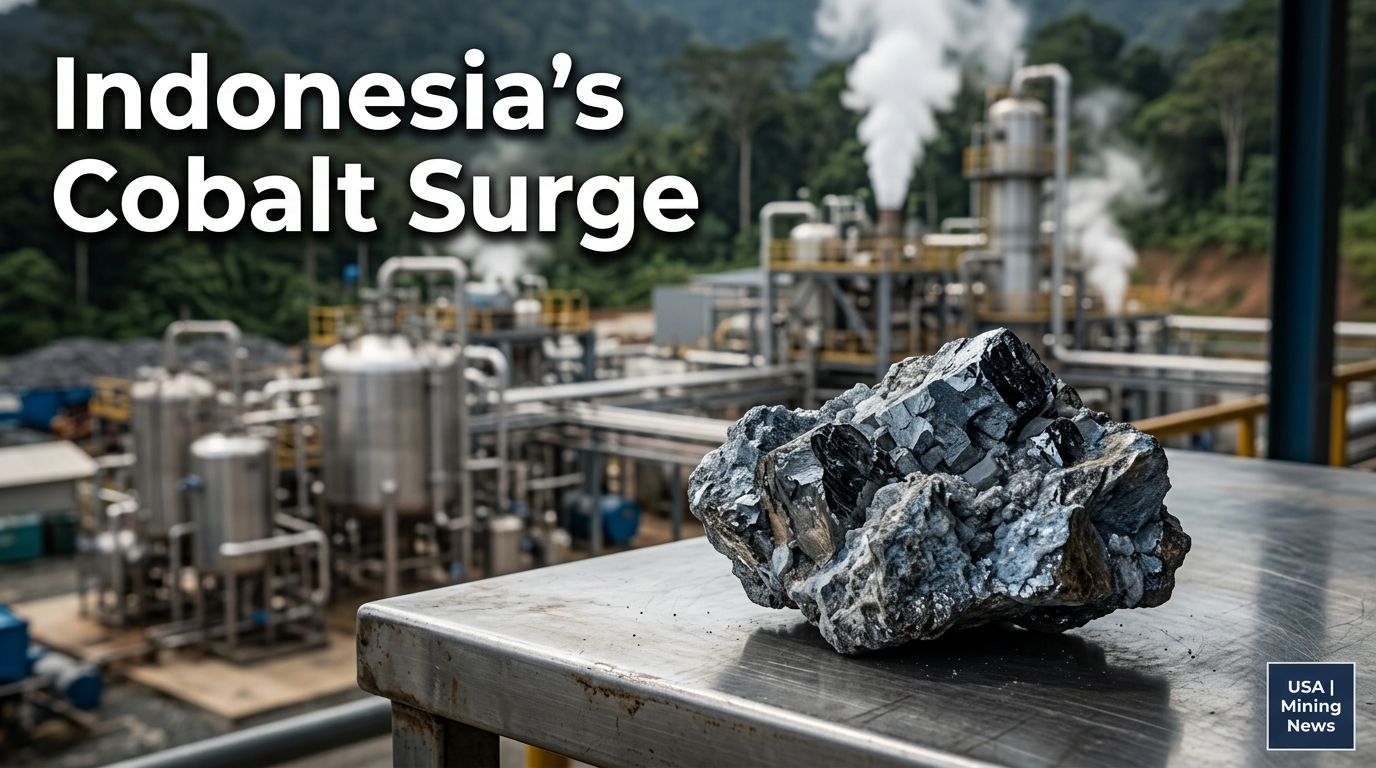
Jakarta, Indonesia – In a remarkable transformation over the past decade, Indonesia has rapidly emerged from a minor player to a dominant force in the global cobalt market. This strategic shift, largely propelled by substantial investment in advanced processing technologies, particularly high-pressure acid leach (HPAL) facilities, is poised for another critical phase of expansion. New project launches and the continued ramp-up of existing operations are expected to significantly elevate Indonesia’s cobalt output in 2026, further cementing its role in the global supply chain for electric vehicle (EV) batteries.
Indonesia's Ascent: From Minor Player to Global Powerhouse
The trajectory of Indonesia's cobalt production has been nothing short of extraordinary. From a modest 1,300 tonnes (t) in 2015, the nation's output has skyrocketed to an estimated 49,300t in 2025. This represents an astounding increase of over 3,700% in a single decade, positioning Indonesia as the second-largest cobalt producer globally. The surge in 2025 alone saw production jump by 42.6% over the previous year, underscoring the rapid pace of development in its resource sector.
This remarkable growth is a direct consequence of Indonesia's proactive government policies aimed at establishing a comprehensive domestic supply chain for EVs. A pivotal moment in this strategy was the implementation of a nickel ore export ban in 2020. This policy instrument successfully incentivized substantial foreign investment, predominantly from Chinese companies, into in-country processing capabilities for both nickel and cobalt, transforming raw material exports into higher-value processed products.
Key Projects Fueling Current Growth
The dramatic increase in Indonesia’s cobalt production in 2025 was primarily driven by two key projects. First, Ningbo Lygend Mining’s PT Halmahera Persada Lygend Project played a significant role. This facility, which leverages HPAL technology, saw an increase in supply due to ongoing expansion efforts and the commissioning of additional production lines, progressively reaching towards full operational capacity. It is notable that this project had briefly suspended operations in 2024 to mitigate operational costs amid prevailing market conditions characterized by oversupply and lower prices, demonstrating the industry's responsiveness to market dynamics.
Secondly, the ongoing ramp-up of Zhejiang Huayou’s Huafei Cobalt-Nickel Project has provided crucial impetus to the country’s growth trajectory. This significant venture, which commenced production in the first quarter of 2024, has swiftly moved to contribute to Indonesia's expanding cobalt output.
Looking ahead, the momentum is expected to accelerate. Indonesia’s cobalt output is forecast to grow by an impressive 21.2% in 2026, reaching 59,800t. This continued expansion will be supported by:
- The scheduled start of the Pomalaa and Morowali projects.
- Further ongoing ramp-up activities at the Huafei Cobalt-Nickel Project.
- Continued expansion efforts at Ningbo Lygend Mining’s PT Halmahera Persada Lygend Project.
Strategic Government Policies and Foreign Investment
Indonesia's strategic pivot towards developing a robust domestic EV supply chain is a testament to its long-term vision. The 2020 nickel ore export ban was not merely a protectionist measure but a calculated move to force in-country value addition. By mandating local processing, Indonesia has successfully attracted billions of dollars in foreign direct investment, transforming its resource-rich landscape into an integrated manufacturing and processing hub. This policy has been particularly attractive to Chinese industrial giants, who possess both the capital and the technological expertise, especially in HPAL processing, to fast-track these developments.
This strategic framework is critical for the global EV industry, which is heavily reliant on secure and diversified supplies of battery raw materials like cobalt. By fostering domestic processing, Indonesia is not only creating jobs and economic growth but is also positioning itself as a crucial reliable supplier in an increasingly competitive and geopolitically sensitive market.
Major Upcoming Projects and Partnerships
The pipeline of new projects and expansions underscores Indonesia's commitment to sustained growth in cobalt production:
- Indonesia Growth Project (IGP) Pomalaa: This highly anticipated project is a joint venture between Zhejiang Huayou Cobalt Co., PT Vale Indonesia, and Ford Motor Company. It encompasses the development of a new nickel mine and a state-of-the-art HPAL processing plant, along with associated mine infrastructure. The project is currently in advanced construction stages and is targeted to commence operations in the fourth quarter of 2026. Crucially, the HPAL plant will produce mixed hydroxide precipitate (MHP), a key intermediate material essential for the production of high-performance EV batteries. The involvement of a major automotive manufacturer like Ford highlights the strategic importance of securing supply chains directly at the source.
- Indonesia Morowali Industrial Park (IMIP): A cornerstone of Indonesia’s industrial transformation, IMIP is a sprawling industrial complex jointly owned by China’s Tsingshan Holding Group (66.25%) and PT Bintang Delapan Group (33.75%) through their subsidiaries. IMIP hosts numerous smelters and HPAL facilities. Its integrated approach enables partner companies within the park to develop infrastructure for battery material production, facilitating the extraction of cobalt as a valuable byproduct of nickel processing. This exemplifies the efficiency and synergy achieved through industrial clusters.
- PT QMB New Energy Materials HPAL project: This project is a collaboration between Jingmen GEM and Guangdong Brunp, a subsidiary of the global battery giant CATL. This facility is planned to commence operations in the fourth quarter of 2026, further augmenting the nation's HPAL processing capacity. The partnership with CATL, a leading EV battery manufacturer, underscores the direct link between Indonesia's raw material output and the global EV supply chain.
- Sorowako Limonite HPAL project: Another significant venture, this project involves PT Vale and Zhejiang Huayou Cobalt Co. It is scheduled to begin operations in the second quarter of 2027, adding another major contributor to Indonesia's growing list of HPAL facilities.
- Pt Ceria Nugraha Indotama Project: This project, slated to begin in 2028, further extends Indonesia's long-term growth trajectory in cobalt production.
Projected Growth Trajectory Towards 2035
The robust project pipeline suggests that Indonesia's cobalt production growth is not a fleeting phenomenon but a sustained trend. Over the forecast period from 2026 to 2035, the country’s cobalt output is anticipated to continue its upward trajectory, growing by a Compound Annual Growth Rate (CAGR) of 5.6%. This will culminate in an estimated annual production of 97,900t by 2035. This sustained expansion is directly attributable to the phased commissioning and ramp-up of new projects, including those at Pomalaa and Morowali (2026), Sorowako Limonite (2027), and Pt Ceria Nugraha Indotama (2028).
This long-term outlook provides crucial stability and predictability for the global battery and EV industries, signaling Indonesia's commitment to meeting future demand for critical raw materials.
Broader Implications for the Global Cobalt Market
Indonesia's dramatic rise as a cobalt producer has profound implications for the global mining industry and the broader clean energy transition. Diversification of cobalt supply chains is a high priority for many nations and corporations, given that historically, the Democratic Republic of Congo (DRC) has dominated global output. While the DRC remains the largest producer, Indonesia's parallel growth offers a vital alternative, enhancing supply security and potentially mitigating geopolitical risks associated with over-reliance on a single source.
For EV manufacturers and battery producers, securing MHP from Indonesia provides a more direct pathway to battery precursors, often with competitive cost structures due to the integrated nature of the HPAL facilities. These facilities are designed to process nickel laterite ores, where cobalt is extracted as a co-product or byproduct, enhancing the economic viability of these operations. The increasing availability of MHP from Indonesia will undoubtedly influence global pricing dynamics and procurement strategies for cobalt.
Challenges and Opportunities
While the outlook is overwhelmingly positive, the Indonesian cobalt industry is not without its challenges. The 2024 suspension at the PT Halmahera Persada Lygend Project due to market oversupply and lower prices underscores the sensitivity of commodity markets. Maintaining a balance between rapid expansion and market demand will be crucial. Furthermore, the reliance on HPAL technology, while efficient for low-grade nickel laterites, demands significant capital investment, technical expertise, and stringent environmental management to address potential concerns related to waste disposal and energy consumption.
Despite these complexities, the opportunities far outweigh the challenges. Indonesia's abundance of nickel laterite resources, coupled with strategic policy direction and robust foreign investment, particularly from Asia, positions it uniquely to capitalize on the surging global demand for EV battery materials. The development of an integrated downstream processing industry, from mines to MHP production, offers significant economic benefits and strengthens Indonesia’s standing as a manufacturing hub.
Conclusion
The narrative of Indonesia's cobalt industry is one of strategic foresight, rapid development, and monumental growth. From a nominal producer in 2015 to the second-largest global force by 2025, and with ambitious projections extending to 2035, Indonesia is undeniably a pivotal player in the future of critical minerals. The ongoing ramp-up of existing HPAL projects and the imminent commissioning of new mega-ventures like IGP Pomalaa and those within IMIP, supported by powerful international partnerships, will ensure a sustained surge in cobalt output. As the world accelerates towards an electrified future, Indonesia's continued emergence will be instrumental in ensuring a stable, diversified, and growing supply of the cobalt critical to powering the next generation of electric vehicles.