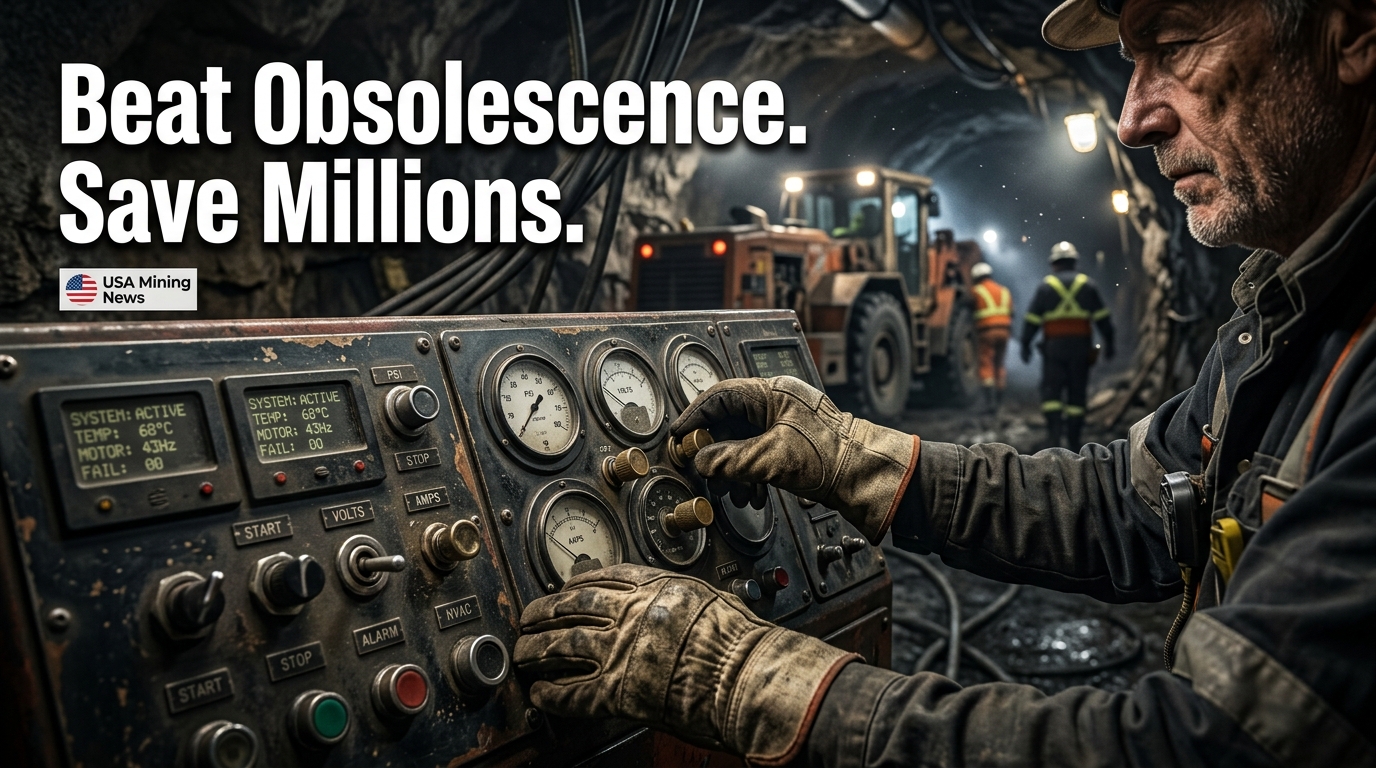
As the global mining industry continues to operate assets well beyond their original design life, a silent but potent threat looms large: component obsolescence. While the fundamental structures of processing plants, heavy machinery, and critical infrastructure may remain robust, the availability of spare parts and support for embedded technologies becomes increasingly precarious. This challenge, though often highlighted in sectors like oil and gas, is acutely relevant to mining operations, where uptime, safety, and efficiency directly impact profitability and market standing.
According to insights shared on April 23, 2026, by engineering specialists like Score, obsolescence is an unavoidable reality in ageing industrial assets. What is avoidable, however, is the significant cost, operational disruption, and heightened risk that stems from reacting to obsolescence too late. For mining companies managing multi-billion-dollar projects and complex supply chains, understanding and proactively addressing this issue can translate into savings of millions of dollars, pounds, or euros annually.
The Silent Threat: Obsolescence in Mining's Aging Infrastructure
Mining operations, by their very nature, involve substantial capital investment in equipment designed for durability and extended service life. Excavators, haul trucks, processing mills, conveyor systems, and sophisticated control systems are routinely kept in service for decades. This longevity, while economically sensible, inherently exposes operators to the risks of obsolescent components. These are parts, sub-systems, or even software elements for which the original equipment manufacturer (OEM) no longer provides support, spare parts, or technical services. The implications for the mining sector are profound:
- Safety Risks: Critical safety systems, such as emergency shutdown mechanisms for conveyors, ventilation controls, or hoist braking systems, can fail due to obsolete components, potentially endangering personnel and operations.
- Reliability and Production Efficiency: The inability to replace a crucial, yet obsolete, component can lead to unexpected breakdowns, forcing unscheduled production curtailments.
- Economic Losses: Downtime in a major mining operation, be it a processing plant, an open-pit mine, or an underground network, can result in daily revenue losses amounting to millions. An unscheduled shutdown, even for a few days, can severely impact financial forecasts and stakeholder confidence.
- Environmental Impact: Component failures can lead to increased fugitive emissions or spills, posing environmental compliance challenges and reputational damage.
- Difficult Operational Decisions: When a critical part fails and is no longer available, operators are often forced into difficult, high-stakes decisions under immense pressure and with limited time.
One of the most common manifestations of this problem arises during routine maintenance, when a required replacement component is found to be obsolete. In the context of the oil and gas industry, a sector with many parallels to mining in terms of asset management, common problem areas cited for valves often include the valve stem, stem packing, trim components, gearboxes, and actuators. While these are specific examples, the underlying challenges are universally applicable to the pumps, motors, gearboxes, and control systems prevalent in mining.
The True Cost of Neglecting Obsolescence: Lessons for Mining Operators
The financial and operational ramifications of obsolescence are substantial. The source material highlights a critical example from the UK regulator, the Health and Safety Executive (HSE). From a sample of 22 operators, 179 emergency shutdown valve failures were reported, with more than 80% attributable to a failure to operate correctly. Significantly, nearly half of these failed valves had experienced at least one previous failure, with corrosion being the most common immediate cause. This data, while specific to valves, underscores a broader truth for critical safety and operational components across heavy industry, including mining. A malfunctioning emergency stop on a conveyor belt, a failed brake in a hoisting system, or a compromised safety relief valve in a processing plant can have similarly catastrophic consequences.
Components can become increasingly difficult to operate effectively due to a complex interplay of factors:
- Internal corrosion and erosion from harsh operational environments.
- Age-related wear and tear.
- Mistreatment by operatives or improper maintenance.
- Physical damage such as scarring or galling.
- Over-torquing of fasteners.
- Misaligned seals leading to leakage.
- Environmental ingress of dust, moisture, or corrosive agents.
Individually, these issues might seem manageable. Cumulatively, especially when compounded by a lack of OEM support for replacement parts, they push operators towards what often appears to be the only solution: a costly and often unnecessary full-system replacement. What should be a straightforward component swap becomes a complex crisis when an OEM reveals that the needed part is no longer manufactured or the entire assembly is unsupported.
At this juncture, mining companies face unenviable choices:
- Option 1: Stick with the OEM for a Full System Upgrade. This often means acquiring the latest version of the equipment, even if only a small part has failed. This can entail significant capital expenditure, extensive re-commissioning, and lengthy lead times that can exceed a year.
- Option 2: Switch to an Alternative Supplier. While potentially offering a more tailored solution, this path triggers a complete Management of Change (MoC) process. This involves detailed risk assessments, design justifications, functional equivalence reviews, and multiple layers of internal and external approvals, all of which are time-consuming and resource-intensive for critical mining equipment.
In an unplanned outage, both options consume precious time that mining operations simply do not have, transforming a maintenance issue into a business-critical emergency with unexpected costs, increased safety exposure, and severe operational disruption.
Beyond Full Replacement: A Smarter Approach to Asset Longevity
In many cases, the need for a full system replacement is an illusion driven by OEM strategies that prioritize the production of new designs over supporting legacy components. A large excavator's frame may be structurally sound while its hydraulic pump or control system has failed. A crucial gearbox in a processing mill might be faulty, but the mill shell itself remains perfectly fit for purpose. Older mounting interfaces may pre-date modern standards, or internal components may have suffered wear, but these do not automatically justify overhauling an entire plant module.
This is where effective obsolescence management
changes the equation. Instead of succumbing to the pressure for wholesale replacement, this approach focuses on preserving and leveraging existing, functional assets. It involves applying modern engineering standards and innovative solutions to address the specific component failures. With the right engineering insight, modern replacements for individual components can be designed to integrate safely and compliantly with existing equipment, turning what appears to be an impossible upgrade into a viable, cost-effective solution.
Implementing Proactive Obsolescence Management in Mining
Most mining operators encounter obsolescence reactively, when a critical failure occurs. However, the greatest value, both in terms of cost savings and improved operational stability, comes from addressing obsolescence proactively. Implementing planned obsolescence assessments allows companies to:
- Identify High-Risk Assets: Systematically pinpoint equipment and components most vulnerable to obsolescence before they fail.
- Understand Component Availability: Map the supply chain for critical spares, identifying components that are already obsolete or nearing end-of-life support.
- Prioritize Interventions: Plan and execute necessary repairs, upgrades, or replacements during scheduled outages, minimizing unplanned downtime.
This proactive strategy significantly reduces exposure to unexpected operational disruptions and prevents being forced into costly, high-risk, snap decisions. A robust approach begins with a comprehensive functional assessment:
- Which components are absolutely critical to ongoing mining operations?
- Which legacy components are still fit for purpose and compliant with current standards?
- Which components no longer meet modern safety, performance, or environmental standards?
Based on this assessment, informed decisions can be made regarding repair, targeted replacement, or strategic life extension of existing equipment. Often, extending the life of current assets can deliver superior outcomes compared to full-scale replacement. This involves re-engineering old components, recreating them using advanced materials, protective coatings, and modern manufacturing techniques. Thorough design verification and testing ensure that these re-engineered components meet or exceed current standards, often enhancing performance beyond original specifications.
This re-engineering approach offers multiple advantages:
- It dramatically reduces operational disruption.
- It shortens lead times for critical parts.
- It limits the scope of change, simplifying or even avoiding extensive MoC processes.
- Crucially, it contributes to a reduced carbon footprint by extending the life of existing assets rather than manufacturing and shipping entirely new systems.
The Future Outlook: Resilience and Sustainability Through Smart Maintenance
For the mining industry, adopting proactive obsolescence management is not merely a maintenance tactical adjustment; it is a strategic imperative. In an era where commodity prices fluctuate, operational efficiency is paramount, and sustainability goals are increasingly stringent, minimizing unplanned downtime and optimizing asset utilization are key differentiators. By embracing smart maintenance strategies that integrate obsolescence planning, mining companies can build greater operational resilience, ensure worker safety, and enhance their environmental stewardship.
The insights from engineering specialists underscore that while obsolescence might be inevitable, the disruption and financial drain it causes are not. By investing in comprehensive assessments and leveraging modern engineering to bridge the gap between legacy systems and current needs, mining operations can future-proof their assets, extend their productive life cycles, and ensure continuous, safe, and cost-effective operations for years to come.