Orogen Royalties Secures Serpent Gold Claims: Unlocking Undrilled Potential in Nevada's Prolific Epithermal Belt
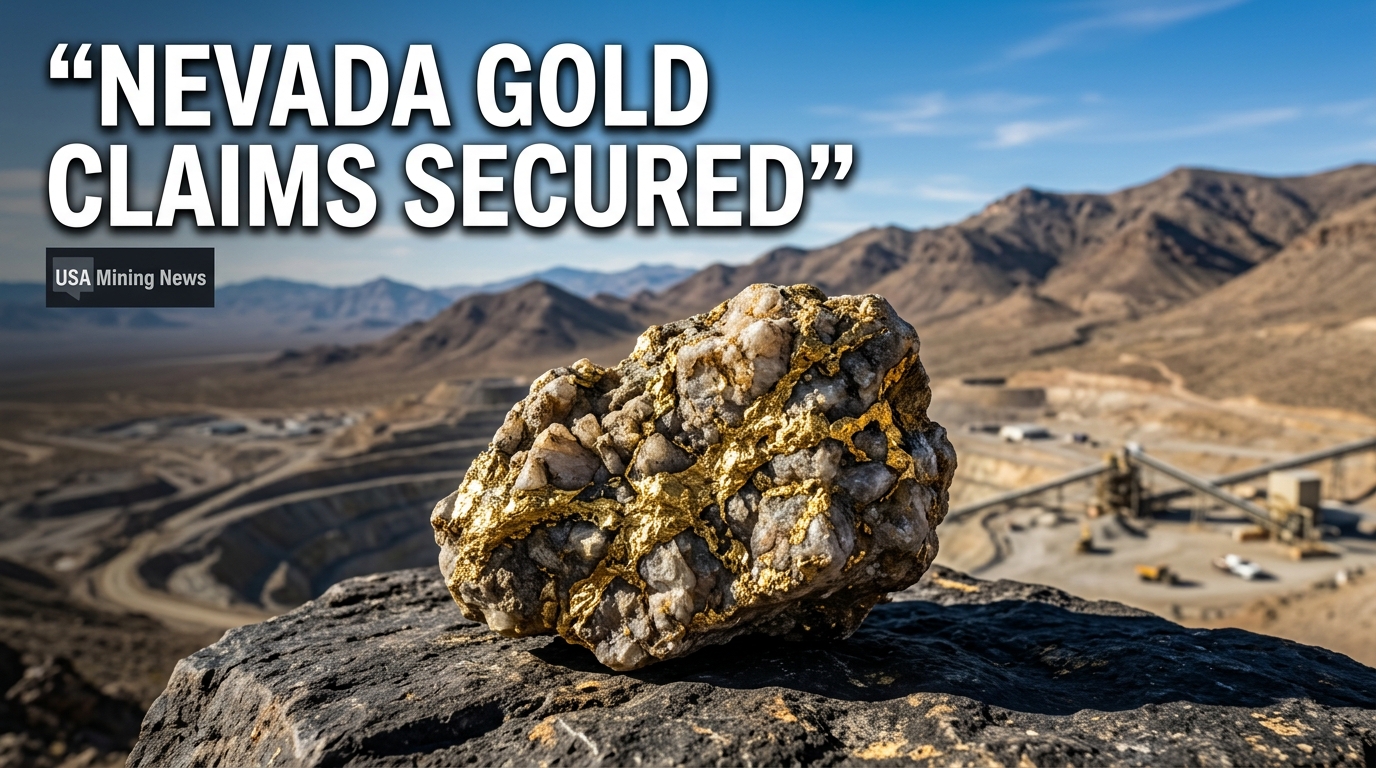
RENO, NV – September 11, 2026 – In a strategic move poised to capture the attention of the global mining investment community, Orogen Royalties Inc. has officially announced the acquisition of the Serpent gold project in central Nevada, USA. This significant development, established in collaboration with Altius Minerals, marks the securing of 225 Bureau of Land Management (BLM) claims, collectively covering an expansive 18.8 square kilometers (km²). Located approximately 25 kilometers north-west of Rachel, Nevada, the Serpent project is being heralded as a district-scale, low-sulphidation epithermal gold target, demonstrating the continued allure and untapped potential of the Great Basin region for precious metals exploration.
The acquisition underscores Orogen's persistent focus on generative exploration within highly prospective geological settings, aligning with its business model of developing and vending projects while retaining valuable royalty interests. The Serpent project's characteristics, from its geological setting to initial sampling results, position it as a compelling opportunity within one of the world's premier gold jurisdictions.
Strategic Position in Nevada's Golden Corridor
Nevada is renowned globally as a top-tier mining jurisdiction, consistently ranking among the most attractive regions for mineral exploration and development due to its rich endowment of gold, silver, and other critical minerals, coupled with a supportive regulatory environment. The state hosts several world-class gold deposits, including those within the prolific Carlin Trend, Battle Mountain-Eureka Trend, and numerous significant epithermal systems. Orogen Royalties’ decision to focus on central Nevada for the Serpent project leverages this established geological potential and infrastructure.
The 225 BLM claims secured for Serpent grant Orogen the exclusive rights to explore and develop minerals on the specified federal lands, a common practice for mineral tenure in the United States. This substantial land package of 18.8 km² provides the scale necessary to pursue a "district-scale" target, implying the potential for multiple significant discoveries and a large overall resource footprint, a critical factor for attracting major mining developers.
Geological Unpacking: The Low-Sulphidation Epithermal Model
At the heart of the Serpent project's potential is its classification as a low-sulphidation epithermal gold target. These types of deposits are typically characterized by gold and silver mineralization formed at relatively shallow depths within the Earth's crust, often associated with ancient volcanic activity. Key geological indicators for such systems include specific alteration mineral assemblages, distinct silica phases, and structural controls.
The host rocks at Serpent are primarily Oligocene-aged ignimbrite tuffs, estimated to be between 23 and 27 million years old. These volcanic rocks are particularly favorable hosts for epithermal deposits due to their inherent permeability and their propensity to fracture, creating conduits for mineralizing fluids. The project's structural framework is defined by a series of regional trends extending for 8 kilometers (km), which have been identified through advanced airborne hyperspectral Airborne Visible/InfraRed Imaging Spectrometer (AVIRIS) data. This remote sensing technique allows for the detection of specific alteration minerals, such as kaolinite and illite, from the air, indicating areas where hydrothermal fluids have interacted with the host rocks – a critical vector for exploration.
The Cobra Corridor: A High-Priority Target
A standout feature of the Serpent project is the north-east-striking Cobra structural corridor, which stretches for an impressive 2 km. This corridor exhibits several characteristics strongly associated with the upper levels of a preserved epithermal mineral system. Orogen’s reconnaissance has identified critical indicators within Cobra, including distinct changes in silicification and the widespread presence of opaline and chalcedonic silica. These silica phases are often direct precipitates from silica-rich hydrothermal fluids and are key markers for epithermal systems, particularly in their upper, less eroded portions.
Crucially, the area displays evidence of a "boiling zone," a geological phenomenon where a sudden drop in pressure causes dissolved gases to escape and metals, particularly gold, to precipitate rapidly from the hydrothermal fluids. Reconnaissance rock sampling within the Cobra structural corridor has yielded compelling gold values, reaching up to 0.95 grams per tonne (g/t). Furthermore, anomalous gold values of up to 0.52 g/t were also discovered in a structure perpendicular to Cobra, suggesting a broader mineralizing footprint. Orogen notes that these significant boiling zones appear to be concentrated at the intersection of the two identified structural trends, a common geological setting for higher-grade mineralization.
Beyond the Cobra corridor, the Ant Hill Zone, located further south on the property, has also yielded promising preliminary rock sampling results. Here, gold grades were reported up to 0.4 g/t, accompanied by elevated mercury concentrations ranging between six parts per million (ppm) and 10 ppm, along with anomalous levels of silver (37 ppm), arsenic, and antimony. This suite of pathfinder elements (mercury, arsenic, antimony, silver) is highly characteristic of low-sulphidation epithermal environments and reinforces the project's prospectivity.
Undrilled Potential and Comparison to Major Deposits
A significant aspect that elevates the Serpent project's profile is the complete absence of any evidence of previous drilling within the primary Cobra structural corridor. Orogen Royalties has confirmed that there is no indication of significant surface disturbance, such as roads or prospect pits, in this key area, suggesting that the core mineralization targets remain pristine and undrilled. This "greenfields" nature for a project showing such promising surface indicators in a well-known gold province is a rare find in modern exploration.
Laurence Pryer, Orogen’s Exploration Vice President, articulated the project's potential, stating, “The Serpent epithermal project contains multiple gold-bearing mineralized structures across an alteration footprint with the size to host a district-scale epithermal system comparable to the nearby Round Mountain or Arthur Gold projects.” This comparison is significant, as Round Mountain is one of Nevada’s largest and most long-lived open-pit gold mines, famous for its large-scale low-sulphidation epithermal gold endowment. Referencing such established producers provides a compelling benchmark for the ultimate scale and economic viability that Orogen envisions for Serpent.
Recent mapping activities on the property have further expanded the prospectivity, revealing the presence of adularia and strong silicification in several additional structures to the north of the Cobra corridor. Adularia is another critical alteration mineral often found in the higher-temperature, gold-depositing zones of low-sulphidation epithermal systems. One such newly identified feature is the 450-meter-long Medusa silicified structure, with assays from these areas currently pending, promising further insights into the project's broader mineralization. The identification of these additional structures underscores the district-scale potential and the likelihood of multiple parallel or intersecting mineralized zones.
Market Implications and Future Outlook
For mining industry professionals and investors, the acquisition of the Serpent gold project by Orogen Royalties represents a compelling, early-stage opportunity. Orogen's business model typically involves identifying, acquiring, and conducting initial exploration on high-potential properties to enhance their value, after which they are made available for option or sale to larger mining companies. This strategy allows Orogen to retain a royalty interest, providing long-term, low-cost exposure to future production without the need for significant capital expenditure on mine development.
The decision to make the Serpent project available for options or sale indicates Orogen's intent to attract a development partner with the financial and technical capabilities to advance the project through more extensive exploration, including drilling, and potentially towards resource definition and production. The strong geological indicators, coupled with the undrilled nature of the prime targets and the strategic location in Nevada, make Serpent a highly attractive proposition for companies seeking to add quality assets to their exploration portfolios.
As the global demand for gold remains robust, driven by economic uncertainties and its role as a store of value, new discoveries in stable jurisdictions like Nevada are increasingly valuable. The Serpent project, with its district-scale potential and compelling early-stage data, is set to become a focal point for exploration news in the coming months as Orogen Royalties seeks to monetize its initial investment and secure a future royalty stream. The pending assay results from the newly mapped areas, particularly the Medusa structure, will be keenly awaited, offering further validation of this exciting new gold frontier in central Nevada.