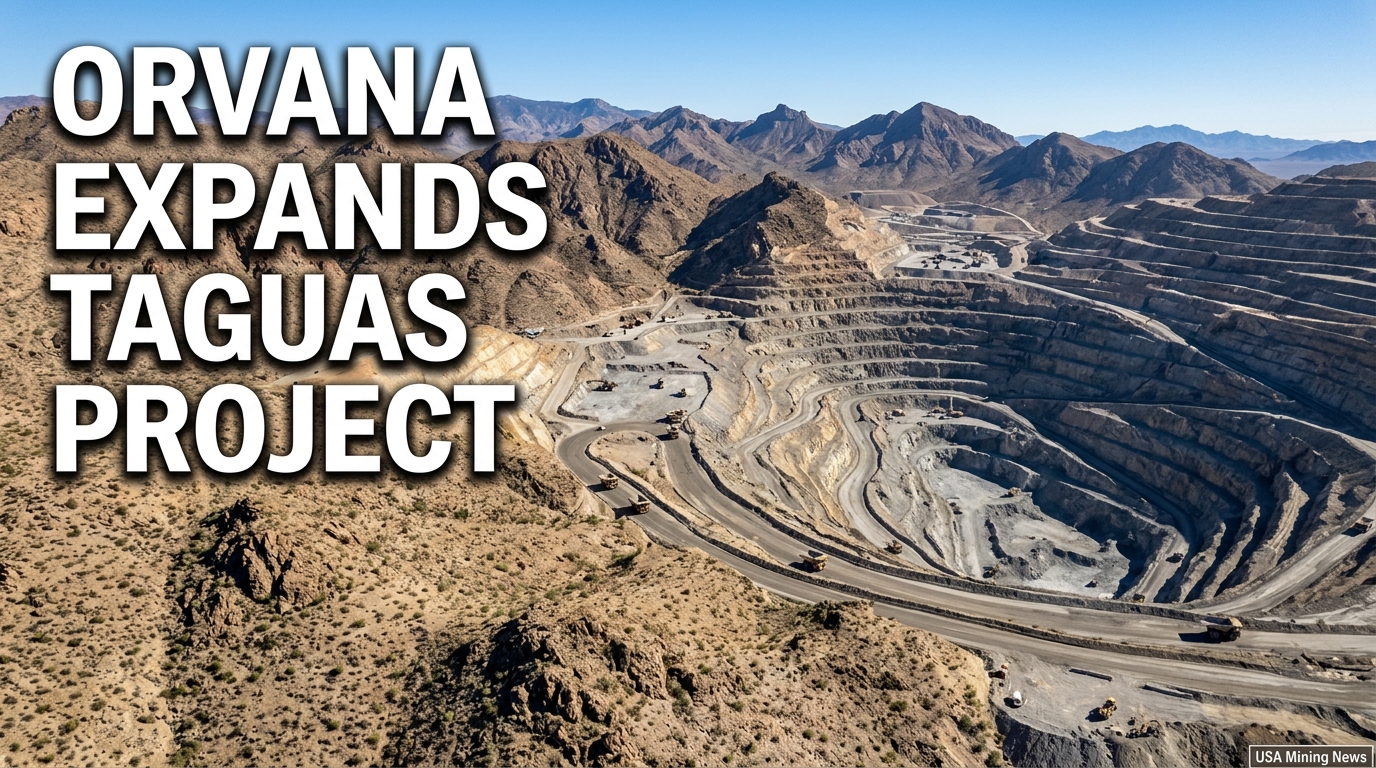
San Juan Province, Argentina – In a strategic move poised to significantly enhance its exploration potential, Orvana Minerals has expanded the land holdings for its Taguas Project in Argentina’s San Juan Province. The company, through its wholly owned subsidiary Orvana Argentina, announced on June 30, 2026, the acquisition of the Evelina claims from a subsidiary of Pan American Silver for a cash consideration of $1.2 million (C$1.7 million). This transaction not only bolsters Orvana’s presence in a key South American mining jurisdiction but also substantially expands the Taguas Project’s footprint, providing critical new ground for future exploration and potential development.
Strategic Land Expansion in a Prospective Region
The newly acquired Evelina property encompasses four distinct mining claims – Evelina I, Gabriela 1, Gabriela 2, and Gabriela 3 – covering a substantial area of 4,015 hectares. These claims are located within the Iglesia Department of San Juan, a region renowned for its significant mineral endowments and existing large-scale mining operations. With this addition, the overall land area of Orvana’s Taguas Project has seen a dramatic increase, expanding by approximately 123% from its previous 3,274 hectares to a consolidated total of 7,289 hectares. This represents a substantial enlargement of Orvana’s operational flexibility and geological optionality within the district.
The acquisition of contiguous land packages like Evelina is a fundamental strategy in mineral exploration, particularly for large-scale deposits such as porphyries or extensive epithermal systems. It allows for a more comprehensive and efficient approach to geological mapping, geophysical surveys, and drilling programs, eliminating issues of fragmented ownership that can complicate resource definition and future mine planning. Orvana’s CEO, Juan Gavidia, underscored this strategic rationale, stating, “As we advance our understanding of the porphyry system at depth at Taguas, we are expanding our land position and strengthening our presence in the district. The Evelina property acquisition consolidates a continuous land package alongside Taguas, enhancing our geological optionality and increasing flexibility for potential future development.”
Geological Context and Prospectivity of the Evelina Claims
The Evelina property is strategically situated within the same Oligocene–Miocene metallogenic belt that hosts the existing Taguas Project. This specific geological epoch and regional belt are globally recognized for hosting significant precious and base metal deposits, including large-scale epithermal gold-silver systems and porphyry copper-gold-molybdenum deposits. The acquisition directly targets the potential extension of such known mineralized systems.
Initial geological interpretations and historical data suggest significant prospectivity within the Evelina claims:
- Evelina East: This area is interpreted as a possible southern continuation of the Cerros Taguas mineralized corridor, which is central to Orvana’s current exploration efforts. Historical exploration on Evelina East has been more extensive compared to other new claims. Satellite imagery has further supported this prospectivity by identifying distinct geological features indicative of an underlying epithermal system, often characterized by quartz veins, stockworks, and widespread alteration zones that host gold and silver mineralization.
- Evelina West: In contrast, Evelina West remains largely unexplored, presenting a significant greenfield opportunity. Despite the limited historical work, the area exhibits encouraging signs of hydrothermal activity. Alteration patterns consistent with high-sulphidation environments have been identified. High-sulphidation systems are a specific type of epithermal deposit known for their potential to host substantial gold, silver, and copper resources, characterized by intense acid-sulfate alteration and specific sulphide mineral assemblages. The largely underexplored nature of Evelina West suggests a compelling target for future reconnaissance and drilling.
These geological characteristics align well with Orvana's current focus at Taguas, where the company is actively investigating deep-seated porphyry systems and their associated epithermal expressions. The expanded land package ensures that any extensions of these mineralizing systems are captured within Orvana’s control.
Intensified Exploration and Early Drill Insights at Taguas
The acquisition of the Evelina claims comes amidst a period of intensive exploration activity at the Taguas Project. Orvana has been systematically advancing its understanding of the underlying geology through a multi-faceted approach:
- Updated Geological Model: A refined geological model, critical for guiding exploration, has been developed to integrate all available data and provide a more comprehensive understanding of the deposit's architecture.
- Geophysical Survey: A significant geophysical survey was initiated in November of the preceding year (November 2025). This program, assigned to Ridgeback Geofísica Argentina, an affiliate of Southernrock Geophysics, was designed to penetrate depths of up to 1,500 meters. Geophysical methods, such as induced polarization (IP) or magnetotellurics (MT), are instrumental in identifying sub-surface geological structures, alteration zones, and sulphide mineralization that are often associated with porphyry and epithermal deposits. The depth target suggests Orvana is keen on understanding the larger, deeper porphyry architecture that typically underpins these systems.
- Fiscal Year 2026 Drilling Campaign: For its fiscal year 2026, Orvana executed a targeted drilling campaign comprising two deep drill-holes, TADD-278 and TADD-279, totaling 2,173.7 meters.
Results from the first hole, TADD-278, which reached a depth of 1,331.7 meters, have provided encouraging insights. Petrographic studies on core samples from this hole confirmed the presence of a dacitic porphyry system. Dacitic porphyry intrusions are common hosts for significant copper-gold deposits worldwide. Furthermore, petrographic work identified pervasive quartz-sericite-pyrite alteration, a signature alteration assemblage typical of the phyllic alteration zone within a porphyry system, indicating the proximity to economic mineralization. Critically, the drill core also revealed pyrite-associated ore minerals, specifically enargite and chalcopyrite. Chalcopyrite is the most important copper ore mineral, while enargite is a copper arsenic sulfosalt that often occurs in high-sulfidation epithermal or porphyry-related environments. The presence of these minerals at depth is a strong indicator of potential economic mineralization within the system.
Results from the second hole, TADD-279, are currently pending, with more information anticipated as the data from assays, geological logging, and petrographic studies is processed. The industry will be watching these results closely for further confirmation of the tenor and extent of mineralization at Taguas.
Implications for the Mining Industry and Future Outlook
This expansion and the ongoing exploration efforts at Taguas hold several key implications for the mining industry and investors:
- Enhanced Resource Potential: By securing a larger and continuous land package, Orvana significantly increases the potential for identifying and expanding mineral resources. The geological continuity between the existing Taguas claims and the newly acquired Evelina property suggests that the mineralized systems are open at depth and laterally.
- Strategic Position in San Juan: San Juan Province is a key jurisdiction for mining in Argentina, known for its investor-friendly policies and significant mineral potential. Companies actively consolidating land and demonstrating progress in advanced exploration phases often gain a competitive advantage in attracting further investment and partnerships.
- De-risking Exploration: The systematic approach involving updated geological models, deep geophysics, and targeted drilling helps de-risk the exploration process. Confirmation of a dacitic porphyry system at depth, coupled with promising alteration and mineralogy, provides a strong foundation for future resource definition.
- Flexibility for Future Development: A larger land package offers greater flexibility for potential future mine development, including the siting of infrastructure, tailings facilities, and processing plants, which are critical considerations for large-scale operations.
Moving forward, the mining community will keenly anticipate the detailed results from drill hole TADD-279, which will further clarify the scope of the deep porphyry system at Taguas. The acquisition of the Evelina claims also paves the way for dedicated exploration programs on these new lands, potentially involving new geophysical surveys, detailed geological mapping, and subsequent drilling to test the conceptual targets identified in Evelina East and Evelina West. Orvana’s disciplined, geology-driven approach to expanding its land position and aggressively exploring its targets positions the Taguas Project as an increasingly significant asset within the South American mining landscape.