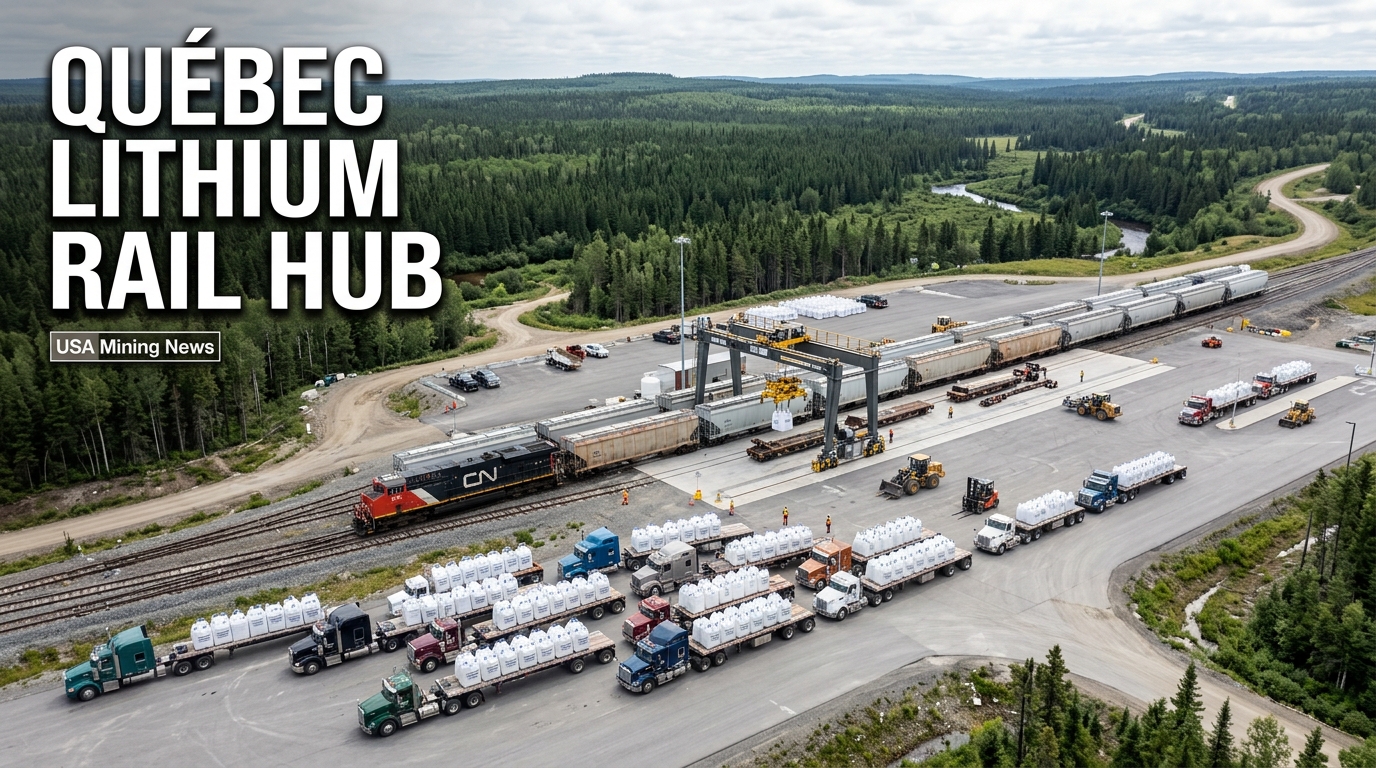
In a significant development for North America's burgeoning critical minerals sector, PMET Resources has announced the signing of a Letter of Intent (LoI) with the City of Matagami in Québec, Canada. Dated October 5, 2026, this strategic agreement lays the groundwork for establishing a crucial trans-shipment hub for spodumene concentrate originating from PMET's Shaakichiuwaanaan Project. The LoI is not merely a formality; it represents a tangible progression in securing the vital logistics infrastructure necessary to bring the project to fruition, connecting a remote mine site to global markets and bolstering Québec's position as a key supplier of battery-grade materials.
A Crucial Link for Québec's Lithium Ambitions
The core of the agreement between PMET Resources, an emerging pegmatite critical mineral exploration and development company, and the municipality of Matagami centers on the efficient and cost-effective movement of spodumene concentrate. Spodumene, a primary ore mineral for lithium, is in high demand globally due to its indispensable role in the manufacturing of lithium-ion batteries, which power electric vehicles (EVs) and grid-scale energy storage solutions. The Shaakichiuwaanaan Project, wholly owned by PMET and situated in the mineral-rich Eeyou Istchee James Bay region of Québec, is poised to contribute significantly to this supply chain.
Under the proposed arrangement, spodumene concentrate from the Shaakichiuwaanaan mining site will be transported by truck to Matagami's dedicated trans-shipment yard. This initial leg of the journey addresses the immediate logistical challenge of moving bulk material from a potentially remote mine. Upon arrival at Matagami, the concentrate will then be efficiently transferred and loaded onto railcars for onward shipment to port facilities, from where it can be exported to refining and processing plants. This truck-to-rail intermodal strategy is a common and often essential solution for bulk commodities, offering a balance of flexibility for the "first mile" and the economic efficiency and environmental benefits of rail for long-haul transport.
Frédéric Mercier-Langevin, PMET's Chief Operating Officer, underscored the importance of this LoI, stating, “The LoI with Matagami marks another tangible step in advancing the infrastructure required to support the development of Shaakichiuwaanaan. Trans-shipment at Matagami is expected to provide a key link in our planned logistics chain, connecting concentrate trucked from the project to onward rail transportation. We look forward to working closely with the City of Matagami to progress the required infrastructure and commercial upgrades as we continue to advance Shaakichiuwaanaan towards a final investment decision.” His comments highlight the strategic value of Matagami as a logistical nexus in the region.
Strategic Location and Infrastructure Development
The Eeyou Istchee James Bay region of Québec is rapidly becoming a focal point for critical mineral exploration and development, thanks to its rich geological endowment and the provincial government's proactive support for mining initiatives. The Shaakichiuwaanaan Property benefits from year-round access via existing all-season roads, a crucial advantage for any mining operation in northern climates, which mitigates logistical disruptions. Furthermore, its proximity to regional hydropower facilities offers a significant competitive edge, promising access to clean, reliable, and potentially lower-cost energy – a critical factor for reducing operational expenses and the carbon footprint of future mining activities.
Matagami itself is strategically positioned within this region, serving as a vital transportation and service hub. The LoI specifically sets out a framework for the necessary infrastructure improvements and operational services required to establish this comprehensive logistics route. While the exact details regarding infrastructure investments, service fees, and precise operational responsibilities are yet to be finalized, the LoI provides guiding principles for cooperation on facility upgrades and ongoing trans-shipment operations. This collaborative approach between a mining developer and a local municipality is often vital for successful project execution, ensuring that local needs and infrastructure capacities are integrated into the project's development plan.
The nature of these infrastructure upgrades could range from enhancing existing rail sidings and loading facilities to constructing new storage yards and material handling equipment. Such investments not only support the specific mining project but also contribute to the broader economic development and infrastructural resilience of the Matagami region, potentially attracting other industrial activities and creating local employment opportunities.
PMET's Shaakichiuwaanaan Project: A Snapshot
PMET Resources operates with a specific focus on pegmatite-hosted critical minerals, a geological setting known to host significant deposits of lithium, tantalum, niobium, and other strategic elements. The Shaakichiuwaanaan Property represents a key asset in PMET’s portfolio, and its successful development is integral to the company's growth strategy. As a wholly-owned project, PMET retains full control over its exploration and development trajectory, allowing for streamlined decision-making and operational efficiency.
The global energy transition is driving unprecedented demand for critical minerals, with lithium standing at the forefront. As nations worldwide accelerate their efforts to decarbonize transportation and energy grids, the secure and diversified supply of battery raw materials has become a strategic imperative. Projects like Shaakichiuwaanaan, therefore, are not just commercial ventures but also play a critical role in geopolitical resource security and the global push towards a greener economy. The ability to reliably and efficiently transport spodumene concentrate is a non-negotiable prerequisite for the project to contribute meaningfully to this supply. The LoI with Matagami is a direct response to this fundamental requirement.
Navigating the Path to a Final Investment Decision
The signing of the LoI is an important milestone, but it is one step in a multi-stage process. PMET and the City of Matagami now plan to negotiate a definitive commercial agreement. This subsequent stage will delve into the intricate details of the partnership, including the precise financial commitments from both parties for infrastructure investments, the structure of service fees for trans-shipment operations, and the clear delineation of operational responsibilities. The successful conclusion of these negotiations is paramount for PMET, as it will precede the company’s final investment decision (FID) for the Shaakichiuwaanaan Project.
A positive FID typically hinges on a comprehensive evaluation of all project facets, including resource estimates, metallurgical recoveries, capital and operating costs, environmental and social impact assessments, and crucially, market access and logistics. By securing a clear framework for concentrate transportation early in the development process, PMET is effectively de-risking a major component of its future operational expenses and timelines. Reliable and cost-effective logistics can significantly impact the overall economic viability and attractiveness of a mining project to potential investors and off-take partners.
The commitment outlined in the LoI provides a strong signal to the market that PMET is systematically addressing the logistical challenges inherent in developing a remote mining project. For investors, this demonstrates prudent project management and a focused approach to mitigating risks that often plague large-scale resource developments. The ongoing collaboration with local authorities like the City of Matagami also underscores a commitment to sustainable development and positive community relations, factors increasingly valued by investors and stakeholders in the mining industry.
Broader Implications for Québec and the North American EV Market
This partnership between PMET Resources and the City of Matagami holds broader implications beyond the immediate scope of the Shaakichiuwaanaan Project. Québec has strategically positioned itself as a leading jurisdiction for critical minerals, actively promoting exploration, extraction, and processing within its borders to establish a robust, vertically integrated battery materials supply chain. The province’s abundant natural resources, combined with its commitment to sustainable development and access to green hydropower, make it an attractive destination for investments in the EV ecosystem.
Projects like Shaakichiuwaanaan, backed by foundational logistics agreements such as this LoI, are vital pieces of this provincial strategy. They feed into the larger North American ambition to build secure and resilient supply chains for EVs, reducing reliance on foreign sources for critical components. As manufacturing of EV batteries and vehicles scales up across Canada and the United States, a consistent and reliable flow of raw materials like spodumene concentrate from Québec will be indispensable. The Matagami trans-shipment hub, therefore, could become an important node in a broader continental logistics network, facilitating the movement of materials from mine to processing plants and ultimately to gigafactories.
Furthermore, the development of new infrastructure and the long-term operational needs associated with a project of this scale promise significant economic benefits for the City of Matagami and the surrounding Eeyou Istchee James Bay region. These benefits include job creation, local procurement opportunities, and increased economic activity, reinforcing the symbiotic relationship between resource development and regional prosperity. The proactive engagement of the City of Matagami reflects its understanding of these potential benefits and its role in fostering responsible industrial growth.
In conclusion, the Letter of Intent between PMET Resources and the City of Matagami represents a critical, foundational step for the Shaakichiuwaanaan Project. It not only outlines a viable logistics pathway for spodumene concentrate but also exemplifies the collaborative spirit required to advance major resource projects in complex environments. As PMET moves towards negotiating a definitive commercial agreement and ultimately a final investment decision, this LoI stands as a testament to the methodical de-risking and strategic planning necessary to unlock Québec’s critical mineral potential and contribute to the global energy transition.