ReElement Technologies Navigates Setback in Pentagon Funding for Critical Minerals
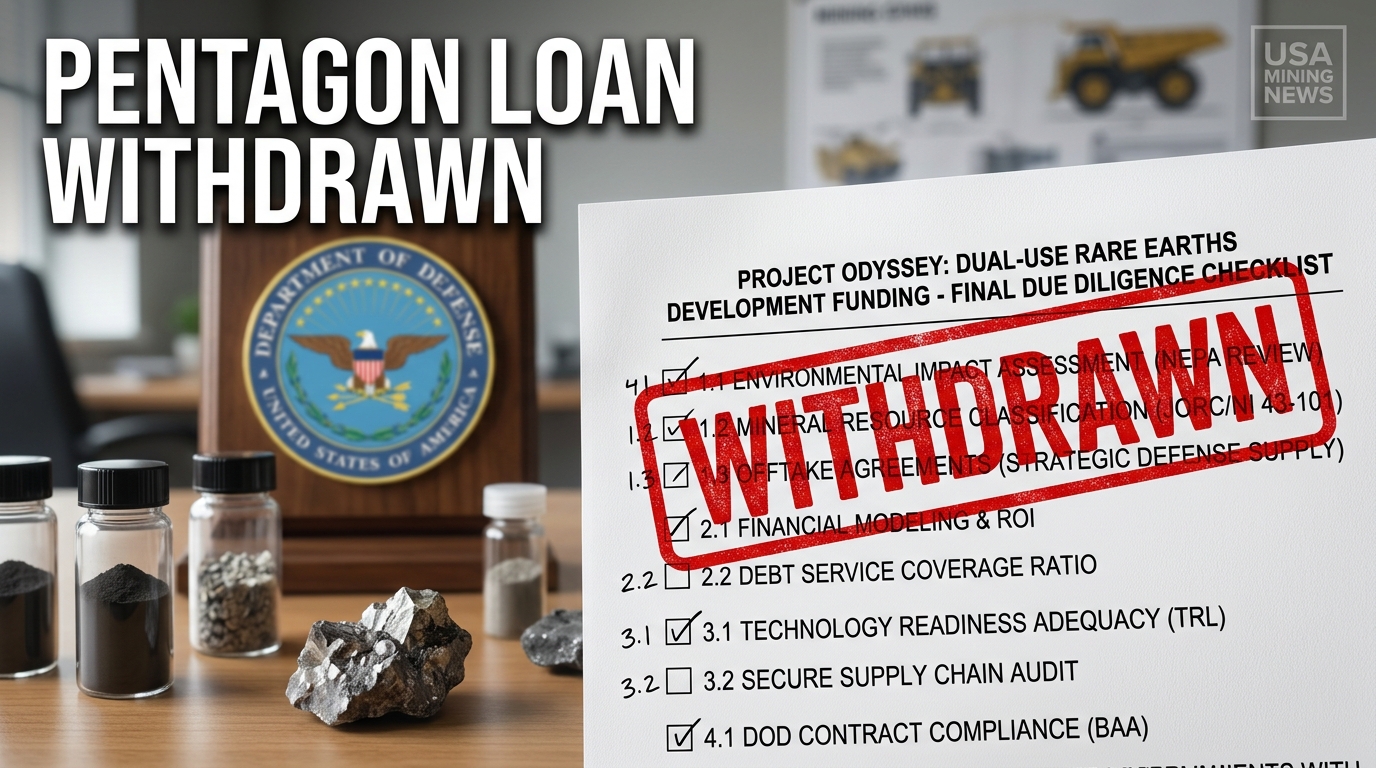
In a significant development for the burgeoning US critical minerals sector, ReElement Technologies, a rare earths start-up, has formally withdrawn from a conditional $80 million loan process with the US Department of Defense (DoD). The decision, reported by Reuters on July 13, 2026, stems from the company's inability to satisfy federal due diligence criteria, casting a spotlight on the rigorous evaluation processes governing government funding initiatives aimed at securing vital domestic supply chains. This move underscores the complexities and high standards associated with federal support for strategic industries, particularly those essential for national security and economic resilience.
The $80 million loan was initially earmarked to support ReElement's innovative technology for processing rare earths and other critical minerals, a capability deemed crucial for establishing a robust, independent domestic supply chain. This funding formed a component of a larger $700 million critical minerals funding initiative, which the Office of Strategic Capital announced last November. The initiative itself represents a concerted effort by the US government to mitigate reliance on geopolitical adversaries, primarily China, which currently dominates much of the global critical mineral processing and magnet manufacturing landscape.
The Pentagon's Critical Minerals Push and Due Diligence Imperatives
The US Department of Defense, through initiatives like the Office of Strategic Capital's program, has been actively seeking to fortify domestic capabilities across the entire critical minerals value chain. These efforts are not merely about resource extraction; they extend to advanced processing, refining, and manufacturing of high-value components such as permanent magnets, which are indispensable for defense systems, electric vehicles, and renewable energy technologies. The $700 million funding initiative reflects a strategic imperative to de-risk supply lines and foster American technological leadership in this domain.
For ReElement Technologies, the conditional $80 million loan represented a substantial opportunity to scale its proprietary processing technology. However, administration officials, who spoke to Reuters, did not disclose specific details regarding the issues that led to the company's failure to meet federal due diligence standards. In the context of government-backed loans, due diligence typically involves a comprehensive assessment of a company's financial health, technical viability, operational capabilities, environmental compliance, governance structures, and market potential. For a strategic sector like critical minerals, these evaluations often include national security considerations, intellectual property security, and long-term supply resilience. The lack of specific information on ReElement's particular challenges during this process leaves industry observers to infer that the identified shortcomings were significant enough to preclude the progression of the loan as initially structured.
Strategic Recalibration and Private Investment Focus
Following the withdrawal, ReElement Technologies has indicated a pivot in its funding strategy. ReElement CEO Mark Jensen commented in June, prior to the official withdrawal announcement, that "Putting debt on your balance sheet adds cost to your balance sheet." He emphasized the company's intention to focus instead on securing private investment as a means to lower costs and bolster its competitiveness directly against China's established dominance in the rare earths market.
In a subsequent statement, Jensen reiterated this strategic shift, noting, "The structure has been changed based on mutual desire and we are working through the process," though he did not clarify whether this implied continued pursuit of differing forms of government assistance or an exclusive focus on private capital. Nevertheless, the company's proactive stance on seeking private funding is already evident. Earlier this year, ReElement secured a substantial $200 million investment from Transition Equity Partners. Additionally, Japan's Mitsubishi Materials, a global leader in materials and metals, agreed to acquire an undisclosed stake in ReElement, signifying international confidence in the company's technology and market potential. These investments demonstrate the private sector's willingness to back innovative ventures critical to diversifying global supply chains.
The Interplay with Vulcan Elements and Broader Market Implications
ReElement's withdrawal also impacts its potential symbiotic relationship with another key player in the US critical minerals strategy: Vulcan Elements. As part of the same $700 million critical minerals funding initiative, Vulcan Elements, a start-up magnet manufacturer backed by the 1789 private equity fund (in which Donald Trump Jr. is a partner), was allocated a separate $620 million loan from the Pentagon.
Plans announced last year envisioned ReElement supplying Vulcan Elements with the processed rare earths necessary to produce up to 10,000 tonnes per year of magnets specifically for the Pentagon. This arrangement was designed to create a fully integrated, domestic rare-earth-to-magnet supply chain, directly addressing a critical vulnerability identified by the DoD. The fact that Vulcan Elements' Pentagon loan remains in place, according to administration officials, suggests that the Department of Defense is committed to supporting domestic magnet production. However, ReElement's ability to fulfill its part of the supply chain will now depend on its capacity to secure alternative funding and scale its processing operations independently or through revised federal assistance. This highlights the interconnectedness of various projects within the broader strategic initiative and the ripple effects of challenges faced by one participant.
Scrutiny, Political Influence, and the Path Forward
The broader $700 million critical minerals funding initiative has not been without its critics. Democratic lawmakers have scrutinized the funding process, raising questions about potential political influence and the robustness of the review procedures for these significant loans. Given the high stakes involved in securing critical mineral supply chains and the substantial government investment, transparency and rigorous oversight are paramount. ReElement's inability to meet due diligence standards, even without specific details, could fuel further scrutiny into the selection and vetting processes for such strategic funding programs.
For the mining industry, this development underscores several crucial themes. Firstly, securing federal funding, particularly in areas deemed critical for national security, comes with stringent requirements that go beyond technical merit to encompass financial and governance solidity. Secondly, the pursuit of domestic critical mineral supply chains is a capital-intensive and complex endeavor, often requiring a delicate balance of government support and private investment to manage risk and accelerate deployment. Finally, the ongoing efforts by the US government to build out these supply chains reflect a long-term strategic priority that will continue to shape investment and operational decisions across the sector.
While ReElement has not publicly disclosed cost estimates for its planned commercial facility in Marion, Indiana, the company's stated intent to explore "other forms of federal assistance, potentially including a loan with different terms," suggests that avenues for government support may still be open, albeit under revised conditions. The challenge for ReElement, and indeed for many emerging players in the critical minerals space, will be to demonstrate not only technological innovation but also the financial and operational maturity required to meet the exacting standards of both government and private investors. As the US strives to disentangle its critical mineral supply chains from geopolitical vulnerabilities, the scrutiny on companies receiving public funds will only intensify, demanding unparalleled rigor and transparency from all participants.