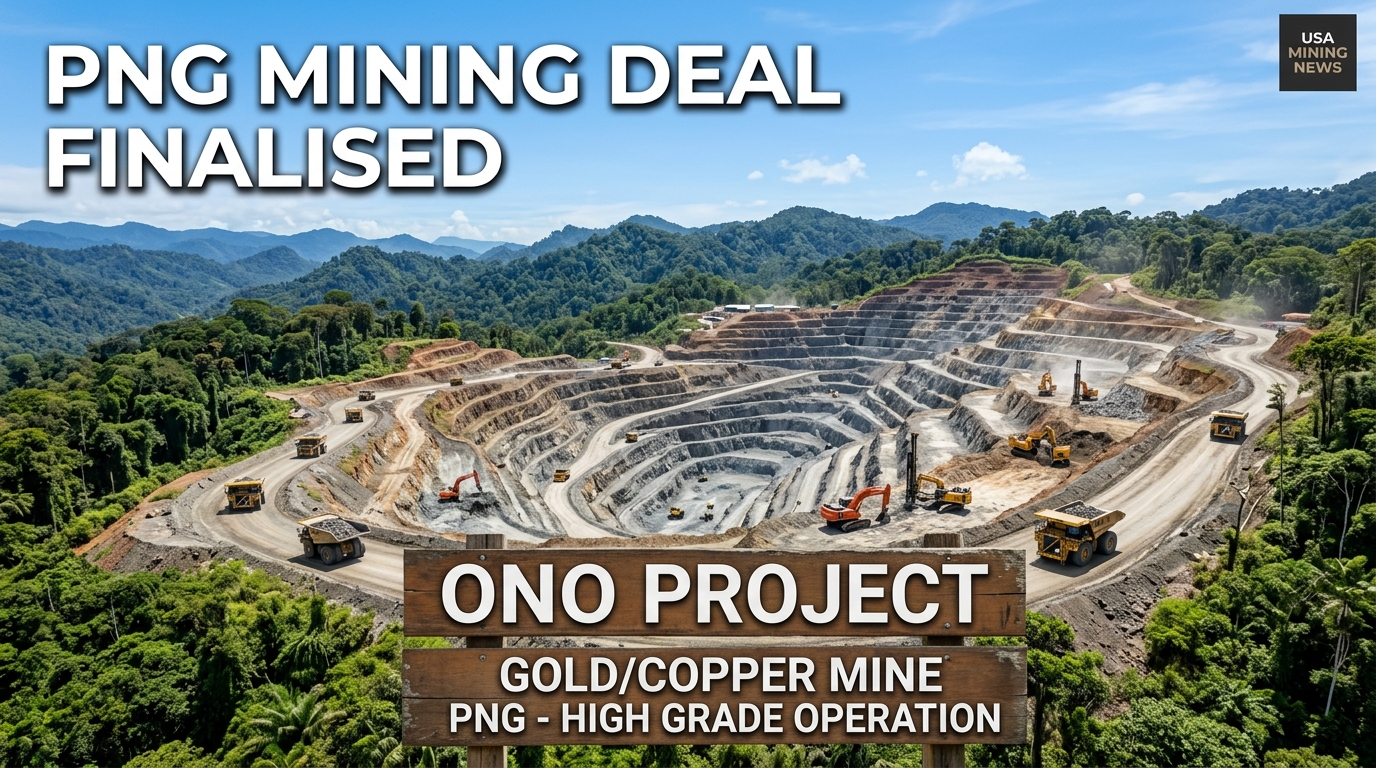
Rio Tinto Forges New Path in Papua New Guinea with Ono Project Earn-in
The global mining industry is keenly watching as major player Rio Tinto Exploration formalizes a strategic earn-in agreement with LCL Resources for the Ono Project, situated in the resource-rich nation of Papua New Guinea. Announced on March 23, 2026, this collaboration signals a renewed focus by one of the world's leading diversified miners on the significant mineral potential of PNG, particularly within the Owen Stanley Metamorphic Belt, an area renowned for its substantial copper and gold endowments.
The Ono Project, strategically located approximately 150 kilometers south of the key maritime hub of Lae port, represents a compelling opportunity for both companies. For LCL Resources, it provides access to the extensive financial resources and world-class exploration capabilities of Rio Tinto, essential for advancing a project of this scale. For Rio Tinto, it offers a foothold in a geologically prospective region with a proven track record of hosting large-scale copper-gold deposits, aligning with the industry's increasing demand for these critical metals.
This agreement comes at a time when the global appetite for copper, driven by the energy transition and electrification, and gold, as a perennial store of value, remains robust. The partnership thus carries significant implications not just for the involved parties but for the broader investment landscape in tropical exploration frontiers.
Strategic Partnership Targets High-Value Porphyry Deposits
The core objective of the Rio Tinto-LCL Resources collaboration at the Ono Project is to uncover significant porphyry copper-gold deposits. Porphyry deposits are vital to the global mining industry, often characterized by their large tonnage and contained metal content, making them attractive targets for major mining companies capable of developing long-life assets. The Owen Stanley Metamorphic Belt, where Ono is situated, is a geological province intimately associated with such mega-deposits.
The earn-in arrangement is structured in phases, providing a clear pathway for Rio Tinto's increased involvement based on exploration success and investment milestones:
- Initial Phase (51% interest): Rio Tinto Exploration can earn an initial 51% interest in the Ono Project by committing a minimum of A$8 million (approximately US$5.61 million) to exploration activities. This initial investment mandates a minimum of 4,000 meters of drilling, a critical step to test the subsurface potential and confirm geological models. Such a substantial drilling program is indicative of a serious commitment to systematic exploration required for porphyry systems, which often require deep drilling to intercept mineralization.
-
Second Phase (up to 80% interest): Should the initial exploration prove promising, Rio Tinto has further rights to increase its stake to a commanding 80%. This can be achieved in two ways:
- By committing an additional A$40 million towards exploration activities, demonstrating a continued belief in the project's prospectivity.
- Alternatively, by defining a mineral resource that complies with the internationally recognized Joint Ore Reserves Committee (JORC) standards. This resource must comprise at least 1.25 million tonnes of contained metals on a copper-equivalent basis. The requirement for a JORC-compliant resource, coupled with a scoping study, signifies a progression from pure exploration to preliminary economic assessment, a crucial step in de-risking a project for future development.
Beyond exploration expenditures, the agreement also outlines that Rio Tinto will make total cash payments of up to A$1.5 million to LCL. These payments are strategically disbursed in phases, linked to the achievement of specific project milestones, providing LCL with supplementary capital as the project advances.
Geographic and Geologic Context of the Ono Project
The Ono Project’s geographical and geological setting is a fundamental aspect of its appeal. Located in southern Papua New Guinea, approximately 150 kilometers south of Lae port, the project area is nestled within the Owen Stanley Metamorphic Belt. This particular geological belt is globally recognized for its significant mineral endowments, hosting several world-class deposits.
Illustrious neighbors of the Ono Project within this prolific region include the well-established Hidden Valley gold mine, an open-pit gold and silver operation majority-owned by Harmony Gold, and the Wafi-Golpu copper/gold project, a massive undeveloped deposit jointly owned by Newcrest Mining (now part of Newmont) and Harmony Gold. The presence of such significant, high-grade operations and projects in close proximity strongly underpins the geological prospectivity of the Ono area, suggesting similar mineralizing systems could be present.
Further enhancing the project's allure, LCL Resources’ exploration license for Ono includes the known Kusi Gold skarn resource. Skarn deposits are typically formed by contact metamorphism and metasomatism, often associated with porphyry intrusions, and can host substantial gold mineralization. Additionally, the project benefits from an application for the contiguous Kau Creek area, which would expand the exploration footprint and potentially unlock further prospectivity. The strategic partnership between Rio Tinto and LCL is expected to leverage these existing high-grade gold and silver findings, reinforcing the project's overall potential.
Operational Management and Financial Synergies
Under the terms of the earn-in agreement, LCL Resources will initially retain the role of managing the Ono Project’s operations. This arrangement ensures continuity of local knowledge and stakeholder relationships, which are critical in Papua New Guinea. In recognition of its management responsibilities, LCL will receive a management fee equivalent to 10% of the expenditure, providing a reliable income stream to support its ongoing corporate activities and other projects.
The agreement also includes provisions for contingencies. Specifically, during the initial phase of the farm-in, if exploration licence application ELA2837 faces delays or rejection, amendments to Rio Tinto’s minimum commitment may be negotiated. Such clauses are standard practice in complex exploration agreements, acknowledging the dynamic nature of regulatory processes in various jurisdictions.
Mr. Chris van Wijk, Executive Chairman of LCL Resources, articulated the profound significance of this transaction for his company: "This transaction is a transformational step for LCL. Partnering with Rio Tinto brings world-class exploration capability and substantial funding to the Ono Project, enabling a level of exploration activity that would not otherwise be possible for a company of our size." He further emphasized, "Importantly, the structure allows LCL shareholders to retain significant exposure to exploration success and any potential discoveries funded by Rio Tinto. We look forward to watching the Ono Project develop alongside one of the world's leading miners." This sentiment highlights the dual benefit of capital injection and de-risking for a junior explorer, allowing it to accelerate discovery without excessive shareholder dilution in the early high-risk exploration stages.
LCL Resources' Broader Portfolio and Strategic Context
While the Ono Project is a major focus, LCL Resources is an active explorer with a broader portfolio. In 2024, the company notably received a forest use permit for the Miraflores gold deposit, which forms part of its Quinchia Gold Project in Colombia. This indicates LCL’s strategy of developing a diversified portfolio across South America and the Pacific, targeting high-potential gold and copper assets. The ability to attract a major like Rio Tinto for its PNG asset speaks volumes about the perceived quality and prospectivity of the Ono Project within LCL's overall exploration strategy.
Broader Industry Context and Implications for PNG
This agreement by Rio Tinto, a titan in the global mining arena, to invest significantly in PNG's exploration sector is more than just a corporate transaction; it is a powerful signal to the international investment community. For Papua New Guinea, a nation heavily reliant on its natural resources, the re-engagement of a company of Rio Tinto’s stature can inject renewed confidence and stimulate further foreign direct investment into its minerals sector. The country has faced challenges in attracting and retaining large-scale mining investment due to regulatory uncertainties and complex socio-political dynamics in recent years.
The pursuit of porphyry copper-gold deposits by a major miner aligns perfectly with burgeoning global demand trends. Copper is indispensable for the burgeoning green energy sector, including electric vehicles, renewable energy infrastructure, and smart grids. Gold, conversely, provides hedging against inflation and geopolitical instability, remaining a crucial component of investor portfolios. The potential for a new, large-scale copper-gold discovery in PNG could significantly impact global supply chains and economic development in the region.
Furthermore, such partnerships exemplify the evolving financial models in mineral exploration. Junior exploration companies like LCL Resources, often rich in geological ideas but constrained by capital, benefit immensely from farm-out agreements. These arrangements allow them to leverage the financial muscle and technical expertise of majors, de-risking exploration endeavors and increasing the probability of discovery, while retaining a meaningful stake in any future success. This collaborative model is critical for advancing early-stage projects that would otherwise struggle to attract the necessary capital at scale.
Future Outlook and Next Steps
The immediate future for the Ono Project will involve Rio Tinto Exploration mobilizing its technical teams and resources to commence the mandated 4,000 meters of drilling. This phase of intensive exploration will be crucial in defining the extent and tenor of the mineralization within the project area. Concurrently, efforts will likely focus on securing and expediting the approval of ELA2837 for the contiguous Kau Creek area, which could significantly expand the exploration potential.
Should the initial drilling and geological assessments confirm the presence of a substantial porphyry system, the project would then progress toward the delineation of a JORC-compliant resource and feasibility studies, potentially culminating in a decision to develop a major mine. The phased nature of the earn-in agreement means that each milestone achieved strengthens Rio Tinto's commitment and solidifies the project's trajectory toward potential production.
The long-term impact of a significant discovery at Ono could be transformative for the local communities in southern PNG, promising employment opportunities, infrastructure development, and economic growth. For LCL Resources, a successful outcome would validate its exploration strategy and significantly enhance shareholder value. For Rio Tinto, it would further diversify its global portfolio with a potentially world-class asset in a key resource jurisdiction. As exploration activities ramp up, the mining world will be closely monitoring the Ono Project's progress, anticipating the next chapter in Papua New Guinea's storied mining history.