In the global pursuit of net-zero emissions, the decarbonization of heavy industry and transportation remains one of the most significant challenges. These "hard-to-abate" sectors, which include the extensive operations within the mining industry, are largely dependent on fossil fuels, making the development of cost-competitive and scalable low-carbon alternatives a critical priority. While green hydrogen, ethanol, and synthetic fuels have seen limited adoption, a concerted effort by researchers across the solar, wind, and tidal energy spectrum is pushing the boundaries toward widespread commercial viability. This exploration into renewable energy’s role in low-carbon fuel production, as highlighted in a recent Energy Technology episode on October 1, 2026, holds profound implications for how mining operations will power their future.
The cutting-edge work discussed in this critical research involves four key experts: Maren Cordts, co-founder of photreon; Motiar Rahaman, an assistant professor at the University of Liège; Catrin Garrett, an energy systems engineer at the European Marine Energy Centre (EMEC); and Alessandro Giampieri, a research associate at Durham Energy Institute. Their collective endeavors are charting a course for a sustainable energy future that promises to revolutionize industrial fuel consumption.
Solar's Promise: Direct Pathways to Green Fuels
Solar energy, with its ubiquitous availability, is a natural candidate for low-carbon fuel production. Two distinct research pathways demonstrate significant promise:
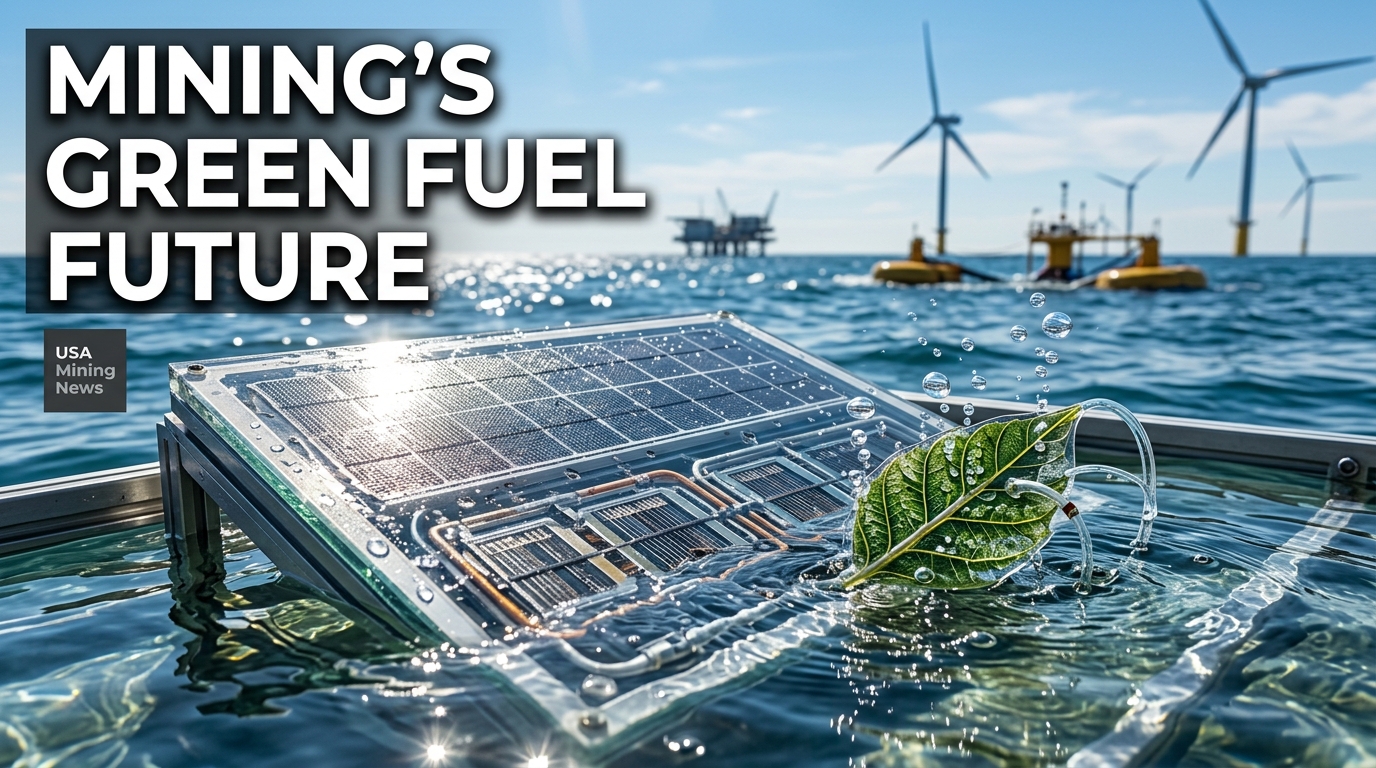
Photreon's Photoreactor Panels: Maren Cordts and her team at photreon are developing a groundbreaking technology that produces hydrogen directly from water and sunlight, bypassing the need for electrolyzers, external electricity, or grid connections. Cordts explains, “Our photoreactor panels use light directly to split water solar chemically.” The core innovation lies in a photocatalyst submerged in water within the panel, which absorbs sunlight. In this excited state, the sun’s energy facilitates the chemical reaction, effectively splitting water molecules into oxygen and hydrogen.
This direct approach is anticipated to significantly reduce overall system costs, offering a lower levelized cost of hydrogen (LCOH) compared to current production methods. As production scales, photreon plans to leverage existing manufacturing capacities, such as polymer extrusion for panel production and evaporative coating for reflective surfaces. Furthermore, the large-quantity production of the photocatalyst powder is also expected to benefit from existing industrial processes. For the mining industry, which often operates in remote locations with abundant sunlight but limited grid access, this decentralized, grid-independent hydrogen production method could prove transformative, enabling on-site fuel generation for heavy machinery and processing plants.
Artificial Leaves for Ethanol Production: In parallel, Motiar Rahaman, affiliated with the University of Liège and a research team at Cambridge, is advancing the concept of ‘artificial leaves’ for ethanol production. Rahaman draws a direct analogy: “While natural leaves produce oxygen and sugars through photosynthesis, an artificial leaf produces oxygen and multi-carbon alcohols as renewable fuel that can be used in our daily life.”
These artificial leaves contain a photocathode and a photoanode. The photocathode is designed to reduce carbon dioxide into fuel, while the photoanode oxidizes water to produce oxygen. Crucially, these devices operate without external electricity. Both reduction and oxidation sides incorporate light-absorbing materials that capture sunlight to generate photovoltage, augmented by catalysts to accelerate the necessary chemical processes. Rahaman notes that the Cambridge research specifically targeted ethanol due to a “growing trend towards ethanol gasoline blends, like with e10 (10% ethanol and 90% gasoline mixture) being one of the most widely adopted fuels.” For mining, which relies heavily on internal combustion engines for much of its mobile fleet, the potential for a solar-derived, lower-carbon liquid fuel alternative like ethanol could facilitate a more immediate transition away from pure fossil fuels.
Harnessing the Tides: Reliable Energy for Complex Fuels
Beyond solar, the predictable power of tidal energy is being leveraged for low-carbon fuel synthesis, addressing challenges inherent in intermittent renewables.
EMEC's Role and Tidal Innovations: The European Marine Energy Centre (EMEC) in Orkney stands as a world-leading facility for testing and demonstrating wave and tidal energy technologies under real-sea conditions. Catrin Garrett, an energy systems engineer at EMEC, observes a strategic shift in research trends. She highlights “a general understanding that, with renewables, we need to look at locating industrial scale use, particularly when this can absorb the extra electricity that would otherwise be being curtailed.”
While hydrogen production has faced challenges related to cost per kilowatt-hour from tidal sources, Garrett has witnessed a pivot towards producing ammonia, methanol, and other e-fuels, which are often “less complicated to move around.” This focus on more energy-dense, transportable fuels is highly relevant for mining operations, which typically require large volumes of fuel to be moved across vast distances.
Pioneering Demonstrations: EMEC has been instrumental in several world firsts, including powering the first aircraft flight with synthetic fuel in 2021. Furthermore, IGTL (now Zero Petroleum) utilized EMEC’s hydrogen, produced from tidal power, for a temporary synthetic gasoline demonstration plant at its onshore test facilities at Bilia Crew. These demonstrations underscore the practical applicability of tidal-derived fuels.
More recently, EMEC achieved another first-of-its-kind integration by combining Orbital Marine’s tidal turbine with vanadium flow batteries and an electrolyzer. The batteries played a crucial role in smoothing power input, allowing for a consistent flow of electricity despite the inherent fluctuations of tidal currents. Garrett emphasizes that this project demonstrated the ability to “harness that predictability to overcome those grid constraints and keep a constant flow of electricity.” This breakthrough “really opens up a new world of offtake opportunities, and hopefully paves the way for a new resilient, responsive energy system.” For mining, the predictability and resilience offered by tidal energy, particularly when coupled with storage, could provide a stable, dispatchable power source for continuous processing operations and large-scale fuel production, reducing reliance on often unreliable or expensive grid connections in coastal mining regions.
Wind Power's Offshore Evolution: Optimizing Hydrogen Production
Offshore wind, with its vast potential, is also a significant contender in the race to produce low-carbon fuels, particularly hydrogen.
Techno-Economic Assessments of Offshore Wind-to-Hydrogen: In 2025, Alessandro Giampieri collaborated with colleagues to publish a critical techno-economic assessment comparing different offshore wind-to-hydrogen scenarios. Their simulation models sought to understand the advantages and challenges of powering onshore electrolysis with offshore wind versus producing green hydrogen directly at offshore wind farms and then transporting it to shore.
Giampieri highlights a key insight: for onshore hydrogen production, the transport of electricity back to shore, especially over longer distances, involves converting alternating current (AC) to direct current (DC), which can incur significant losses and, consequently, reduce the amount of hydrogen produced. In contrast, offshore hydrogen production allows for the immediate utilization of power where it is generated, leading to “less conversion losses.” However, this approach is not without its trade-offs. Giampieri notes that “Offshore production increases complexity.” While an onshore electrolyzer is generally easier to run and maintain, offshore facilities introduce challenges related to harsh marine environments, accessibility for maintenance, and specialized infrastructure requirements.
For the mining industry, these findings are crucial for strategic energy planning. Large-scale mining operations often require immense power. The efficiency gains of offshore hydrogen production could be compelling, particularly for coastal mines or those with access to deepwater ports, despite the increased operational complexity. Such developments could provide a reliable, high-volume source of green hydrogen for mine site power, heavy haulage, and even processing facilities, significantly curbing Scope 1 and Scope 2 emissions.
Broader Implications for the Mining Sector
The advancements in solar, wind, and tidal-derived low-carbon fuels are not merely academic exercises; they represent fundamental shifts that will directly impact the mining sector's operational strategies and environmental footprint.
Decarbonization Imperative: The mining industry, characterized by its energy-intensive processes and extensive use of heavy diesel equipment, faces immense pressure to decarbonize. These renewable fuel pathways offer concrete solutions for reducing direct emissions from haul trucks, excavators, and processing plants, as well as indirect emissions from purchased electricity for stationary operations.
Operational Benefits and Strategic Autonomy: Moving towards renewable-derived fuels can offer mining companies greater energy independence and resilience against the volatility of fossil fuel prices. On-site or near-site production of hydrogen or synthetic fuels can also mitigate supply chain risks associated with global fossil fuel markets, especially in remote mining regions. The predictable nature of tidal energy, for instance, provides a stable power input crucial for continuous mining and processing operations, minimizing costly downtime.
Critical Mineral Demand: Importantly, the widespread adoption of these renewable energy and low-carbon fuel technologies will itself drive significant demand for critical minerals. Mining plays an indispensable role in supplying the raw materials for solar panels (e.g., silicon, silver), wind turbines (e.g., copper, rare earth elements), electrolyzers (e.g., nickel, platinum group metals), and advanced batteries (e.g., lithium, cobalt, nickel, vanadium). Thus, the mining sector is not just a consumer but also a foundational enabler of this energy transition.
The Road Ahead: Scaling Innovation for Commercial Viability
While the research outlined by Cordts, Rahaman, Garrett, and Giampieri presents a compelling vision, the journey from laboratory breakthroughs to widespread commercial adoption is long and fraught with challenges. Cost-competitiveness and scalability remain the primary hurdles. Developing the infrastructure for production, storage, and distribution of these new fuels will require massive investment and coordinated policy support.
Nevertheless, the rapid pace of innovation suggests a promising future. Continued research, strategic pilot projects, and collaborative efforts between industry, academia, and government will be essential. The integration of diverse renewable sources—solar, wind, and tidal—provides a robust, multi-faceted approach to energy security and decarbonization. For mining professionals and investors, understanding these emerging fuel pathways is crucial for forecasting future operational costs, managing regulatory pressures, and identifying strategic investment opportunities in a rapidly evolving global energy landscape. The drive towards low-carbon fuels is not merely an environmental imperative; it is an economic necessity shaping the future of industrial power.