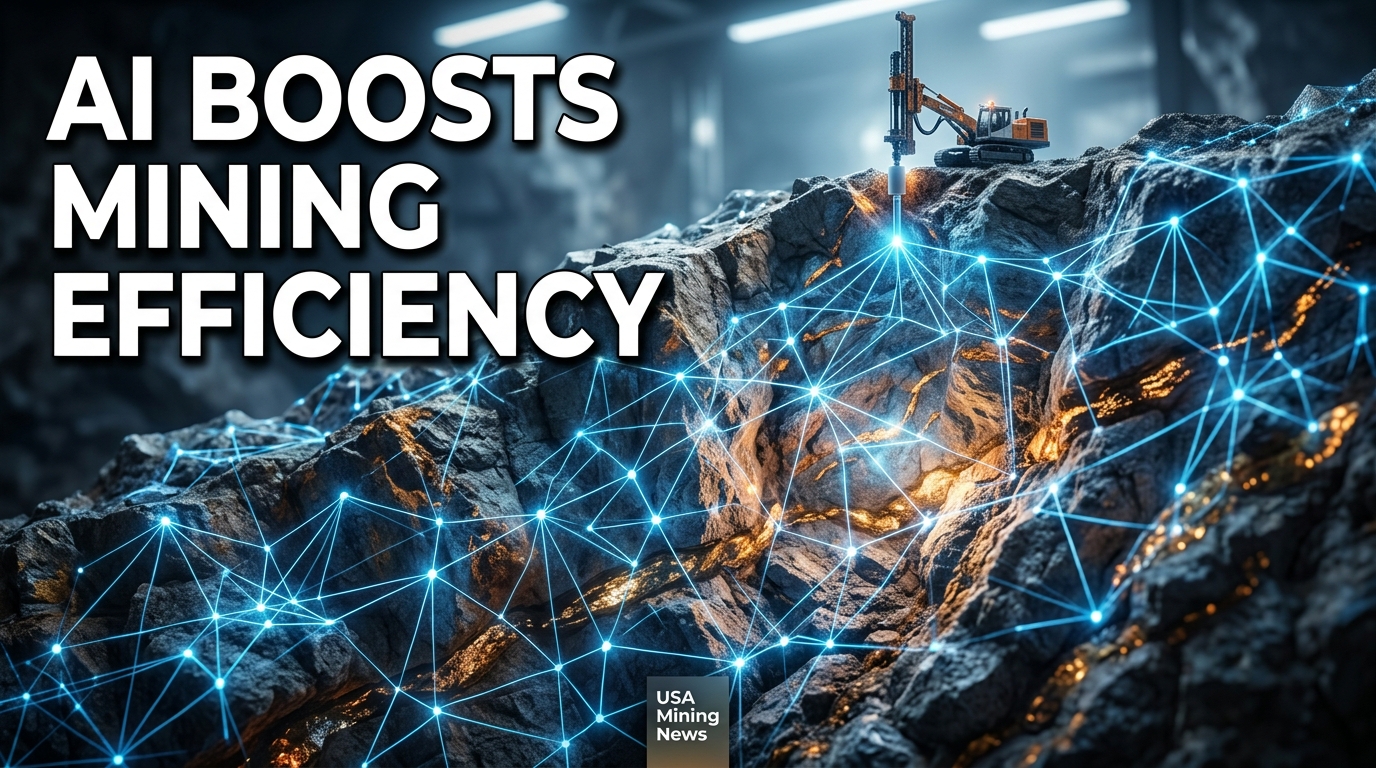
The global mining industry stands on the precipice of a technological transformation, with artificial intelligence (AI) emerging as a powerful tool to unlock efficiencies and address complex operational challenges. A significant development in this arena is new research in the United States, which is harnessing AI to improve the effectiveness of in-situ recovery (ISR) methods for critical minerals. This pioneering work aims to integrate sophisticated physics and chemistry models to predict, with unprecedented accuracy, how injected fluids and reagents navigate and react within the Earth’s varied, heterogeneous rock structures.
This initiative represents a pivotal step towards optimizing a mining technique that holds immense promise for sustainable resource extraction, particularly as the demand for critical minerals intensifies globally. By providing a clearer understanding of subsurface dynamics, AI-enhanced ISR could redefine the economic and environmental calculus of mineral production.
The Promise of In-Situ Recovery (ISR)
In-situ recovery, sometimes referred to as in-situ leach (ISL), is a mining technique that extracts minerals directly from the ore body underground without the need for traditional excavation or extensive surface disturbance. The process involves injecting a lixiviant (a chemical solution) through a series of injection wells into a mineralized zone. This solution dissolves the target minerals from the surrounding rock. The resultant metal-bearing solution, known as the pregnant leach solution (PLS), is then pumped to the surface via recovery wells for processing.
ISR offers several compelling advantages over conventional open-pit or underground mining, making it an attractive option for certain ore bodies and commodities. These benefits include:
- Reduced Environmental Footprint: ISR significantly minimizes surface disruption, avoiding large waste rock dumps, tailings facilities, and extensive dust and noise pollution associated with conventional mining.
- Lower Capital and Operating Costs: Without the need for extensive earthmoving equipment, ventilation systems, or large processing plants at the mine site, ISR operations can often have lower capital expenditures and operational costs.
- Enhanced Worker Safety: The absence of personnel working underground or in deep open pits inherently reduces the safety risks associated with traditional mining.
- Access to Deeper or Lower-Grade Deposits: ISR can make economically viable the extraction of minerals from deposits that are too deep or too low-grade to be mined conventionally.
Historically, ISR has been successfully applied to extract uranium and, to a lesser extent, copper. However, its potential for a broader range of critical minerals – those essential for modern technologies, defense, and the transition to a green economy – has been hampered by significant technical challenges, primarily related to the complex geological characteristics of ore bodies.
Addressing ISR's Core Challenge: Subsurface Heterogeneity
The principal hurdle in optimizing ISR operations lies in the inherent heterogeneity of subsurface rock formations. Geological environments are rarely uniform; they comprise varying rock types, mineralogical compositions, permeability, porosity, fractures, and faults. These variations create unpredictable pathways for the injected lixiviant, leading to several critical issues:
- Uneven Lixiviant Distribution: The chemical solution may channel through highly permeable zones, bypassing significant portions of the mineralized ore. This results in inefficient mineral dissolution and lower recovery rates.
- Uncontrolled Reagent Consumption: Lixiviants can react with non-target minerals or be lost in unintended pathways, leading to excessive reagent consumption, increased operational costs, and the generation of unwanted byproducts.
- Environmental Containment Risks: Unpredictable fluid migration poses a risk of lixiviant escape from the designed mining zone, potentially contaminating groundwater or surrounding geological formations.
- Difficulty in Predicting Reaction Kinetics: The rate and extent of mineral dissolution are influenced by localized geological and geochemical conditions, which are difficult to model accurately without detailed subsurface understanding.
These challenges underscore the need for a more precise and dynamic understanding of the subsurface environment during ISR operations. Without it, operators are often forced to rely on conservative estimates and empirical adjustments, which can limit efficiency, increase risk, and ultimately restrict the economic viability of ISR for many critical mineral deposits.
AI as a Transformative Solution
The US research initiative directly addresses this fundamental challenge by leveraging AI to integrate advanced physics and chemistry principles. This approach moves beyond traditional static geological models, aiming to create dynamic predictive systems that can simulate the complex interactions occurring hundreds or thousands of feet beneath the surface. The core innovation lies in the AI's ability to:
- Model Fluid Flow (Physics): Utilizing principles of hydrodynamics and geomechanics, the AI can simulate how fluids move through porous media, predicting preferential flow paths, pressure gradients, and the influence of fractures and varying rock permeability. This involves accounting for factors like viscosity, density, and flow rates under different geological conditions.
- Predict Chemical Reactions (Chemistry): Simultaneously, the AI incorporates geochemical models to predict how specific reagents will interact with the target minerals and, crucially, with non-target host rock components. This includes dissolution kinetics, precipitation reactions, and the consumption of lixiviant over time and distance.
- Integrate Heterogeneity: The AI system is designed to process vast datasets derived from geological surveys, geophysical imaging, hydrological monitoring, and core sample analyses. By learning from these diverse inputs, it can effectively map and predict the influence of subsurface heterogeneity on both fluid flow and chemical reactions. This predictive capability allows for the anticipation of channeling, dead zones, and the optimal spread of the lixiviant.
The synthesis of physics-based simulations with chemistry-based reaction modeling, all powered by AI's pattern recognition and predictive capabilities, promises a paradigm shift. It could enable operators to create sophisticated, real-time subsurface models, leading to more informed decision-making during the ISR process.
Critical Minerals and Geopolitical Imperatives
The focus of this AI research on "critical minerals" is particularly pertinent in the current global economic and political landscape. Critical minerals, such as lithium, cobalt, rare earth elements, nickel, and graphite, are indispensable components for a vast array of high-tech and clean energy applications, including electric vehicle batteries, renewable energy systems, advanced electronics, and defense technologies. The escalating demand for these minerals, coupled with geopolitical supply chain vulnerabilities, has made securing reliable domestic sources a strategic imperative for many nations, particularly the United States.
Currently, the supply chains for many critical minerals are concentrated in a few countries, raising concerns about price volatility and potential disruptions. By enhancing ISR, AI could make previously uneconomic or technically challenging critical mineral deposits in the U.S. and elsewhere viable for extraction. This would bolster domestic supply, reduce reliance on foreign imports, and contribute to national economic security and energy independence goals.
Operational and Environmental Implications
The implications of successful AI integration into ISR operations are profound, spanning both operational efficiency and environmental stewardship:
- Optimized Recovery Rates: Better predictability of lixiviant flow and reaction allows for more precise targeting of ore, minimizing bypassed minerals and maximizing the amount of target mineral recovered from a given deposit.
- Reduced Reagent Consumption: By understanding and controlling where lixiviants flow and react, operators can optimize their concentration and delivery, leading to significant reductions in chemical usage. This not only cuts operational costs but also minimizes the environmental load.
- Enhanced Environmental Controls: Improved modeling of subsurface conditions can provide a clearer picture of potential lixiviant migration paths, enabling the design of more effective containment strategies. This reduces the risk of groundwater contamination and aids in more targeted site remediation after mining.
- Economic Viability for Challenging Deposits: The ability to accurately model and manage the complexities of heterogeneous ore bodies could unlock the economic potential of critical mineral deposits that are currently deemed too difficult or costly to exploit using existing ISR methods.
- Faster Project Development and De-risking: Enhanced predictability reduces uncertainty in project planning and execution, potentially accelerating the development timeline for new ISR projects and de-risking investments.
The Road Ahead: Integration and Adoption
While the US research is still in its developmental stages, its potential impact on the mining industry is substantial. The next steps for this technology would involve extensive validation through laboratory experiments, pilot-scale field trials, and eventually, full-scale commercial deployment. Collaboration between research institutions, mining companies, and technology providers will be crucial to refine the AI models, gather real-world data, and adapt the technology for diverse geological settings and critical mineral types.
The broader adoption of AI-enhanced ISR will also depend on the industry's willingness to invest in new technologies, develop the necessary skilled workforce to operate and interpret AI systems, and navigate evolving regulatory frameworks. However, as the industry increasingly seeks sustainable and efficient methods to meet the soaring demand for critical minerals, intelligent solutions like AI-driven ISR are poised to become indispensable tools in the modern mining playbook.
The integration of AI, physics, and chemistry in ISR marks a significant step forward in making critical mineral extraction more precise, predictable, and responsible. This U.S. research holds the key to unlocking new domestic supplies of essential resources, simultaneously advancing both economic resilience and environmental stewardship in the mining sector.