Talisman Metals Expands Tirzzit Copper Project with Key Moroccan License Acquisition
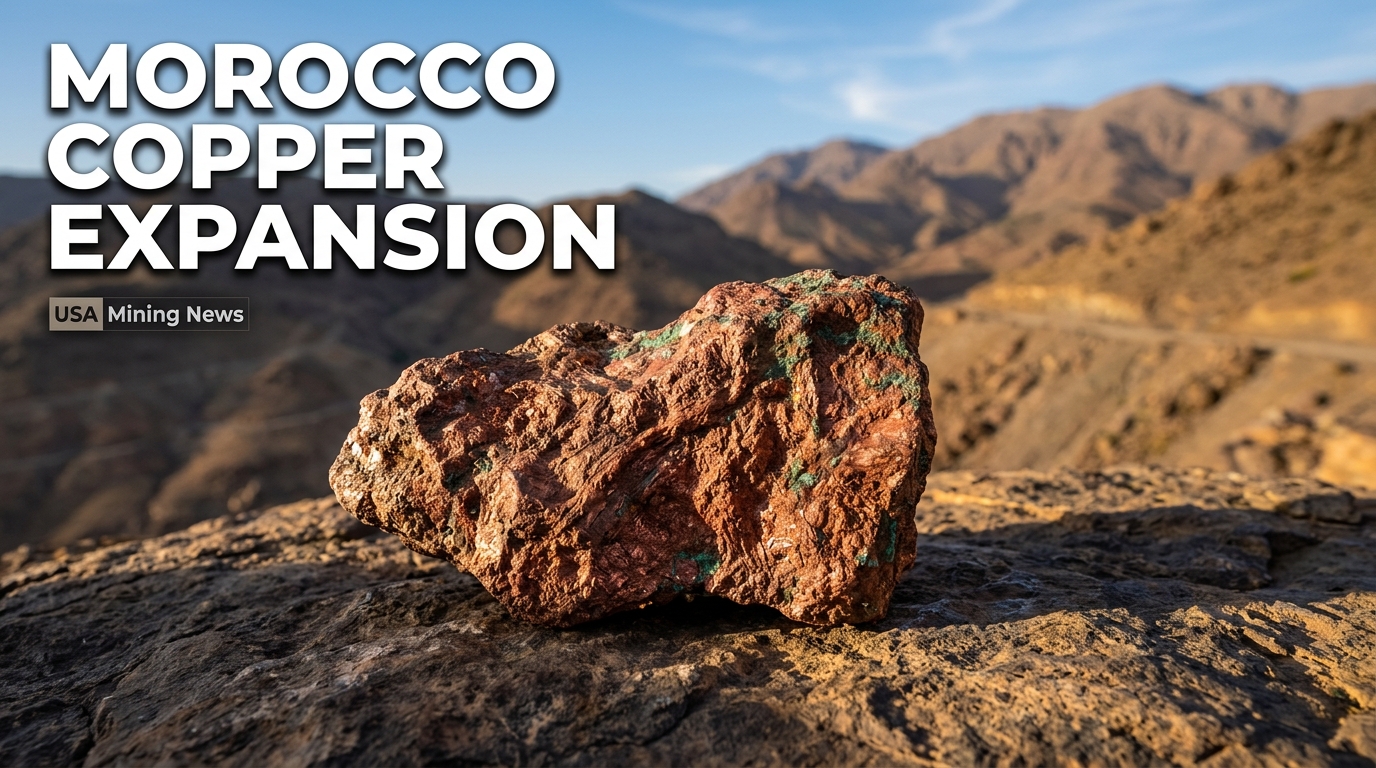
Denver, CO – September 24, 2026 – Talisman Metals, an emerging player in the global exploration sector, has announced a significant expansion of its Tirzzit Copper Project in Morocco, securing three new exploration licenses directly adjacent to its existing permits. This strategic acquisition, granted by the Agadir office of the Ministry of Energy and Mines through a direct claim process from the Moroccan Government, dramatically increases the company’s exploration footprint and underscores the growing appeal of Morocco as a destination for mineral resource development.
The newly acquired permits encompass a substantial area of 47km², effectively expanding Talisman’s total exploration ground at Tirzzit from 16.5km² to an impressive 63.5km². This represents a 2.8-fold increase in the project’s total surface area, providing Talisman with a considerably larger canvas for potential discoveries. The licenses are valid until July 24, 2029, offering a solid four-year window for initial exploration and assessment. The entire Tirzzit project, including these latest additions, is situated within the Agadir regional mining department, approximately 225km east of the major port city of Agadir. Significantly, it lies about 85km north-east of the active Tizert copper-silver mine, a prominent operation that extracts four million tonnes annually, providing valuable regional context for the mineralization potential.
Strategic Expansion in Morocco's Anti-Atlas Copper Belt
The expansion of the Tirzzit Copper Project is a pivotal development for Talisman Metals, consolidating its position in a highly prospective region of Morocco. The Anti-Atlas Mountains, where Tirzzit is located, are renowned for their significant geological potential, particularly for sediment-hosted stratiform copper-silver systems. These deposits are characterized by their typically large scale and consistent mineralization, making them attractive targets for long-term resource development.
Talisman's decision to expand its holdings through a direct claim process highlights the efficiency and accessibility of Morocco’s current mining regulatory framework. The Ministry of Energy and Mines, through its regional offices, is actively fostering exploration and development, creating an environment conducive to both established and nascent mining companies. For a company like Talisman, acquiring such a substantial increase in tenure in a favorable jurisdiction without complex bidding processes or lengthy negotiations can be a significant competitive advantage. The proximity to an active, large-scale operation like the Tizert mine also provides infrastructural advantages and validates the regional prospectivity for similar deposit types.
Geological Prospectivity and Mineralization Model
The geological underpinnings of the Tirzzit Copper Project are particularly compelling for a sediment-hosted stratiform copper-silver system. The copper mineralization at Tirzzit is hosted within the Neoproterozoic-age Adoudou Formation, a geological unit known globally to host significant copper deposits in similar settings. This geological classification is critical, as sediment-hosted stratiform copper deposits are typically characterized by widespread, relatively consistent mineralization, often leading to large-tonnage resources.
Talisman’s assessment indicates that the newly acquired licenses possess a highly favorable geological context for further discoveries. This assessment is not speculative but is grounded in tangible geological indicators. These include the presence of mineralized outcrops on the surface, which provide direct evidence of mineralization. Furthermore, the area is characterized by a deep regional geological structure that trends north-east across the Anti-Atlas, a feature often associated with the localization of significant mineral deposits. The presence of large domes and antiforms, interpreted as paleo horsts, which are analogous to the structural settings observed at the Tizert deposit, further bolsters the prospectivity. Surface observations, such as the identification of iron gossan, also serve as critical indicators of potential sulfide mineralization at depth, providing compelling targets for subsequent exploration phases.
Talisman's Vision and Moroccan Opportunity
Commenting on the acquisition, Talisman CEO Tim McCutcheon emphasized the strategic rationale behind the expansion. "The significant increase in the Tirzzit Copper Project footprint gives Talisman more opportunities to uncover mineralisation and expand westwards on mapped mineralised zones," McCutcheon stated. This vision speaks to a methodical approach to exploration, aiming to extend known mineralization and leverage geological understanding across a wider area. His remarks also shed light on Morocco's evolving stance on mineral resource development: "Morocco is opening up opportunities by allowing companies to acquire new licenses." This statement underscores a perceived shift in the country’s regulatory environment, encouraging foreign investment and exploration.
McCutcheon further highlighted Talisman's agility, stating, "Even though Talisman is a small, new player in the Moroccan exploration sector, we have the know-how and flexibility to act quickly and decisively to benefit our company and its future prospects." This demonstrates an understanding of the competitive landscape, where smaller, focused explorers can sometimes outmaneuver larger entities by being more nimble in identifying and securing promising ground. For junior mining companies, such strategic land acquisitions in underexplored but prospective regions are foundational to building a valuable project pipeline and ultimately, a significant resource base.
Planned Exploration and Recent Milestones
With the expanded land package, Talisman Metals has outlined a comprehensive exploration program for the initial four-year term of the new permits. This multi-faceted approach is designed to systematically advance the project through various stages of target generation and definition. The planned activities include:
- Detailed Geological Mapping: To refine the understanding of the structural and lithological controls on mineralization across the expanded area.
- Rock-Chip Sampling: Focused specifically on the Basal Series, which is often a key host for stratiform copper mineralization in such systems.
- Stream Sediment Geochemical Surveying: A regional-scale technique to identify anomalous concentrations of target elements, indicating potential mineralization source areas.
- Geophysical Surveys: Including both ground electromagnetic (EM) and induced polarisation (IP) surveys. These advanced techniques will be deployed over key target areas to define conductive and chargeable horizons, which are typically associated with sulfide mineralization, to depths of up to 400m.
These exploration methods are standard practice in the industry for delineating sediment-hosted deposits and are critical for identifying precise drill targets. The deployment of geophysical surveys to depths of 400m indicates a commitment to exploring beyond surface expressions, targeting potentially larger, buried deposits. Furthermore, this strategic expansion follows a recent, significant operational milestone. Just last month, Talisman commenced mobilizing a new drilling program at the Tirzzit project. Geosond Maroc SARL has been contracted to complete approximately 3,000m of reverse circulation (RC) drilling. RC drilling is a cost-effective and efficient method for initial resource definition and testing of geochemical and geophysical anomalies, providing critical subsurface information to guide future exploration and development decisions.
Market Implications and Future Outlook
The expansion of the Tirzzit Copper Project by Talisman Metals carries notable implications for the broader mining industry and the global copper market. Copper, often referred to as "Dr. Copper" due to its bellwether status for global economic health, is witnessing unprecedented demand growth driven by the accelerating energy transition. The proliferation of electric vehicles (EVs), renewable energy infrastructure (wind turbines, solar panels), and associated grid upgrades are creating a robust long-term demand outlook for the metal. Consequently, identifying and developing new copper resources is paramount for ensuring future supply stability.
Morocco is increasingly positioning itself as an attractive jurisdiction for mineral exploration and production, leveraging its geological prospectivity, stable political environment, and evolving regulatory framework. Projects like Tirzzit, even in their early exploration stages, contribute to the global copper discovery pipeline, a critical factor given the increasing difficulty and cost of finding new large-scale deposits. For investors, Talisman's aggressive expansion and systematic exploration approach at Tirzzit offer exposure to a high-potential copper asset in a favorable jurisdiction. The success of junior explorers in advancing such projects can lead to significant value creation, potentially attracting partnerships with larger mining companies seeking to bolster their copper portfolios. The four-year validity of the new licenses provides ample time for Talisman to execute its planned exploration program, define significant resources, and potentially elevate the Tirzzit project to a nationally significant copper asset, thereby contributing to Morocco's mineral economy and the global supply of critical metals.