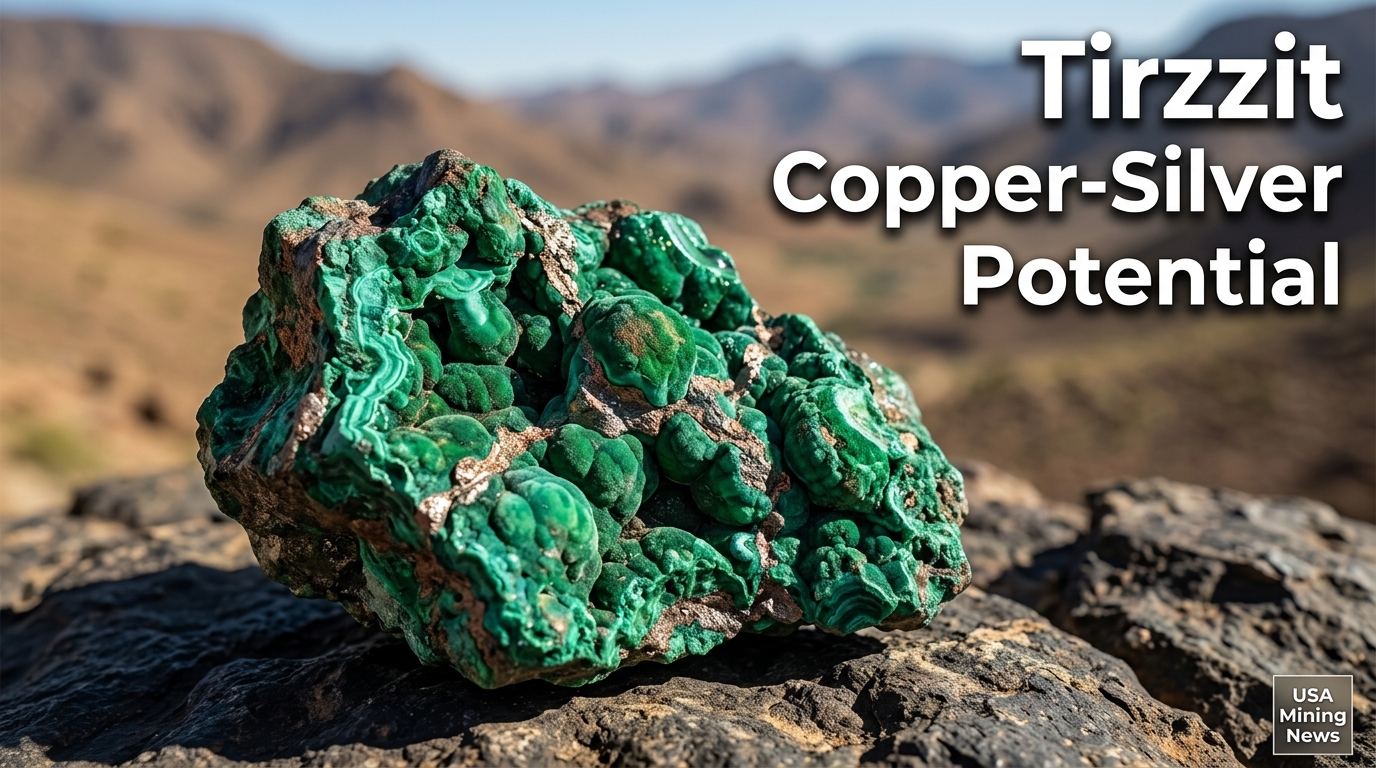
Talisman Metals Unveils Strong Channel Sampling Results at Tirzzit Copper-Silver Project in Morocco
Rabat, Morocco – Talisman Metals, an emerging player in the global metals exploration landscape, has reported highly encouraging assay results from its recent channel sampling program at the Tirzzit copper-silver project in Morocco. Conducted in April 2026, this strategic sampling campaign has confirmed the presence of significant surface malachite mineralisation within the property's Basal Series, underscoring the potential for a substantial sediment-hosted stratiform copper-silver system. The findings provide a critical data foundation for advancing Tirzzit towards a maiden drilling program, a key milestone in mineral exploration.
Assay Results Confirm Significant Mineralisation at Tirzzit
The channel sampling, which targeted visible malachite mineralisation at surface, focused on an estimated 700m segment of a broader 4.6km trend. The results have exceeded expectations, with all seven channels sampled over this distance yielding copper grades comfortably above the company's internal cut-off grade of 0.3%. Specific noteworthy intervals include:
- Channel TZ-CH001: This interval returned an impressive 2.65m at 1.71% copper and 22.25 parts per million (ppm) silver. Significantly, mineralisation was noted to continue at the end of this channel, suggesting potential for further extension.
- Channel TZ-CH003: Recorded a solid 0.94m at 1.11% copper and 6ppm silver.
- Channel TZ-CH005: Intersected 1.63m at 1.06% copper and 4.25ppm silver.
Across the entire 700m strike length, the weighted average result for the sampled channels stands at 1.25m in thickness at 1.21% copper and 12.25ppm silver. The observed alteration halo, indicative of mineralising fluids, was found to be approximately 2m thick on average. The copper results from individual channels ranged from 0.75% to 1.74%, while silver grades varied between 3ppm and 22ppm. These figures represent strong grades for a stratiform copper-silver deposit at surface, providing compelling evidence for the prospectivity of the Tirzzit project.
Project Location and Geological Context
The Tirzzit project is strategically located 225km east of Agadir, a major city and port on Morocco's Atlantic coast. This positioning offers potential logistical advantages for future development. Geologically, Tirzzit is described as a sediment-hosted stratiform copper-silver system. This particular deposit type is globally significant, responsible for some of the world's largest and most economically viable copper deposits, such as those found in the Central African Copperbelt and the Kupferschiefer deposits of Central Europe. These systems are characterized by mineralisation that occurs parallel to sedimentary bedding planes, often forming extensive, tabular bodies that can be amenable to bulk mining methods.
The area under licence at Tirzzit covers a substantial 16.5 square kilometres over two granted mining licences. This extensive land package provides Talisman Metals with ample ground for further exploration and potential resource delineation, building on the encouraging initial surface results. The geological model, coupled with these high-grade surface samples, points towards the possibility of a large-scale mineralised system at depth.
Operational Details of the Sampling Campaign
The integrity and reliability of exploration data are paramount within the mining industry. Talisman Metals employed rigorous methodologies during its April 2026 sampling campaign to ensure the quality of its results. Sampling was conducted using sub-vertical groves cut directly against outcrops that typically dip 30 degrees to the north-north-west. The equipment used was chosen to match an HQ core diameter, a standard size often used in initial drilling programs, ensuring comparability of future drill core data with current surface samples.
Determining the "true thickness" of mineralisation is crucial for accurate resource estimation. At Tirzzit, this was meticulously ascertained using a Jacob Staff, a geological tool specifically designed for measuring true stratigraphic thickness in dipping beds. To further uphold data quality, a robust Quality Assurance/Quality Control (QA/QC) program was implemented. This included the insertion of six QA/QC samples within the batch, representing approximately 5% blanks, 5% field duplicates, and 5% certified reference materials. These measures are standard industry practice to monitor potential contamination, evaluate sampling and analytical precision, and verify the accuracy of laboratory analysis. All collected samples underwent preparation and analysis at the ONHYM laboratory, a reputable facility where they were crushed to 3mm (with 85% passing this size) and subsequently pulverised to 75 microns, preparing them for precise geochemical analysis.
Strategic Context and Management Commentary
Talisman CEO, Tim McCutcheon, offered valuable insights into the strategic rationale behind the Tirzzit sampling program. He described the seven-channel sample program as an "opportunistic effort" that followed earlier work at the company's Fougnar project. The primary objective was to obtain "hard data" on what the field team had observed – namely, obvious outcropping mineralisation that could indicate a long target horizon.
"This work, combined with historical data, lays out an approximate 4.6km horizon of mineralisation with clear potential to extend mineralisation data points to the east and to the west," McCutcheon stated. This commentary highlights Talisman's methodical approach to exploration, first identifying geological trends and then methodically collecting definitive data to validate these observations. The immediate goal, after fully delineating and extending this mineralised horizon, is to "commence a drill program on the project to show that the mineralisation extends at depth and that it widens out in those areas." This statement clearly outlines the critical next steps in advancing Tirzzit from a promising prospect to a potentially drill-defined resource.
Broader Implications for Talisman Metals and the Moroccan Mining Sector
These positive results at Tirzzit carry significant implications for Talisman Metals. Confirming high-grade mineralisation at surface along an extended strike length substantially de-risks the project and enhances its attractiveness to potential investors and strategic partners. Such early-stage results are vital for demonstrating the project's potential scale and economic viability, justifying the significant capital expenditure required for subsequent drilling and resource definition. The confirmation of copper and silver, two critical metals for the global energy transition, positions Tirzzit well within the current market environment, which is highly focused on securing reliable supplies of future-facing commodities.
For the Moroccan mining sector, these results further underline the country's substantial, yet often underexplored, mineral wealth. Morocco has a long history of mining and possesses a favorable geological setting for various metallic deposits, including copper, silver, and phosphates. Continued success in projects like Tirzzit contributes to Morocco's growing reputation as a stable and prospective jurisdiction for mineral exploration and development, potentially attracting further foreign investment into its base metals sector. Talisman Metals also recently announced results from stream sediment sampling at its Fougnar project, located 25km west of the Tizert copper-silver mine, indicating a broader exploration strategy within the country.
The Path Forward: From Surface Samples to Drill Programs
The immediate future for the Tirzzit project will involve a two-pronged strategy as outlined by CEO Tim McCutcheon. Firstly, Talisman will focus on extending the known mineralisation data points to both the east and west, aiming to fully define the 4.6km target horizon identified through surface observations and historical data. This will likely involve further surface mapping, geological trenching, and potentially additional geochemical sampling to identify the full extent of the prospective zone.
Secondly, and most crucially, the company intends to transition swiftly to a comprehensive drill program. Drilling is the definitive method for probing the subsurface to determine the vertical and lateral continuity of mineralisation. Its primary objectives will be to demonstrate that the mineralisation observed at surface persists at depth and that it widens in specific areas, which is fundamental for establishing a commercially viable mineral resource. A successful drill program, confirming significant intersections of copper and silver, would represent a major step towards delineating a maiden mineral resource estimate under international reporting standards, a pivotal step in the mining project lifecycle.
In conclusion, the recent channel sampling results from Talisman Metals' Tirzzit project represent a significant advancement for the company and highlight the substantial potential of this Moroccan copper-silver asset. The consistent high-grade mineralisation over an extensive strike length provides a robust foundation for an aggressive exploration push, with the ultimate goal of defining a substantial resource in a geopolitically stable and mineral-rich region.