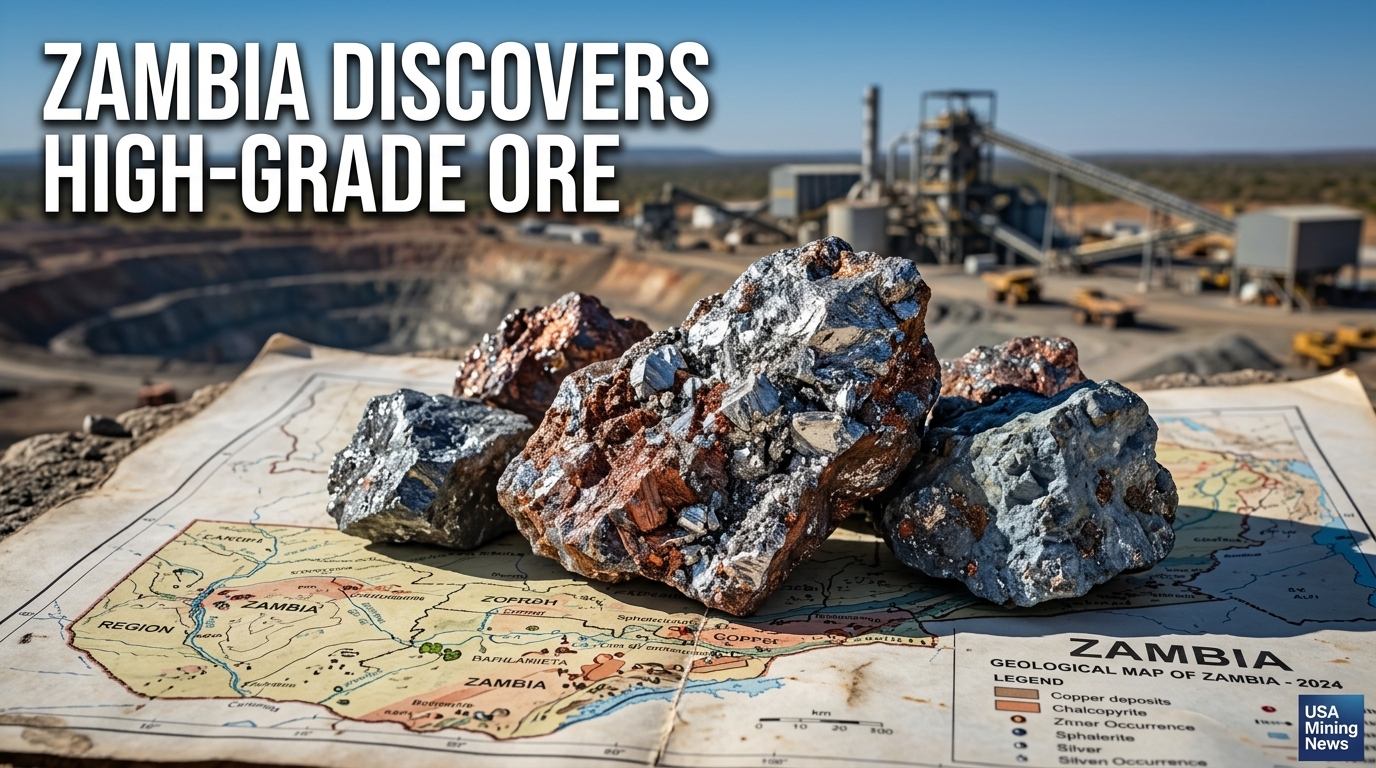
Lusaka, Zambia – Tertiary Minerals Plc, an exploration and development company focused on strategic and precious metals, has announced compelling drill results from its Phase 4 exploration program at the Mushima North Project in Zambia. The findings, released on September 21, 2026, confirm the continuation of high-grade silver-copper-zinc mineralization, extending beyond the previously defined exploration target boundary at Target A1 and indicating a robust mineral system. This development is set to significantly shape the project's trajectory and has broader implications for Zambia's burgeoning mining sector.
Significant Intersections Define High-Grade Discovery Zone
The core of Tertiary Minerals' latest update focuses on the Discovery Zone within Target A1, where drilling has successfully delineated a shallow, high-grade mineralized zone. To date, the company has reported assay results from 29 out of a total of 39 reverse circulation (RC) drill-holes, covering 3,639 meters. The remaining eight holes are currently awaiting laboratory assays, with expectations for their release in the coming weeks. RC drilling, a common and cost-effective method for initial exploration and resource definition, has provided critical geological and grade data for Mushima North.
The mineralized footprint identified at the Discovery Zone now measures approximately 400 meters in length and 150 meters in width, indicating a substantial target for further development. The assays reveal impressive grades across multiple intersections, underscoring the project's potential. Notable results include:
- 52 meters at 99 grams per tonne (g/t) silver, 0.41% copper, and 0.43% zinc, encountered from a shallow depth of 39 meters.
- Another significant interval of 22 meters at 90 g/t silver, 0.13% copper, and 0.44% zinc.
Beyond these, the program also returned intersections exceeding 1% copper, a critical threshold for economic viability in base metal deposits. One such highlight included 10 meters at 1.01% copper, 165 g/t silver, and 0.78% zinc. These high-grade copper values, coupled with strong silver and zinc credits, enhance the overall economic attractiveness of the polymetallic mineralization.
A particularly encouraging aspect highlighted by Tertiary Minerals is that the Discovery Zone remains open both along strike and at depth. Furthermore, several drill holes concluded still within mineralisation, suggesting the extent of the deposit has yet to be fully defined. While the true widths for these reported intervals are currently unknown, which is standard at this stage of exploration, the consistency and grades observed are highly promising. The presence of accessory minerals such as bismuth, antimony, and cobalt has also been noted, though their potential economic significance is yet to be fully assessed. Should these prove to be economic by-products, they could further enhance the project's value proposition.
Strategic Location and Project Ownership
The Mushima North Project is strategically located in north-west Zambia, a region known for its rich geological endowment and proximity to established mining infrastructure. It lies approximately 28 kilometers east of the historic Kalengwa mine, which was a significant copper producer in its time. This location places Mushima North within a prospective geological setting, benefiting from regional exploration models and historical data.
The project is held through Copernicus Minerals Limited, an entity structured with a 90% ownership by Tertiary Minerals (Zambia) Limited, with the remaining 10% held by Mwashia Resources Limited. This ownership structure provides Tertiary Minerals with substantial operational control and a strong equity position in the project's future success. Leveraging local partnerships, such as with Mwashia Resources, is often a crucial component for successful mineral exploration and development in African jurisdictions.
Collaboration with Industry Major: First Quantum Minerals
A significant strategic advantage for the Mushima North Project is its technical cooperation agreement with First Quantum Minerals (FQM), one of the world's leading copper producers with extensive operations in Zambia, including the large-scale Kansanshi and Sentinel mines. This agreement grants Tertiary Minerals access to FQM's valuable historical exploration data and geological expertise, which can be instrumental in accelerating the project's understanding and de-risking future exploration efforts. Such collaborations between junior explorers and major mining companies are often mutually beneficial, with juniors gaining technical support and credibility, and majors potentially gaining early insights into future resource opportunities in their operating regions.
Expanding Horizons: The Western Zone and Future Targets
The Phase 4 drilling program also yielded promising results from a separate, new shallow copper zone located in the Western Zone, approximately 900 meters from the main Discovery Zone. Initial analysis from portable X-ray fluorescence (pXRF) results indicated an intersection of 25 meters at 0.38% copper. While pXRF provides immediate, indicative assays, full laboratory assays will be required to confirm these grades. The identification of a new mineralized zone, even at an early stage, significantly expands the overall exploration potential of the Mushima North license area, suggesting a broader mineral system that warrants further investigation.
Beyond the immediate success at Target A1 and the Western Zone, Tertiary Minerals has identified other targets within a 12-kilometer radius of the project area. These additional targets are yet to undergo drill testing, representing significant upside potential for future exploration campaigns. This systematic approach to exploration, targeting multiple prospects within a regional land package, is a hallmark of successful mineral discovery programs.
Towards a Mineral Resource Estimate
With the promising results from the Phase 4 drilling program, Tertiary Minerals has signaled its intention to deliver a mineral resource estimate (MRE) for Target A1 before the end of the year. An MRE is a critical milestone in the development of any mining project, transitioning from exploration success to a quantifiable resource. It involves rigorous geological modeling and statistical analysis, often conforming to international reporting standards such as JORC (Joint Ore Reserves Committee) or NI 43-101 (National Instrument 43-101), which provide transparency and confidence for investors and stakeholders. The timely delivery of an MRE will be a pivotal step, offering a clearer picture of the scale and economic potential of the Mushima North Project.
Industry Implications and Outlook
The ongoing success at Mushima North holds several important implications for the mining industry. For Zambia, a country heavily reliant on its mining sector, new discoveries like Mushima North contribute to strengthening its position as a leading destination for mineral investment, particularly in copper. The polymetallic nature of the deposit (silver, copper, zinc) also diversifies Zambia's mineral output, potentially buffering against commodity price fluctuations for single metals.
For junior exploration companies like Tertiary Minerals, these results are transformative. Proving up a significant, open-ended high-grade discovery is crucial for attracting further investment, potentially through equity financing or joint venture partnerships. The endorsement through the technical cooperation agreement with First Quantum Minerals also lends considerable weight and credibility to the project, reducing perceived risk for future investors.
Looking ahead, the next few months will be critical for Tertiary Minerals. The pending assay results from the remaining eight drill holes, combined with the anticipated mineral resource estimate for Target A1, will provide essential data for advancing the project to its next phase. Future work will likely involve infill drilling to improve resource classification, metallurgical test work to understand processing characteristics, and further exploration drilling on the numerous untested targets within the extensive 12-kilometer radius. The potential for Mushima North to evolve into a substantial new mining camp in north-west Zambia is becoming increasingly apparent.
Richard Belcher, Managing Director of Tertiary Minerals, expressed the company's satisfaction, stating: "We are delighted with the analytical results received to date from our recent Phase 4 drill programme, which have allowed us to delineate a substantial higher-grade mineralised zone within the current Exploration Target. Notably, the mineralisation within the higher-grade zone remains open at depth, with numerous holes ending in mineralisation beyond the current modelled Exploration Target boundary." This sentiment encapsulates the optimism surrounding Mushima North and its potential to become a significant asset in Tertiary Minerals' portfolio and for the Zambian mining landscape.