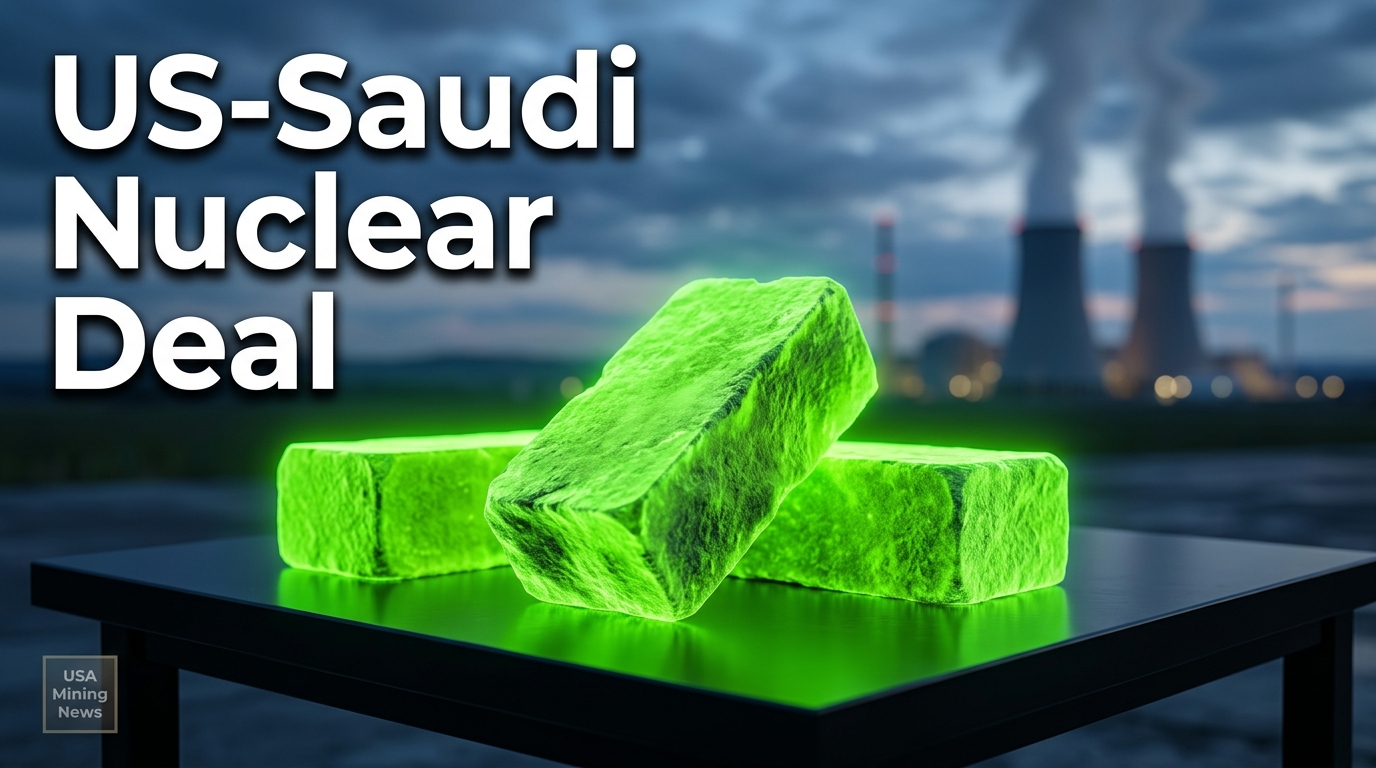
WASHINGTON – The global energy sector witnessed a pivotal moment on July 22, 2026, as the United States and the Kingdom of Saudi Arabia formally embarked on a new era of strategic energy collaboration. In Washington, U.S. Secretary of Energy Chris Wright and Saudi Minister of Energy His Royal Highness (HRH) Prince Abdulaziz bin Salman signed a peaceful nuclear cooperation agreement, commonly referred to as a "123 agreement," alongside an accompanying bilateral safeguards agreement. This comprehensive legal framework is designed to underpin a multi-billion-dollar partnership expected to span several decades, with profound implications for both nations' economic and strategic objectives, including nuclear nonproliferation and, notably, the future demand for uranium.
A Decades-Long Partnership Takes Shape
The signing of the 123 agreement and its complementary bilateral safeguards agreement represents the culmination of extensive diplomatic and technical discussions between the two nations. A 123 agreement, named after Section 123 of the Atomic Energy Act of 1954, as amended, is a prerequisite for any significant transfer of nuclear materials, technology, or components from the United States to another country for peaceful purposes. Its core function is to establish a legal framework ensuring that such cooperation adheres to strict nonproliferation standards, preventing the recipient nation from diverting nuclear materials or technology for weapons development.
The bilateral safeguards agreement further reinforces these nonproliferation commitments by outlining specific verification measures, typically implemented in conjunction with the International Atomic Energy Agency (IAEA). These measures ensure transparency and accountability in the handling and use of nuclear materials and technology provided by the U.S. The combination of these two agreements provides a robust legal and technical foundation, laying the groundwork for what U.S. Secretary of Energy Chris Wright characterized as a "decades-long, multi-billion-dollar partnership."
Strategic Imperatives and U.S. Competitive Edge
For the United States, this agreement offers substantial economic and strategic benefits. It grants "great access for American companies in the Saudi nuclear energy program," thereby positioning U.S. industry, workers, and supply chains to capitalize on a significant new market. Secretary Wright emphasized this dual benefit, stating, "These agreements reflect our two nations' shared commitment to strengthening U.S.-Saudi commercial relations, delivering prosperity at home and security to our allies abroad."
The initiative also aligns with a broader U.S. strategy to reassert its leadership in the global civil nuclear technology sector. Secretary Wright directly attributed this renewed focus to U.S. leadership, noting, "Thanks to President Trump, the American nuclear renaissance is underway and will deliver long-term benefits to the American and Saudi people." This sentiment echoes President Trump's Executive Order on "Deploying Advanced Nuclear Reactor Technologies for National Security," specifically Section 8, which promotes American nuclear exports and encourages an expansion of international partners for U.S. civil nuclear cooperation. The partnership is explicitly designed to:
- Expand American nuclear technology exports.
- Create high-paying U.S. jobs and foster long-term economic growth.
- Strengthen America's energy and national security posture.
- Reinforce global nonproliferation standards.
- Deepen the strategic partnership between the United States and the Kingdom of Saudi Arabia.
For Saudi Arabia, the agreement signifies a crucial step in its ambitious economic diversification strategy, Vision 2030, which aims to reduce the kingdom's reliance on oil and gas. Nuclear power offers a stable, low-carbon energy source to meet rapidly growing domestic electricity demand, support industrial expansion, and potentially power large-scale desalination projects. Access to advanced U.S. nuclear technology, known for its safety and reliability, is a significant advantage in realizing these goals.
The Uranium Market: A Direct Impact for Mining
While the direct technical details of specific reactor types or the exact number of planned power plants were not disclosed in the immediate announcement, a "decades-long, multi-billion-dollar partnership" for nuclear energy development in Saudi Arabia inherently carries immense implications for the global uranium mining sector. The construction and operation of nuclear power plants depend entirely on a reliable and continuous supply of uranium fuel.
Each new gigawatt of nuclear capacity requires a substantial initial load of enriched uranium, followed by annual refueling. Over a multi-decade operational lifespan, even a modest fleet of nuclear reactors in Saudi Arabia would necessitate hundreds of thousands of pounds of uranium concentrate (U3O8) annually. This new, significant source of demand comes at a time when the global uranium market is already experiencing renewed interest and upward price pressure, driven by a growing recognition of nuclear power's role in energy security and decarbonization efforts worldwide.
For uranium mining companies, this announcement signals long-term market stability and growth potential. Major nuclear programs often secure their fuel supply through long-term contracts, typically spanning 5 to 10 years or even longer. Such contracts provide financial certainty for producers, incentivizing investment in new mine development and the expansion of existing operations. Given the long lead times — often a decade or more — required to bring a new uranium mine into production, the clarity provided by a major national commitment like Saudi Arabia's is invaluable for strategic planning and capital allocation within the mining industry.
Furthermore, the U.S. emphasis on "American supply chains" within the nuclear sector could also create opportunities for domestic uranium producers, as the U.S. aims for greater energy independence and resilience across its nuclear fuel cycle. While the initial focus of the agreement is on technology export, a robust domestic fuel cycle, starting with mining, is a strategic priority that could see increased support as the U.S. aims to restore its competitive edge in the global nuclear marketplace.
High Standards for Safety and Security
A cornerstone of the U.S.-Saudi agreement is the unwavering commitment to the highest standards of nuclear safety, security, and nonproliferation. Secretary Wright underscored this, stating, "Rest assured, these agreements uphold the highest standards of nuclear safety and nonproliferation, while relying on the world's best nuclear technology and scientists, designed right here in the United States."
These stringent requirements are critical not only for global security but also for public acceptance and the long-term viability of nuclear energy programs. By partnering with the U.S., Saudi Arabia is committing to a framework that emphasizes the responsible stewardship of nuclear technology, incorporating advanced safety features in reactor designs, robust physical protection of nuclear materials, and international safeguards against proliferation. This approach helps to build confidence among the international community and ensures that regional security is enhanced, rather than undermined, by the development of civil nuclear power.
Economic Benefits and Supply Chain Implications
The "benefiting American industry, workers, and supply chains" aspect extends far beyond just reactor construction. The development of a multi-decade nuclear program involves a vast ecosystem of supporting industries. This includes engineering and design firms, specialized manufacturing for reactor components, construction services, operational and maintenance personnel training, and crucially, the entire nuclear fuel cycle – from uranium conversion and enrichment to fuel fabrication. While the source material focuses on the U.S. side, the implications for Saudi Arabia are equally transformative in developing a skilled workforce and establishing a high-tech industrial base.
For the mining industry, this breadth of demand means not just more raw uranium, but potentially demand for other specialized materials used in nuclear infrastructure, such as certain rare earth elements for advanced materials or specialty steels. The establishment of secure, diversified supply chains for these critical minerals and components becomes a strategic imperative for both nations, further underscoring the interconnectedness of energy, technology, and mining sectors.
The Road Ahead: Congressional Review and Beyond
The signing of these agreements marks a significant milestone, but it is not the final step. As stipulated by U.S. law, the agreement will now be transmitted to the U.S. Congress for review. During this period, Congress has an opportunity to scrutinize the terms and conditions, ensuring they align with national security interests and nonproliferation objectives. While the successful signing by the executive branch indicates strong support, congressional review is a critical procedural safeguard.
Assuming congressional approval, the operationalization of this partnership will involve detailed planning, site selection, technology evaluations, environmental impact assessments, and significant capital investment. The timeline for reactor construction is typically lengthy, often ranging from 5 to 15 years from groundbreaking to commercial operation. However, the overarching commitment to a "decades-long" program indicates a sustained, predictable demand for nuclear fuel and associated mining products well into the latter half of the 21st century.
This landmark agreement between the United States and Saudi Arabia stands as a powerful testament to the resurgence of nuclear energy's role in global energy transition and security. For the mining industry, particularly those involved in uranium extraction and processing, it signals not just a potential increase in demand, but a robust underpinning of long-term market confidence driven by significant new national commitments to nuclear power. As nations increasingly seek stable, clean energy alternatives, such partnerships are likely to become more common, continually reshaping the strategic landscape for critical minerals.